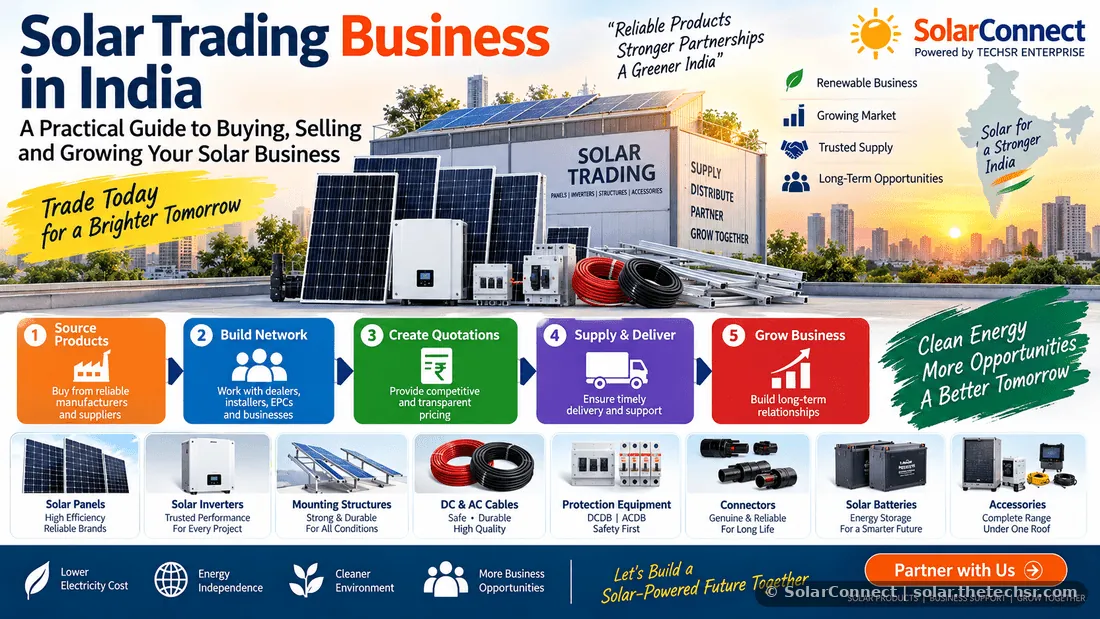
Solar Trading Business in India: A Practical Guide to Buying, Selling and Growing Your Solar Business
Explore how solar trading works in India, from sourcing solar panels and inverters to finding dealers, installers, EPC companies and business customers. Learn practical strategies for pricing, lead generation, quotation management, inventory planning and building long-term solar trading relationships.
Solar Trading Business in India: A Practical Guide to Buying, Selling and Growing Your Solar Business
The growth of rooftop solar, commercial solar projects and renewable energy adoption has created opportunities for businesses involved in solar trading. Solar trading can include sourcing solar panels, inverters, mounting structures, cables, batteries, protection equipment and other solar components and supplying them to dealers, installers, EPC companies, businesses and end customers.
However, successful solar trading is not simply about buying products at a low price and selling them at a higher price. A sustainable trading business requires reliable suppliers, accurate product information, competitive pricing, proper documentation, customer relationships, inventory planning and a strong sales process.
What Is Solar Trading?
Solar trading is the business of purchasing solar products from manufacturers, distributors or authorized suppliers and selling those products to other businesses, dealers, installers, EPC companies or customers.
A solar trader may operate as a distributor, wholesaler, dealer, channel partner or sourcing business depending on the business model and supplier arrangements.
Products Commonly Used in Solar Trading
A solar trading business can deal in different categories of products depending on its target market.
- Solar PV modules
- Solar inverters
- Solar mounting structures
- DC and AC cables
- MC4 connectors
- DCDB and ACDB
- Earthing and lightning protection equipment
- Solar batteries and energy storage products
- Solar water pumping equipment
- Monitoring and communication devices
- Solar installation accessories
- Other balance-of-system components
Product specifications, certifications, warranty terms and eligibility requirements can vary by product, project type and applicable Indian regulations. Traders should verify current requirements before making commercial commitments.
How the Solar Trading Business Works
The basic trading cycle is straightforward:
- Step 1: Identify reliable manufacturers or suppliers.
- Step 2: Compare product specifications and commercial terms.
- Step 3: Negotiate purchase pricing and payment conditions.
- Step 4: Find dealers, installers, EPC companies or customers.
- Step 5: Prepare a quotation based on the requirement.
- Step 6: Confirm the order and payment terms.
- Step 7: Arrange product dispatch and delivery.
- Step 8: Maintain invoices, warranty documents and customer records.
- Step 9: Provide appropriate after-sales coordination.
Choose Your Solar Trading Market
Before starting, decide which customer segment you want to serve.
- B2B dealers: Supply solar products to local dealers and retailers.
- Solar installers: Supply products required for residential and commercial installations.
- EPC companies: Supply equipment for larger projects.
- Commercial customers: Supply components for factories, shops, offices and other businesses.
- Residential customers: Supply products through an installation partner or complete solution provider.
- Institutional buyers: Participate in suitable procurement opportunities where eligibility requirements are met.
Build a Reliable Supplier Network
Supplier selection is one of the most important parts of solar trading. A low purchase price is not enough if delivery is unreliable or warranty support is unclear.
Before working with a supplier, check factors such as:
- Product specifications
- Warranty conditions
- Availability
- Delivery timeline
- Payment terms
- Packaging and transportation
- Return and replacement process
- Required certifications and documentation
- Technical support
- Channel or dealership policies
Maintain records of supplier quotations so you can compare commercial offers before purchasing.
Understand Your Purchase Price
Solar trading margins can be affected by more than the supplier's quoted product price.
Your actual landed cost may include transportation, loading and unloading, insurance where applicable, taxes, financing costs, warehousing, handling and other business expenses.
Calculate the complete cost before deciding your selling price.
How to Create a Solar Trading Quotation
A professional quotation should make the offer easy to understand.
- Customer name and contact information
- Quotation number and date
- Product name and model
- Quantity
- Technical specification
- Unit price
- Applicable taxes
- Transportation or delivery charges, if applicable
- Total quotation value
- Warranty information
- Payment terms
- Delivery terms
- Quotation validity
Clearly state any exclusions so there is less confusion after the order is confirmed.
Do Not Compete Only on Price
Price is important in solar trading, but it is not the only factor customers consider.
A trader can create additional value through reliable delivery, product availability, technical information, quick quotation responses, transparent documentation and responsive communication.
For many B2B customers, saving time and reducing procurement problems can be just as important as getting a lower product price.
Build a B2B Solar Dealer Network
A strong dealer network can help a solar trading business expand into different locations without maintaining a large direct sales team everywhere.
You can approach:
- Electrical shops
- Solar installers
- Electrical contractors
- Renewable energy businesses
- Local entrepreneurs
- EPC companies
- Existing solar dealers
- Businesses entering the solar sector
When onboarding a dealer, clearly explain product availability, pricing structure, payment terms, territory arrangements if any, warranty process and support.
Generate Free Solar Trading Leads
Lead generation does not always require a large advertising budget. A solar trader can develop leads through multiple organic channels.
- Google Business Profile
- Organic search engine traffic
- Educational solar blogs
- WhatsApp business communication
- Local business networking
- Dealer referrals
- Installer partnerships
- Social media content
- Industry communities
- Existing customer referrals
Create useful content around solar pricing, product comparisons, installation requirements, financing information and basic solar education to attract people who are researching solar solutions.
Use a Solar Sales CRM
As the number of leads increases, managing everything through notebooks and scattered spreadsheets can become difficult.
A simple CRM can help track:
- New B2B leads
- Dealer enquiries
- Customer enquiries
- Product requirements
- Quotations
- Calls
- Follow-ups
- Order status
- Payment status
- Sales performance
Keeping this information organized helps salespeople understand which leads require immediate attention and which customers need follow-up.
Solar Trading and Inventory Management
Inventory management is particularly important when dealing with products that have different models, specifications and market demand.
Track product quantities, incoming stock, outgoing stock, reserved stock and pending purchase orders.
Do not purchase large quantities only because a supplier offers a temporary discount. Consider actual demand, available working capital, storage conditions and expected sales before building inventory.
Manage Working Capital Carefully
Solar trading can involve significant purchase values. A business may need to pay suppliers before receiving payment from customers.
For this reason, maintain a clear cash-flow plan.
- Track supplier payment dates.
- Track customer receivables.
- Set appropriate credit limits.
- Avoid unnecessary inventory accumulation.
- Calculate financing costs when applicable.
- Keep emergency working capital available.
Solar Trading Sales Conversation
When speaking with a potential dealer or business customer, start by understanding their requirement.
Example:
"Hello, we supply solar products for dealers and installers. May I know what type of solar projects you are currently handling and which products you are looking for?"
Then ask about quantity, preferred brands or specifications, delivery location and expected purchase frequency.
This approach allows you to prepare a relevant commercial proposal instead of sending a generic price list.
Develop Long-Term Solar Business Relationships
Solar trading can become more stable when customers repeatedly purchase from the same supplier.
To build long-term relationships:
- Respond quickly to enquiries.
- Give accurate product information.
- Maintain agreed delivery commitments.
- Keep pricing transparent.
- Help customers understand product specifications.
- Handle warranty coordination professionally.
- Follow up after delivery.
- Keep regular communication with important dealers.
Common Mistakes in Solar Trading
- Buying products without checking market demand.
- Competing only by reducing price.
- Ignoring transportation costs.
- Giving unclear warranty information.
- Offering credit without proper controls.
- Maintaining poor inventory records.
- Not following up with quotations.
- Making unsupported claims about government schemes.
- Using outdated product specifications.
- Failing to maintain proper invoices and business records.
How to Grow a Solar Trading Business
Once the basic trading operation is stable, growth can come from expanding the product range, geographic coverage and customer network.
- Build more dealer relationships.
- Add complementary solar products.
- Develop installer partnerships.
- Create a regular B2B follow-up process.
- Publish useful solar content online.
- Improve quotation response time.
- Track sales data and customer demand.
- Develop repeat-order programs where commercially appropriate.
- Maintain strong supplier relationships.
Conclusion
Solar trading can create opportunities across India's growing solar ecosystem, but sustainable growth requires disciplined purchasing, competitive and transparent pricing, reliable suppliers, organized sales processes and strong customer relationships.
Whether you are starting as a small solar dealer or building a larger B2B distribution operation, focus on understanding your market before investing heavily in inventory.
The basic principle is simple: source reliably, quote accurately, sell transparently, deliver professionally and build long-term relationships.
With a structured sales process and proper customer and inventory management, a solar trading business can develop from individual orders into a repeat B2B sales network.
Source: SolarConnect India – solar.thetechsr.com
Back to Solar Blog