 ☀️ SolarConnect India
Last updated:
Solar Myths vs Reality + Free Solar Calculators for Indian Homes
Rooftop solar is growing across India, and so is the confusion. This page clears up common solar myths and answers what people search most, from solar panel price in India to PM Surya Ghar Yojana subsidy and how many solar panels you need for home, with simple free tools: size from your bill, PM Surya Ghar subsidy, appliance units, inverter battery backup, system type, generation by region, a buying checklist and a dealer self-check. All results are approximate. For an exact plan, ask the SolarConnect India team for a free site survey.
Is Solar Worth It for Me? 3-Question Check

1. Solar Myths vs Reality: 8 Things People Get Wrong
Guess first, then tap to see the answer.
Read next: Does rooftop solar work in winter in India?
 Myth vs Reality
Solar Myth Quiz (10 questions)
Pick True or False for each. Your score appears at the end, and you can share it.
Read next: Why is my solar panel producing less electricity?
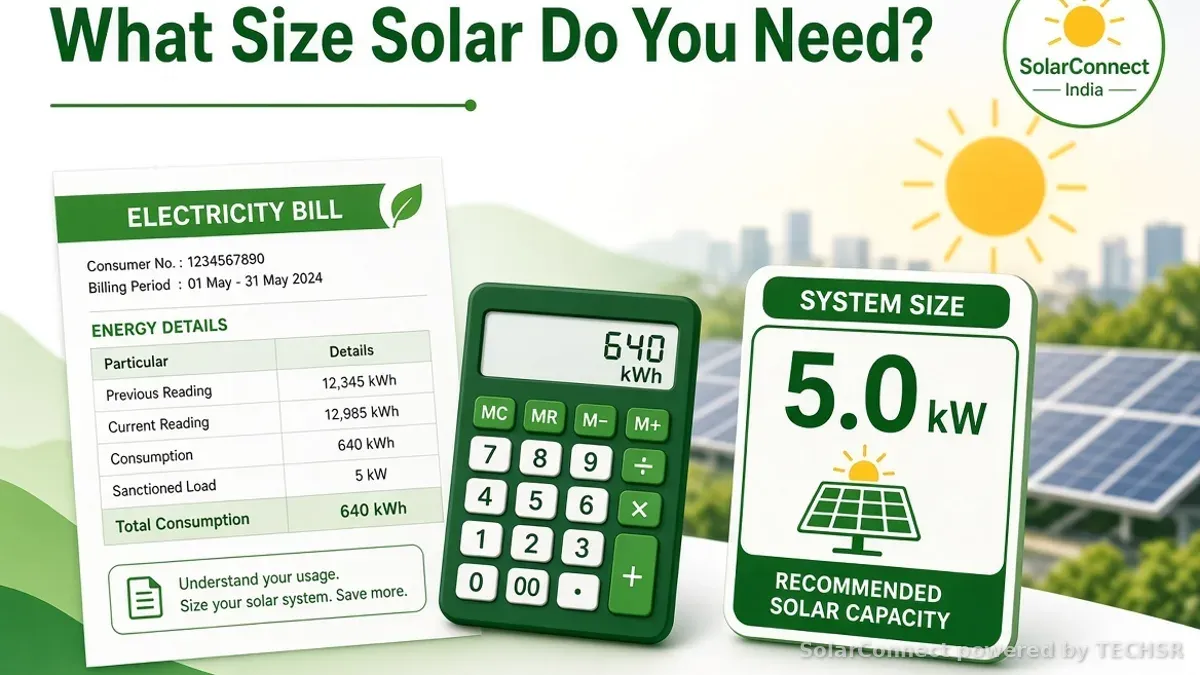 Size by Bill
2. How Many kW Solar Do I Need for Home? Estimate by Electricity Bill
Guide: ₹1,000–1,500 → 1–2 kW · ₹1,500–2,500 → 2–3 kW · ₹2,500–4,000 → 3–5 kW · ₹4,000+ → 5 kW or more (a 5kW solar system). Approximate only; tariffs and usage differ.
Read next: 3 kW solar system for home: units, roof space and subsidy
 PM Surya Ghar Subsidy
Illustration only. Maximum central subsidy is ₹78,000; use the calculator below.
3. Solar Subsidy Calculator: PM Surya Ghar Muft Bijli Yojana
Subsidy rule used: central financial assistance for residential rooftop under PM Surya Ghar: ₹30,000/kW for the first 2 kW, ₹18,000 for the 3rd kW, capped at ₹78,000 (as per the scheme guidelines; check pmsuryaghar.gov.in for the latest). Price per kW is only an assumption you can edit; real prices vary by brand, roof and location, so please get a quote. Some states add their own top-up subsidy; amounts vary and are not included here.
Read next: PM Surya Ghar subsidy status check: when the money comes
 Appliance Units
4. Appliance Unit Calculator: How Many Units Does a 1.5 Ton AC Use per Month?
Wattages are typical values, check your appliance label. Edit quantity and hours per day.
Edit appliances, quantity and hours (20 items)
Read next: Design solar around your electricity habits
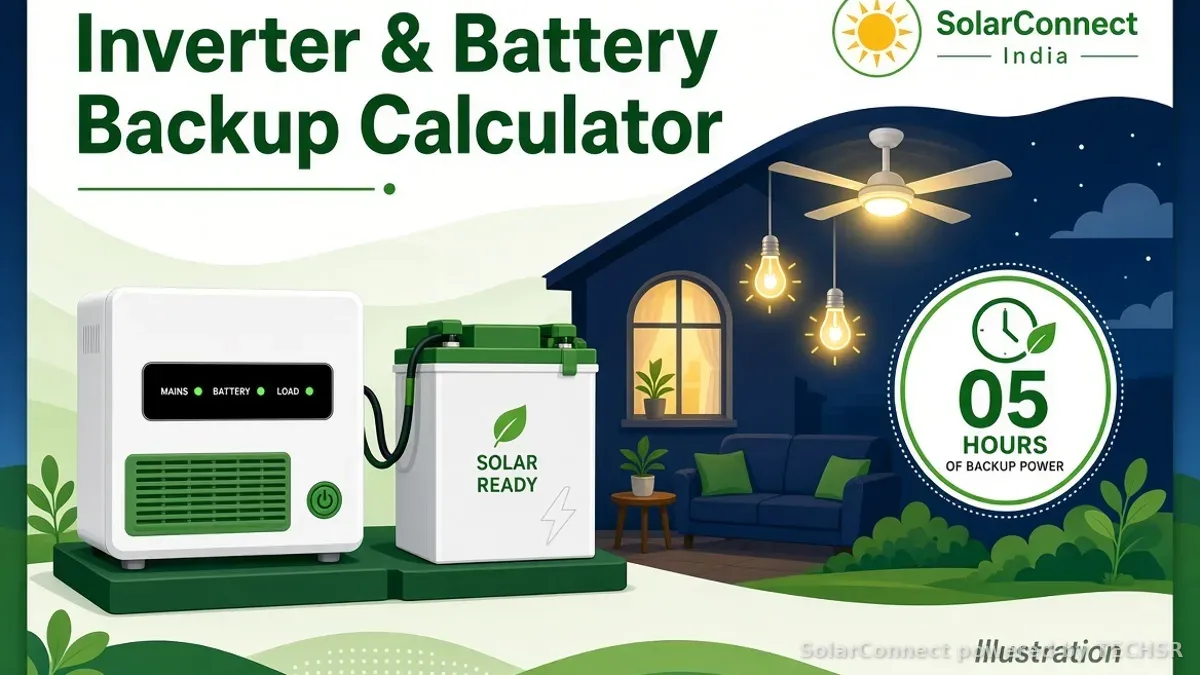 Inverter & Battery
5. Solar Inverter Battery Backup Calculator
Select what you want to run during a power cut. Wattages are typical, check your label.
Edit appliances and watts (10 items)
Formula: Ah = (total watts × hours) ÷ (voltage × 0.8 usable depth × 0.85 inverter efficiency). Inverter VA = total watts ÷ 0.8 power factor × 1.25 margin. Motors, fridges and ACs draw more at start-up; ask a technician to confirm.
 On-grid · Off-grid · Hybrid
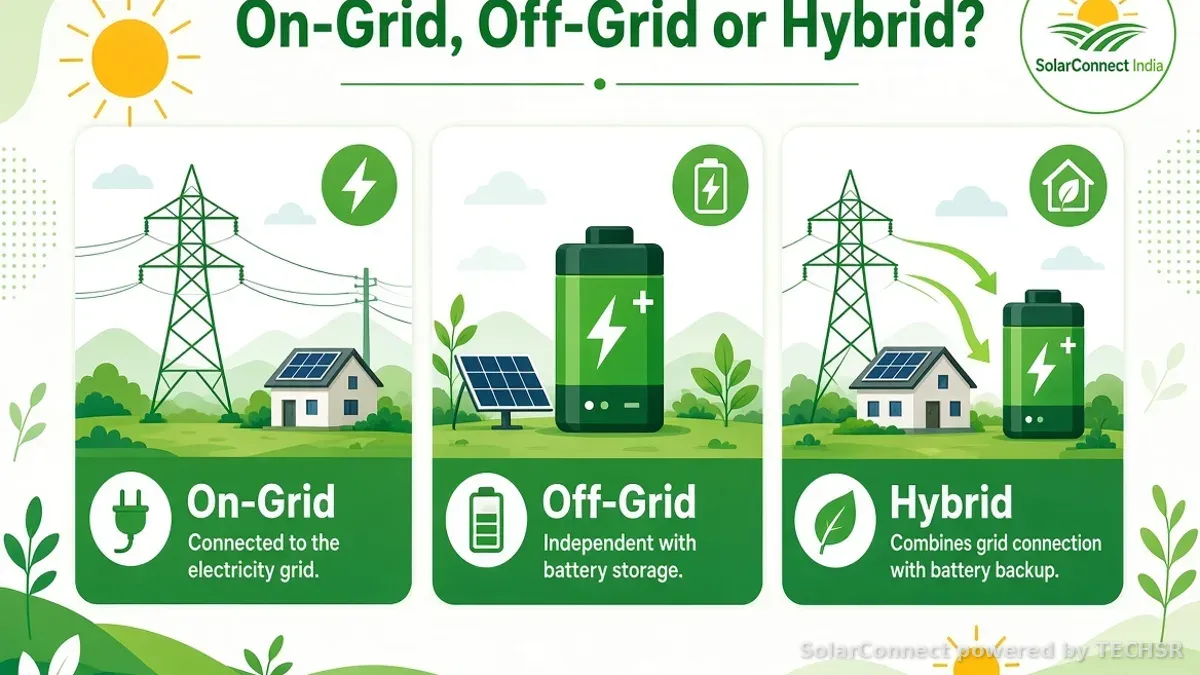
6. On Grid vs Off Grid vs Hybrid Solar: Which Suits You?
Read next: Solar full kit: on-grid, off-grid and hybrid systems explained
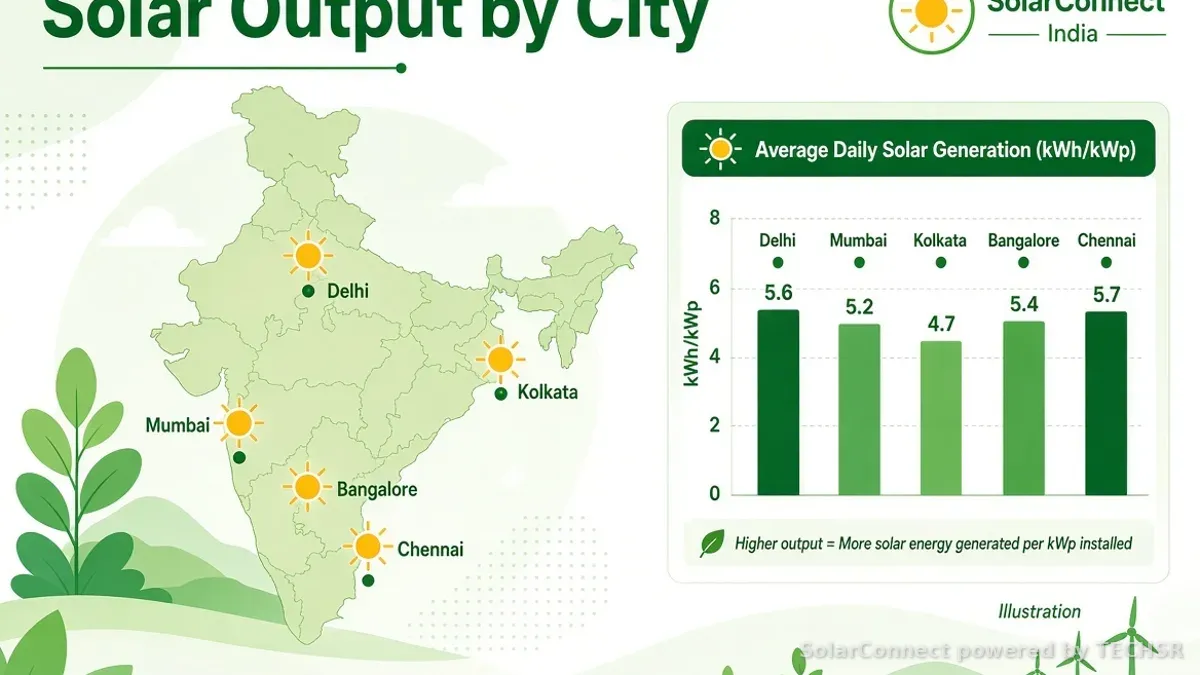 Generation by Region
Illustration only; numbers in the image are not data. Figures below follow the cited planning range.
7. Solar Panel Output per kW in India (by City / Region)
A commonly used planning figure in India is that 1 kW of rooftop solar produces about 4 to 5 units (kWh) per day on average over a year (a widely used planning estimate, not a guarantee; actual results depend on location, shading, tilt, dust and season). We do not show made-up per-city numbers. Use the slider for a rough figure, then check your exact address free on NREL PVWatts or Global Solar Atlas.
Lower end: cloudy, foggy or shaded sites. Higher end: sunny, dry, shade-free roofs.
Read next: Solar panel cleaning and maintenance guide
 Buying Checklist
8. Solar Buying Checklist: 15 Questions to Ask Your Installer
Ticks are saved on this device.
Read next: Before you install rooftop solar: check these 7 things
 Dealer Readiness
9. Solar Dealer Readiness Self-Check
Read next: Solar business in India: dealer, distributor and EPC guide
Solar Glossary: Common Terms Explained
- kW vs kWh
- kW (kilowatt) is power, the size of a solar system. kWh (kilowatt-hour) is energy; one kWh is one electricity unit on your bill.
- Net metering
- A billing setup where a bidirectional meter records power you export to the grid and import from it, and you pay for the net units.
- On-grid solar
- A solar system connected to the DISCOM grid without batteries. It usually switches off during a power cut for safety.
- Off-grid solar
- A solar system with batteries that runs independently of the grid.
- Hybrid solar
- A grid-connected system with batteries, giving backup during power cuts.
- DCR panel
- Domestic Content Requirement panel: a solar module made with Indian-made cells. PM Surya Ghar subsidy requires DCR panels.
- MNRE
- Ministry of New and Renewable Energy, the Government of India ministry for solar and renewable energy schemes.
- ALMM
- Approved List of Models and Manufacturers, MNRE's list of approved solar modules for government-supported projects.
- Bifacial panel
- A solar panel that can generate from both its front and rear side, using light reflected onto the back.
- Mono PERC
- Monocrystalline panel with a Passivated Emitter and Rear Cell layer that improves efficiency over standard mono cells.
- TOPCon
- Tunnel Oxide Passivated Contact, a newer cell technology that generally offers higher efficiency than PERC.
- Inverter efficiency
- The share of DC solar power an inverter converts into usable AC power; the rest is lost as heat.
- Payback period
- The time your electricity bill savings take to equal the net cost of the solar system.
- PM Surya Ghar
- PM Surya Ghar Muft Bijli Yojana, the central scheme giving subsidy for residential rooftop solar, applied via pmsuryaghar.gov.in.
- DISCOM
- Your electricity distribution company, which approves net metering and supplies grid power.
Explore SolarConnect
Solar guides
- Top 10 Solar Myths in India 2026
- PM Surya Ghar subsidy guide: 1 kW to 3 kW
- How many units does 1 kW solar produce per day?
- Can a 3 kW solar system run a 1.5 ton AC?
- Should you add a battery to rooftop solar?
- On-grid vs off-grid vs hybrid explained
- How to compare rooftop solar quotations
- Solar panel price in India
Calculators & tools
State guides
- State-wise solar subsidy 2026
- Solar in West Bengal
- Solar in Maharashtra
- Solar in Tamil Nadu
- Solar in Uttar Pradesh
- Solar in Gujarat
Dealership / Partner
About & contact
Frequently Asked Questions
How many kW solar do I need for my electricity bill?
As a rough guide, a ₹1,000–1,500 monthly bill suits about 1–2 kW, ₹1,500–2,500 about 2–3 kW, ₹2,500–4,000 about 3–5 kW, and above ₹4,000 usually 5 kW or more. Your exact need depends on units used, tariff and roof space.
How much subsidy is available under PM Surya Ghar?
For residential rooftop solar, central assistance is ₹30,000 per kW for the first 2 kW and ₹18,000 for the 3rd kW, up to ₹78,000. Some states offer an extra top-up. Check pmsuryaghar.gov.in for current rules.
What is solar panel output per kW in India?
About 4 to 5 units per day on average across a year is a common planning figure. Cloudy, foggy or shaded sites produce less; sunny dry regions can produce more.
On grid vs off grid vs hybrid: does on-grid solar work during a power cut?
No. For safety, an on-grid inverter switches off when grid power fails. If you need backup, choose a hybrid or off-grid system with batteries.
How do I calculate inverter battery backup?
Multiply total load in watts by backup hours, then divide by battery voltage, usable depth of discharge and inverter efficiency. The calculator above shows the formula and result.
Are these calculator results exact?
No. They are approximate estimates for planning. A free site survey by the SolarConnect India team gives a design based on your roof, load and DISCOM rules.
How many units does a 1.5 ton AC use per month?
It depends on star rating, inverter type, room and hours. Use the appliance calculator above with the wattage from your AC label and your daily hours to get monthly units.
What is the solar panel price in India for 1 kW, 3 kW and 5 kW?
Prices change with panel type, brand, inverter, structure, state and installer, so we do not publish fixed rates. After the PM Surya Ghar subsidy your net cost falls by up to ₹78,000. Contact the SolarConnect India team for a current written quote for your roof.
How many solar panels are required for a 3 kW system?
Divide system size by panel wattage. For example, 3,000 W ÷ 540 W panels ≈ 6 panels, and 5 kW ≈ 10 panels of the same wattage. Higher-wattage panels need fewer units; your installer confirms the final layout.
How much subsidy for 3 kW solar under PM Surya Ghar Yojana?
₹30,000 per kW for the first 2 kW (₹60,000) plus ₹18,000 for the 3rd kW, totalling ₹78,000, the maximum central subsidy. Systems above 3 kW still get ₹78,000. Check pmsuryaghar.gov.in for current rules.
What is the 5kW solar system price in India after subsidy?
A 5kW rooftop solar system usually suits homes with a monthly bill above ₹4,000. The price depends on panel type, brand, inverter, structure, state and installer, so we do not publish fixed rates; use the solar subsidy calculator above with your own per-kW price to estimate. Under PM Surya Ghar, a 5 kW home system gets the maximum central subsidy of ₹78,000, the same as 3 kW. Consult us for a quote.
What is the 2kW solar system price for home and rooftop solar cost per kW?
Rooftop solar cost per kW varies with components, roof and location, so ask for a quote for your site. For a 2kW home system, PM Surya Ghar gives ₹30,000 per kW, i.e. ₹60,000 central subsidy. Enter your expected solar panel for home price per kW in the subsidy calculator above to see your approximate net cost.
How do I apply for PM Surya Ghar subsidy online?
Register on the official national portal pmsuryaghar.gov.in with your DISCOM and consumer number, get feasibility approval, install through a registered vendor, then submit the net-meter and commissioning details to claim the subsidy in your bank account.
Get a Free Site Survey
Want an exact size, subsidy and savings plan for your roof? The SolarConnect India team will guide you, with no obligation.