How Many Units Does a 1kW Solar System Produce Per Day in India? (2026 Guide)
A 1kW solar system in India makes about 4–5 units a day (120–150 a month). See seasonal output, 1–5kW tables and how to size solar from your bill.
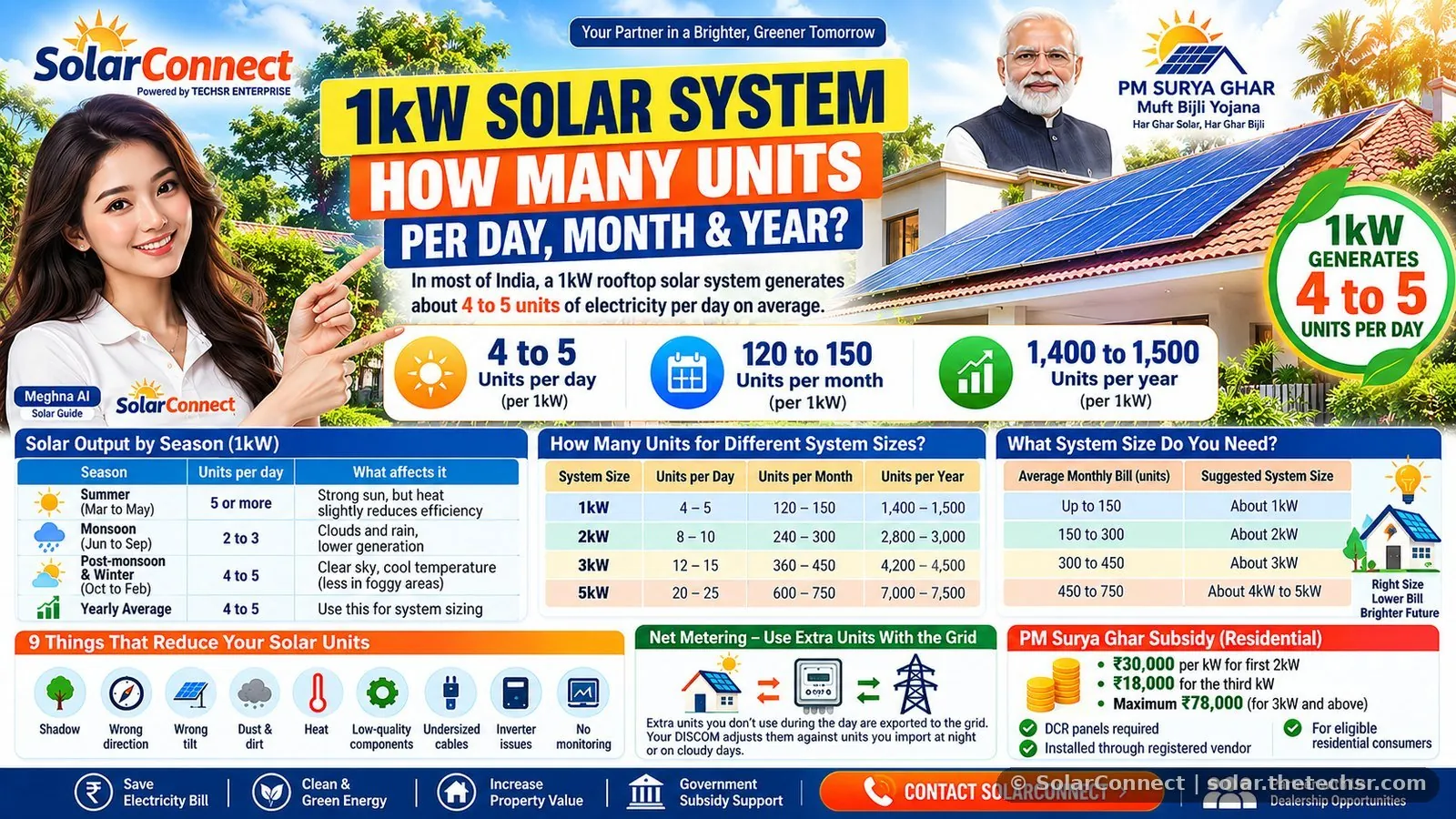
Quick answer: In most of India, a well-installed 1kW rooftop solar system produces about 4 to 5 units (kWh) of electricity per day on average, which is roughly 120 to 150 units per month and around 1,400 to 1,500 units per year. The real number at your home depends on your location, roof direction, shading, season, panel quality and how clean the panels are.
This one number is the key to sizing solar correctly. Once you know how many units 1kW gives, you can look at your electricity bill and work out what size system you actually need, instead of guessing.
Not sure what size or subsidy fits your home? Try our free solar calculators and myth checker.
Why 1kW solar gives "4 to 5 units" a day
A solar panel's rating (1kW = 1,000 watts) is measured under ideal test conditions. On a real rooftop, output depends on peak sun hours, the number of hours per day when sunlight is strong enough to equal full-rated power. Most Indian cities get about 4.5 to 5.5 peak sun hours on average. After normal losses from heat, wiring, dust and the inverter, that works out to roughly 4 to 5 units per kW per day.
1kW solar output by season (typical Indian rooftop)
| Season | Typical units per day (per 1kW) | What affects it |
|---|---|---|
| Summer (March to May) | Higher, often 5 or more | Strong sun, but heat slightly reduces panel efficiency |
| Monsoon (June to September) | Lower, can fall to 2 to 3 on cloudy days | Clouds and rain; panels still work on bright overcast days |
| Post-monsoon and winter (October to February) | Around 4 to 5 | Clear skies and cool temperatures help; shorter days and fog in north India reduce output |
| Yearly average | About 4 to 5 | This is the number to use for sizing |
These are general planning ranges, not a guarantee. Ask your installer for a site-specific generation estimate before you buy.
How much electricity do 1kW, 2kW, 3kW and 5kW systems produce?
| System size | Approx. units per day | Approx. units per month | Approx. units per year |
|---|---|---|---|
| 1kW | 4 to 5 | 120 to 150 | 1,400 to 1,500 |
| 2kW | 8 to 10 | 240 to 300 | 2,800 to 3,000 |
| 3kW | 12 to 15 | 360 to 450 | 4,200 to 4,500 |
| 5kW | 20 to 25 | 600 to 750 | 7,000 to 7,500 |
For a detailed look at the most popular home size, read our 3kW solar system guide.
How to find the right system size from your electricity bill
- Find your monthly units. Look for "units consumed" or "kWh" on your bill. Check a few months (summer and winter) because usage changes with fans and ACs.
- Take the average. For example, if your bills show 280, 350 and 320 units, your average is about 317 units a month.
- Divide by 120 to 150. 317 ÷ 130 ≈ 2.4kW. In practice you would look at a 2kW to 3kW system.
- Check your roof space. A rough rule is about 80 to 100 sq ft of shade-free roof per 1kW.
- Check your sanctioned load. Your DISCOM (electricity distribution company) usually allows rooftop solar up to your sanctioned load; you may need a load increase for a bigger system.
| Average monthly bill (units) | Suggested system size to discuss |
|---|---|
| Up to 150 units | About 1kW |
| 150 to 300 units | About 2kW |
| 300 to 450 units | About 3kW |
| 450 to 750 units | About 4kW to 5kW |
9 things that reduce your solar units (and how to avoid them)
- Shadow: Even a small shadow from a water tank, parapet or tree can cut output noticeably. Keep panels fully shade-free from about 9 AM to 4 PM.
- Wrong direction: In India, south-facing panels usually give the best yearly output.
- Wrong tilt: A tilt close to your city's latitude is a good general starting point.
- Dust: Dust and bird droppings block sunlight. Clean panels with plain water, ideally early morning, every couple of weeks in dusty months.
- Heat: Panels lose some efficiency when very hot, so a raised structure with airflow helps.
- Low-quality components: Panel and inverter quality matters over 25 years.
- Undersized cables or loose connections: These waste power and can be unsafe.
- Inverter issues: Check the inverter display or app regularly for errors.
- No monitoring: If you don't track daily units, you won't notice a drop.
If your system already produces less than expected, see why solar panels produce less electricity.
Where do the extra units go? Net metering explained simply
With an on-grid system and a net meter, units you don't use during the day are exported to the grid. Your DISCOM then adjusts them against the units you import at night or on cloudy days, according to your state's rules. This is why sizing by monthly units works so well. Learn the full process in our net metering guide.
PM Surya Ghar subsidy and system size
Under the PM Surya Ghar: Muft Bijli Yojana, eligible residential consumers can get central financial assistance of ₹30,000 per kW for the first 2kW and ₹18,000 for the third kW, up to a maximum of ₹78,000 for systems of 3kW and above. The system must be installed through a registered vendor using eligible DCR (domestically manufactured) panels. Check the details on our PM Surya Ghar page and read why DCR panels matter.
SolarConnect works with Pro Power, a PM Surya Ghar vendor partner, to help homeowners with eligible installations.
Get a free sizing check from SolarConnect
Send us your last few electricity bills and we will help you estimate how many units your roof can produce and which system size fits. Contact SolarConnect or tap the call button on this page. Want to build a solar business instead? See our dealer partnership.
Frequently asked questions
How many units does a 1kW solar panel produce per day in India?
On average about 4 to 5 units per day, or 120 to 150 units per month, depending on location, season, shading and maintenance.
How many units does a 1kW solar system produce per month?
Roughly 120 to 150 units in a typical month. Summer months are usually higher and monsoon months lower.
Does solar work on cloudy or rainy days?
Yes, but output drops. On heavy cloudy days a 1kW system may produce only 1 to 3 units. Net metering helps balance this over the month.
How much roof space does 1kW solar need?
About 80 to 100 sq ft of shade-free roof, depending on panel size and layout.
Is 1kW enough for a home?
1kW suits homes using up to about 150 units a month. Homes with ACs or higher usage usually need 2kW to 3kW or more.
Can I run an AC on solar?
Yes. With an on-grid system, the AC runs from solar during the day and from the grid when needed. Size your system around total monthly units, including the AC's share.
How can I check how many units my system is producing?
Use your inverter's display or mobile app, and compare with the export and import readings on your net meter.
More Questions People Ask
What is the price of a 1kW solar system in India?
The 1kW solar system price depends on panel type, inverter brand, mounting structure, wiring and installation conditions, so quotations vary by city and vendor. For eligible homes, PM Surya Ghar central financial assistance of ₹30,000 per kW for the first 2kW reduces the net cost. Ask for an itemised quote and check the latest rules on pmsuryaghar.gov.in.
Is 1kW solar enough for a home?
A 1kW system produces about 4 to 5 units per day, or roughly 120 to 150 units per month. That can be enough for a small home using lights, fans, a TV, a fridge and a few small appliances. Families with higher bills, or those using ACs and geysers often, usually need 2kW or 3kW. Check your monthly units on your electricity bill.
Can a 1kW solar system run an AC?
A 1kW on-grid system cannot fully run a 1.5-ton AC for long hours. Such an AC can use around 1 to 1.5 units per hour, so daily use of several hours would exceed the 4 to 5 units a 1kW system makes. It can offset part of the AC's consumption through net metering, but regular AC users should consider a larger system.
How much roof space does a 1kW solar system need?
A 1kW rooftop system generally needs around 80 to 100 square feet of shadow-free area, depending on the panel size and mounting layout. South-facing roofs with no shade from water tanks, trees or nearby buildings give the best output. A site survey helps confirm the space and expected units before installation.
Who can install a 1kW system under PM Surya Ghar?
Installation must be done by a vendor registered on the official portal. Pro Power Energies is a registered PM Surya Ghar vendor, and SolarConnect carries out the installation work. You can read the steps in our PM Surya Ghar guide and find more answers on our solar FAQ page.
Source: SolarConnect India – solar.thetechsr.com
Back to Solar Blog