DCR vs Non-DCR Solar Panel: Electricity Generation, Subsidy Eligibility & Why DCR Panels Matter in India
DCR and Non-DCR solar panels both generate electricity from sunlight, but their eligibility and compliance requirements can differ. Learn what DCR solar panels mean, how DCR differs from Non-DCR modules, why DCR matters for eligible government-supported rooftop solar projects, and what buyers should check before installation.
Solar panels are electricity-generation products. Whether a solar module is classified as DCR or Non-DCR, its fundamental purpose is the same: converting sunlight into electrical energy through photovoltaic technology. The major difference between DCR and Non-DCR is not the basic electricity-generation principle, but the domestic-content and scheme-compliance requirements applicable to the project.
For Indian residential and government-supported solar projects, this distinction has become increasingly important. A customer may see two solar panels with similar wattage and wonder why one is marked DCR and another is Non-DCR.
The answer is important because the panel selected for a project can affect eligibility under schemes where Domestic Content Requirement conditions apply.
What Does DCR Mean in Solar Panels?
DCR stands for Domestic Content Requirement. In simple terms, DCR requirements are designed to ensure that specified solar cells and modules used in applicable government schemes are domestically manufactured according to the applicable MNRE requirements.
MNRE has issued specific DCR norms for Solar PV cells. Its March 2025 memorandum states that, for crystalline-silicon solar PV cells covered by the requirement, domestic manufacturing involves manufacturing in India using undiffused silicon wafers and carrying out the required cell-manufacturing processes in India.
Therefore, customers should not assume that a module is DCR merely because the module is assembled in India. The applicable DCR documentation and manufacturer/module compliance should be verified.
Are DCR and Non-DCR Solar Panels Both Electricity-Generation Products?
Yes, their basic function is electricity generation.
A photovoltaic solar module receives sunlight and produces DC electrical power. The inverter can then convert the DC electricity into AC electricity for use in a building or for grid-connected applications, subject to the applicable technical and regulatory requirements.
So the DCR label does not mean that a DCR panel generates electricity while a Non-DCR panel does not. Both are photovoltaic electricity-generation products.
The important difference is the source and manufacturing compliance of the cells/modules and whether the particular project or government programme requires DCR compliance.
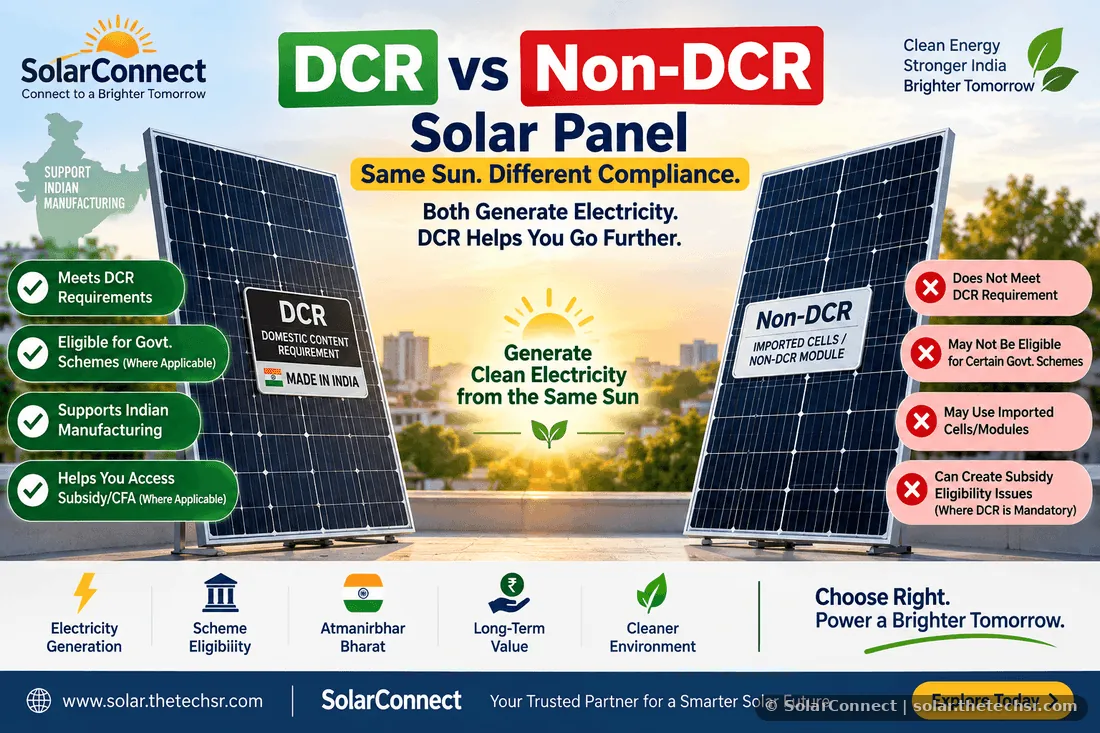
DCR vs Non-DCR Solar Panel: What Is the Main Difference?
| Feature | DCR Solar Panel | Non-DCR Solar Panel |
|---|---|---|
| Basic function | Generates electricity from sunlight | Generates electricity from sunlight |
| DCR compliance | Designed to meet applicable Domestic Content Requirement | Does not satisfy DCR where DCR is mandatory |
| Domestic manufacturing | Must satisfy applicable MNRE domestic manufacturing requirements | May use imported cells/modules depending on the product |
| Government-supported projects | Can be used where applicable DCR conditions are satisfied | May not qualify where DCR is mandatory |
| Subsidy-related importance | Important where the applicable subsidy/CFA requires DCR compliance | Can create eligibility issues where DCR is a condition |
Why Is DCR Important for Residential Solar Customers?
For a homeowner installing rooftop solar, the biggest mistake is to look only at the panel wattage or price.
A solar quotation should also be checked for:
- Whether the project is being installed under a government-supported scheme.
- Whether DCR compliance is required for the particular project.
- Whether the proposed module satisfies the applicable DCR requirement.
- Whether the manufacturer and module are eligible under the applicable MNRE/ALMM requirements.
- Whether the vendor is following the applicable DISCOM and national portal process.
- Whether the documentation required for subsidy/CFA has been properly maintained.
MNRE's published information on the Approved List of Models and Manufacturers also makes clear that ALMM is an important eligibility mechanism for specified government and government-assisted projects, schemes, open-access and net-metering projects.
DCR Is Not the Same as ALMM
This is one of the most important points for solar buyers.
DCR and ALMM are related to solar-project compliance, but they are not the same thing.
DCR focuses on the applicable domestic-content requirement, while ALMM is the Ministry's approved list mechanism for eligible models and manufacturers in specified project categories.
Therefore, simply hearing that a module is “ALMM listed” should not automatically be treated as proof that it satisfies every DCR requirement applicable to a particular project.
Buyers should ask the vendor for the appropriate compliance documentation before finalising the system.
Why DCR Panels Are Important for Government-Linked Solar Schemes
India has been strengthening domestic solar manufacturing through policies that encourage the use of domestically manufactured solar cells and modules in applicable government programmes.
MNRE has issued specific clarification on DCR under its schemes and programmes, and its DCR norms provide the framework for determining domestic manufacturing of covered solar PV cells.
This makes DCR particularly important when a customer is installing a solar system where subsidy, CFA, government assistance or another programme-specific benefit is linked to DCR compliance.
DCR Solar Panel and PM-Surya Ghar
For residential rooftop solar customers, the DCR question is especially important when applying under PM-Surya Ghar: Muft Bijli Yojana.
The published operational framework for the residential CFA component specifies that solar modules used for the installation must satisfy the Domestic Content Requirement condition, meaning domestically manufactured modules manufactured from domestically manufactured cells, for the purpose of CFA eligibility.
That is why a customer who is considering a subsidised residential rooftop solar system should not select a panel solely because it is cheaper.
First verify the applicable scheme requirements. Then select the module.
Does a Non-DCR Panel Generate Electricity?
Yes.
A Non-DCR solar module can also generate electricity from sunlight. The distinction is primarily about the applicable domestic-content requirement and project eligibility, not whether photovoltaic technology can generate electricity.
For a private project where no DCR requirement applies, the customer may have different product options. However, if a particular scheme requires DCR compliance, choosing a Non-DCR module can affect eligibility for that scheme.
Why SolarConnect Recommends Checking DCR Compliance First
At SolarConnect, we believe a solar purchase should be evaluated as a complete electricity-generation system rather than simply as a collection of panels.
A proper rooftop solar system can include:
- Solar PV modules
- Solar inverter
- Mounting structure
- DC and AC protection
- Cables and connectors
- Earthing and safety components
- Net-metering related requirements where applicable
- Installation and commissioning
- Required project documentation
For customers looking for government-supported residential rooftop solar, DCR-compliant modules should be considered where DCR is an applicable eligibility requirement.
How to Check Whether a Solar Panel Is DCR
Before paying an advance, ask the solar vendor for proper documentation.
- Ask for the exact module make and model.
- Check the manufacturer's documentation.
- Ask whether the module is DCR compliant for your specific project.
- Check applicable MNRE/ALMM requirements.
- Keep the invoice and module details.
- Match the installed module with the approved quotation.
- Do not rely only on a verbal statement such as “Made in India”.
The official MNRE DCR framework should be used for compliance verification rather than relying only on marketing descriptions.
DCR Solar Panel: More Than Just a “Made in India” Label
DCR should not be treated as a simple marketing label.
The purpose of the DCR framework is connected with domestic manufacturing requirements for applicable solar PV cells and modules used in specified government programmes.
Therefore, a customer should distinguish between:
- Made in India
- Module assembled in India
- Domestic cell manufacturing
- DCR compliance
- ALMM listing
- Eligibility under a specific government scheme
These terms can overlap in a project, but they should not automatically be treated as identical.
Why Choosing the Right Solar Panel Matters
A solar system is normally expected to operate for many years. Therefore, the initial purchase decision should consider more than the lowest quotation.
Customers should consider:
- Module technology and efficiency
- Manufacturer credentials
- Warranty terms
- Applicable DCR compliance
- Applicable ALMM eligibility
- Inverter compatibility
- Installation quality
- After-sales service
- Project documentation
- Subsidy/CFA eligibility where applicable
DCR Solar Panel for a Future-Ready Rooftop Solar System
For customers planning a rooftop solar system under a government-supported programme, selecting a compliant DCR module can simplify the compliance side of the project when DCR is required.
Instead of asking only, “Which panel is cheaper?”, ask:
“Which panel is suitable for my project, compliant with the applicable requirements and appropriate for my electricity-generation needs?”
This approach helps customers make a more informed solar investment.
Explore SolarConnect Solar Tools
Before finalising your solar project, you can explore the SolarConnect solar resources:
- Solar Calculator
- Solar Estimate
- Solar Quotation Tool
- SolarConnect Knowledge Centre & Solar Blog
- Solar Products
- Solar Services
- Solar Subsidy Information
Final Takeaway
DCR and Non-DCR solar panels are both photovoltaic electricity-generation products. The key difference is the domestic-content and project-compliance requirement applicable to the particular installation.
For projects where DCR is mandatory, using a compliant DCR module is an important part of meeting the applicable scheme requirements. For residential customers seeking government-supported rooftop solar, DCR should therefore be checked before the purchase order and installation.
Choose the solar panel based on electricity-generation performance, project requirements, documentation, warranty, compliance and long-term value, not simply on the lowest price.
SolarConnect helps customers understand solar systems, solar products, rooftop solar requirements and solar project planning with practical information before installation.
Important: Government schemes, eligibility conditions, DCR/ALMM requirements and applicable procedures can be amended. Always verify the latest official MNRE/portal requirements applicable to your project before installation or claiming any subsidy/CFA.
Source: SolarConnect India – solar.thetechsr.com
Back to Solar Blog