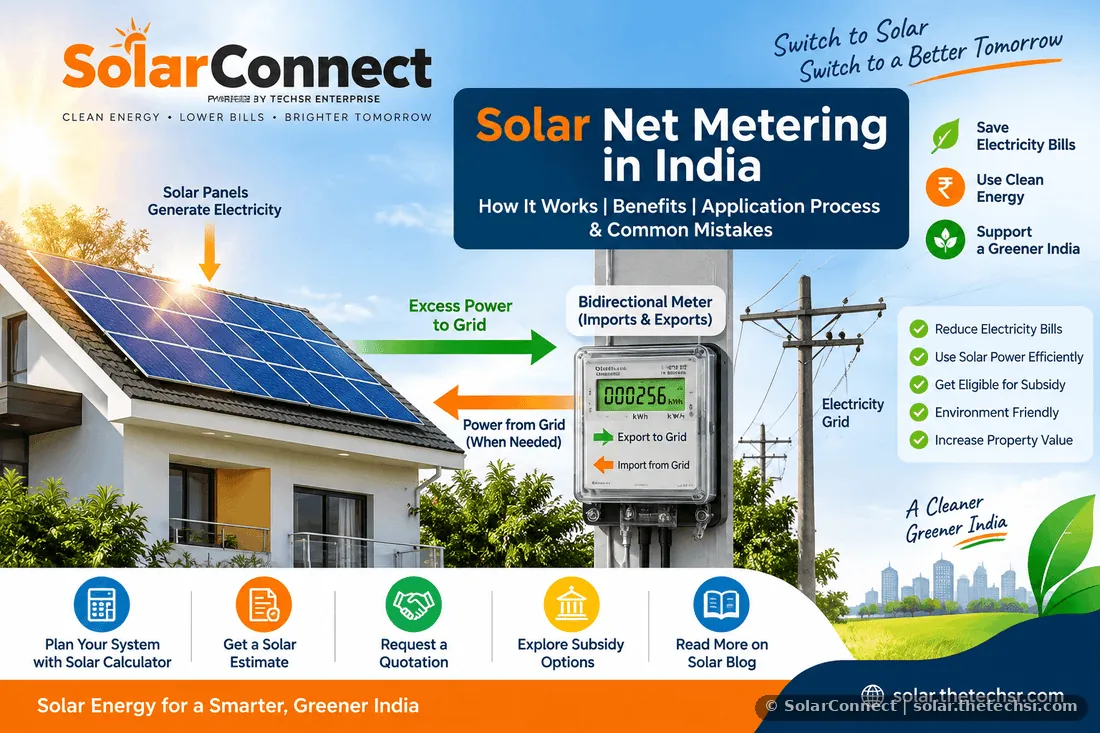
Solar Net Metering in India: How Rooftop Solar Net Metering Works, Electricity Bill Savings, Application Process & Common Mistakes
Learn how solar net metering works in India, how rooftop solar electricity is adjusted against grid consumption, the application process, billing basics, important documents, and common mistakes homeowners should avoid before installing a grid-connected solar system.
If you are planning to install a rooftop solar system for your home or business, one term you will hear frequently is solar net metering. But what exactly does net metering mean, and how can it affect your monthly electricity bill?
A rooftop solar system does not always produce exactly the same amount of electricity that a property consumes at every moment. During sunny hours, your solar panels may generate more electricity than your home needs. At other times, especially at night, you may need electricity from the grid.
This is where net metering for solar panels becomes important for eligible grid-connected consumers.
In this guide, SolarConnect explains how net metering works, how solar electricity can interact with the electricity grid, what a bidirectional meter does, what homeowners should check before installation, and which common mistakes should be avoided.
What Is Solar Net Metering?
Solar net metering is a billing mechanism associated with eligible grid-connected rooftop solar systems. It allows electricity generated by a solar system to be used by the property, while electricity generated in excess of immediate consumption may be exported to the grid according to the applicable rules of the local electricity distribution company.
When the solar system is not generating enough electricity to meet the property's demand, electricity can be imported from the grid.
In simple terms, the electricity meter records the relevant flow of electricity between the property and the grid. The billing arrangement then accounts for the applicable imports and exports according to the rules in force in the consumer's location.
This is why understanding rooftop solar net metering is important before purchasing a grid-connected solar system.
How Does Net Metering Work?
The basic concept is easier to understand with a simple example.
During the daytime
Suppose your rooftop solar system is producing 5 units of electricity during a particular period, while your home is using 3 units.
The solar electricity first serves the property's electricity demand. The remaining generation may be exported to the grid, subject to the applicable connection and metering rules.
When solar generation is lower
Now suppose your property needs 4 units but the solar system is producing only 2 units.
The remaining electricity can be supplied by the grid.
At night
A rooftop solar system normally does not generate electricity after sunset. If there is no battery system supplying the load, electricity is generally imported from the grid.
This is the basic principle behind a grid connected solar system.
What Is a Bidirectional Electricity Meter?
A conventional electricity meter primarily records electricity consumption. A rooftop solar connection that allows electricity to move in both directions requires appropriate metering arrangements.
A bidirectional electricity meter can record electricity imported from the grid and electricity exported to the grid, subject to the applicable metering configuration.
This is why you may hear terms such as net meter for solar, bidirectional meter, or solar meter installation when discussing a rooftop solar connection.
The exact technical requirements, approval procedure, meter specifications and billing mechanism can vary by electricity distribution company and state regulations.
Net Metering and Your Solar Electricity Bill
One of the main reasons homeowners investigate solar net metering India is the potential impact on their electricity bill.
However, it is important to understand that solar does not automatically mean that every consumer will receive the same bill or the same savings.
Your actual result depends on several factors, including:
- Solar system capacity
- Daily electricity consumption
- Time of electricity consumption
- Solar electricity generation
- Roof orientation and available sunlight
- Shading conditions
- Local electricity tariff
- Applicable metering and settlement rules
- System performance and maintenance
Therefore, a proper assessment is more useful than simply choosing a solar system based on panel capacity.
On-Grid Solar System and Net Metering
On grid solar system installations are connected to the electricity grid. These systems are commonly considered when the objective is to generate solar electricity while remaining connected to the utility grid.
An on-grid system is different from an off-grid system because an off-grid installation is designed to operate independently from the electricity grid, normally with battery storage or another suitable energy-storage arrangement.
A hybrid solar system can combine solar generation, grid connection and battery storage depending on the system design.
Before selecting a system, homeowners should understand the difference between on-grid, off-grid and hybrid configurations rather than assuming that every solar installation works in the same way.
You can also explore SolarConnect's solar information and tools to understand your requirement before requesting a quotation.
How Much Solar Electricity Can a Rooftop System Generate?
Solar electricity generation depends on much more than the number of panels installed.
Important factors include:
- Installed solar capacity
- Solar irradiation at the location
- Roof direction and tilt
- Shadow from buildings, trees or other objects
- Panel technology and condition
- Inverter performance
- Temperature
- Dust and cleanliness
- System design and installation quality
- Operational and maintenance conditions
For this reason, a 3 kW solar system installed at two different locations may not generate exactly the same amount of electricity.
If you are planning a rooftop installation, use an estimated generation figure as a planning tool rather than treating it as a guaranteed monthly output.
Who Should Consider Rooftop Solar With Net Metering?
A grid-connected rooftop solar system may be worth investigating for households and businesses that have suitable roof space, regular electricity consumption and access to an eligible grid connection.
It can be particularly useful to study when:
- Your property has regular electricity consumption
- You have suitable rooftop space
- Your roof receives adequate sunlight
- You want to reduce dependence on purchased grid electricity
- You want to evaluate long-term solar energy savings
- You are considering a residential rooftop solar system
However, the final system design should be based on actual electricity consumption, site conditions and the rules applicable to your electricity connection.
How Does the Solar Net Metering Process Work?
The exact solar net metering process differs between states and distribution companies. In general, the process may involve several stages.
- Assess your electricity consumption and rooftop suitability.
- Select an appropriate solar system design.
- Submit the required application through the applicable process.
- Complete the required technical review or approval.
- Install the rooftop solar system through the applicable procedure.
- Complete inspection or commissioning requirements where applicable.
- Install or configure the required metering arrangement.
- Start the approved grid-connected operation.
The exact documents, fees, technical conditions, timelines and approval process should always be confirmed with the relevant electricity distribution company or official government portal.
Documents You May Need
Depending on the location and applicable process, consumers may be asked for documents or information such as:
- Electricity consumer number
- Recent electricity bill
- Identity or address documentation
- Property-related information
- Solar system technical details
- Installer-related information
- Bank or subsidy-related details where applicable
Requirements can change depending on the electricity distribution company and the particular rooftop solar programme. Always check the current requirements before submitting an application.
Net Metering and PM Surya Ghar Rooftop Solar
The PM Surya Ghar: Muft Bijli Yojana has accelerated residential rooftop solar adoption in India. The programme is designed to support rooftop solar adoption among households, with financial assistance available under the applicable scheme rules.
Government data released in 2026 reported that the programme had crossed 50 lakh beneficiary households by August 2026. The government also reported significant rooftop solar capacity commissioned under the programme.
However, subsidy eligibility and net-metering arrangements are related but should not be treated as exactly the same thing. A consumer should separately understand the subsidy requirements and the electricity-distribution requirements applicable to the rooftop connection.
For a detailed explanation of the subsidy structure, see our existing SolarConnect guide:
PM Surya Ghar Solar Subsidy 2026: 1kW, 2kW and 3kW Rooftop Solar Subsidy Guide
Net Metering Does Not Mean Free Electricity From the Grid
This is one of the most common misunderstandings.
Installing solar panels does not mean that the property can automatically consume unlimited electricity without a bill.
The actual bill depends on electricity consumption, solar generation, imported electricity, exported electricity and the applicable billing and settlement rules.
There may also be fixed charges, minimum charges, taxes, duties or other components depending on the applicable tariff structure.
Therefore, when someone asks, “Will my solar electricity bill become zero?”, the correct answer depends on the system, consumption pattern and applicable electricity rules.
Common Mistakes to Avoid Before Installing Solar
1. Choosing system size only from the electricity bill
Your annual and monthly consumption pattern is more useful than looking at one unusually high or low electricity bill.
2. Ignoring roof shading
A shaded roof can reduce solar generation. Trees, nearby buildings, water tanks and other structures should be considered during site assessment.
3. Assuming every state follows identical rules
Electricity distribution procedures and applicable regulations can differ by state, DISCOM and consumer category.
4. Looking only at panel price
The complete solar project can include panels, inverter, mounting structure, protection equipment, wiring, installation, metering-related work and other components.
5. Ignoring future electricity consumption
If your household is planning to add an air conditioner, electric vehicle, heat pump or other major electrical load, this may change your future solar requirement.
6. Choosing a system without understanding the quotation
Before accepting a solar quotation, check the system capacity, panel specifications, inverter details, warranty, installation scope, structure, protection equipment, meter-related work and applicable taxes or charges.
You can use the SolarConnect estimate tool to organise your solar requirement:
How to Compare Solar Quotations
Two quotations can show the same system capacity but still have different specifications and project scopes.
Before comparing prices, check:
- Total system capacity
- Solar panel specifications
- Inverter brand and capacity
- Mounting structure
- Protection devices
- DC and AC cabling
- Installation scope
- Monitoring system
- Warranty terms
- Metering-related responsibilities
- Applicable taxes
- After-sales service
This approach helps consumers compare the complete project rather than comparing only the headline price.
Can Solar Net Metering Reduce Your Electricity Bill?
It can reduce the amount of electricity purchased from the grid when the solar system generates electricity that offsets eligible consumption under the applicable billing arrangement.
The actual savings, however, depend on the relationship between solar generation and electricity consumption.
For example, a household that consumes more electricity during daylight hours may directly use a larger share of its solar generation. Another household may consume more electricity at night.
This is why understanding your consumption pattern is an important part of solar planning.
What Should You Check Before Installing Rooftop Solar?
Before moving ahead with rooftop solar installation India, make a checklist.
- Check your average electricity consumption.
- Check available roof area.
- Check shading throughout the day.
- Understand the proposed solar capacity.
- Check whether your connection is eligible for the applicable programme.
- Understand the local net-metering procedure.
- Compare complete system quotations.
- Check warranty and after-sales support.
- Understand subsidy requirements separately.
- Keep all application and installation documents safely.
Frequently Asked Questions About Solar Net Metering
What is solar net metering?
Solar net metering is a mechanism used for eligible grid-connected rooftop solar consumers to account for electricity imported from and exported to the grid according to applicable rules.
What is a net meter for solar?
A net meter generally refers to the metering arrangement used to record relevant electricity flow between a grid-connected solar property and the electricity grid.
Can I install solar without net metering?
Different solar system configurations and connection arrangements exist. Whether net metering is required, available or applicable depends on the system type, consumer category and local electricity regulations.
Does net metering make the electricity bill zero?
Not necessarily. The final bill depends on electricity consumption, solar generation and the applicable tariff and settlement rules.
Is net metering available everywhere in India?
The applicable process and rules can differ between states and electricity distribution companies. Consumers should check the current rules applicable to their connection.
Is net metering the same as solar subsidy?
No. Net metering concerns the electricity connection and accounting of electricity flow, while a solar subsidy is a financial-support mechanism subject to its own eligibility and programme rules.
Plan Your Rooftop Solar System With Better Information
Rooftop solar is a long-term energy investment. The right system is not simply the system with the largest number of panels or the lowest quoted price.
A better approach is to understand your electricity consumption, roof condition, solar generation potential, system configuration, applicable subsidy, net-metering process and complete project cost before making a decision.
SolarConnect provides solar information and tools designed to help consumers understand these steps before requesting a solar quotation.
Calculate Your Solar Requirement
Explore Solar Quotation Options
For more educational content, visit the SolarConnect Solar Blog.
Source: SolarConnect India – solar.thetechsr.com
Back to Solar Blog