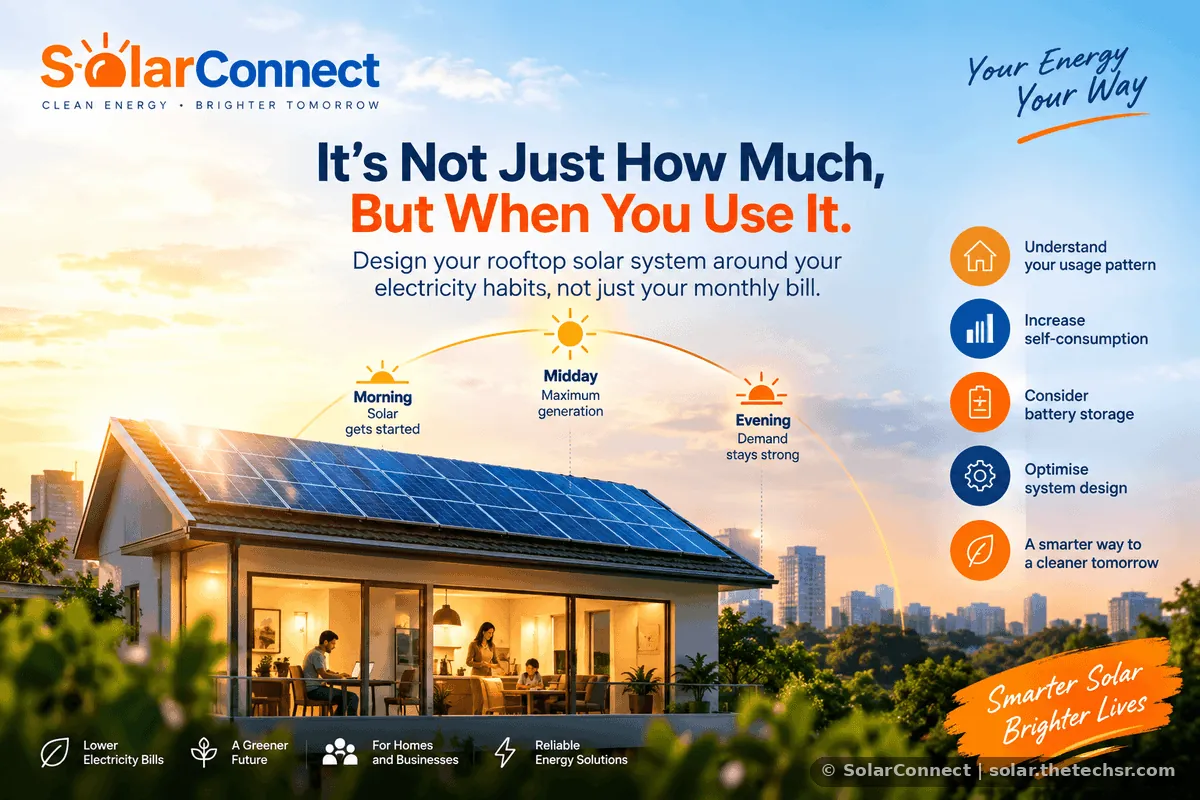
The Solar Timing Problem: Why Your Rooftop Solar System Should Be Designed Around Your Electricity Habits, Not Just Your Monthly Bill
A rooftop solar system should not be designed from your monthly electricity bill alone. Learn how daily electricity habits, daytime consumption, roof orientation, evening demand, battery storage and solar timing can influence the right solar system design for Indian homes and businesses.
When people start planning a rooftop solar system, one question usually comes first: “How many kilowatts of solar do I need?”
But there is another question that can be just as important:
“When do I actually use electricity?”
This is where an important but often overlooked concept appears: solar timing.
A solar system does not produce the same amount of electricity throughout the day. Generation rises after sunrise, reaches its strongest period around the middle of the day, and falls toward sunset. Electricity consumption, however, may follow a completely different pattern.
A household may produce most of its solar electricity while family members are at work or school. A shop may consume more electricity during the afternoon and evening. A factory may have its largest loads during production hours. A clinic, school or office may have a completely different demand curve.
That means two buildings with the same monthly electricity bill may not necessarily need the same solar design.
Why the Monthly Electricity Bill Is Only the Starting Point
Your monthly electricity bill is useful because it tells you how much electricity has been consumed over a billing period. However, it usually does not tell the complete story of when that electricity was consumed.
Imagine two homes that each consume 600 units of electricity per month.
- Home A uses a large portion of its electricity between 10 AM and 4 PM.
- Home B uses relatively little electricity during the day but consumes much more between 6 PM and 11 PM.
Their monthly consumption is identical, but their solar utilisation pattern can be very different.
This is why a good solar assessment should look beyond the monthly number and consider the customer's daily operating pattern.
The “Solar Clock” of a Typical Rooftop
Think of rooftop solar generation as a clock.
In the morning, generation starts building. During the middle of the day, solar production is generally much stronger. Later in the afternoon, generation starts declining, and after sunset photovoltaic panels no longer generate electricity.
Electricity demand follows a different clock.
Many homes have higher demand before leaving for work, during cooking hours, when air conditioners operate, and after people return home in the evening.
This creates a simple but important question:
How much of your solar electricity can you use while the panels are producing it?
The answer can influence the design of your rooftop solar system, inverter, battery requirement and energy-management strategy.
Solar Self-Consumption vs Solar Generation
Generating solar electricity and using solar electricity are not exactly the same thing.
For example, if your rooftop system produces electricity at noon but your major appliances are switched off, some of that generation may be exported to the grid depending on your system configuration and applicable electricity rules.
On the other hand, if you operate an air conditioner, water pump, machinery, refrigeration system or other large load during the daytime, a greater portion of the solar generation may be consumed directly on-site.
This is known as self-consumption.
For many solar projects, understanding self-consumption can be more useful than simply looking at the total annual generation number.
Why Two 5 kW Solar Systems Can Behave Differently
Consider two customers who install identical 5 kW rooftop solar systems.
Customer A: Daytime User
- Works from home
- Runs air conditioning during the day
- Uses washing machines and pumps during daylight hours
- Has regular daytime electricity consumption
Customer B: Evening User
- Family leaves home in the morning
- Most appliances are used after returning from work
- Cooking loads increase in the evening
- Air conditioning is mainly used after sunset
Both customers may have similar monthly electricity consumption, but their solar utilisation can be very different.
Customer A may naturally consume a larger portion of solar generation during production hours. Customer B may need to think more carefully about grid export, net-metering arrangements, load shifting or battery storage depending on local rules and project economics.
The New Solar Question: When Do You Need Your Energy?
Traditional solar planning often starts with:
Monthly electricity consumption → estimated solar capacity → expected generation.
A more detailed approach can add another layer:
Monthly consumption → daily load pattern → solar generation profile → self-consumption → export/import pattern → system design.
This does not mean every solar customer needs a battery. It means the system should be designed according to the actual operating conditions of the property.
Why Evening Electricity Demand Matters
One of the major challenges in solar energy is that electricity demand can remain high after solar generation falls.
Recent analysis of India's electricity system has highlighted the growing importance of storage and flexibility because solar helps strongly during daylight hours while evening demand continues after sunset. 1
This creates several possible strategies depending on the consumer and local electricity regulations:
- Increase daytime electricity consumption where practical.
- Shift flexible loads into solar production hours.
- Use suitable net-metering or grid-export arrangements where available.
- Consider battery storage where the economics and usage pattern justify it.
- Consider hybrid systems when backup and energy shifting are important requirements.
Load Shifting: The Simple Solar Strategy Many Consumers Miss
You do not always need more solar panels to make better use of solar energy.
Sometimes you can change when you use electricity.
For example, a customer could schedule flexible appliances or equipment during daylight hours when solar generation is available.
Possible examples include:
- Water pumping
- Water heating
- Washing machines
- Commercial refrigeration management
- Industrial machinery where operating schedules allow flexibility
- EV charging
The objective is simple: move suitable electricity consumption closer to the period when solar generation is available.
Roof Orientation Is Also a Timing Decision
Solar panel orientation is often discussed only in terms of maximum annual generation. But orientation can also influence when electricity is generated.
For some properties, an east-west roof arrangement can produce a broader generation profile across the day instead of concentrating as much production around the middle of the day.
The correct design depends on roof geometry, shading, inverter configuration, local solar conditions, electricity consumption and the project's financial and regulatory conditions.
Therefore, roof orientation should not be selected from a generic rule alone.
Where Battery Storage Fits Into the Solar Timing Problem
A battery can change the relationship between solar generation and electricity consumption.
Instead of using all available solar electricity immediately, a suitable battery system can store part of the energy and make it available later.
For example:
- Solar panels generate electricity during the day.
- Some electricity is consumed immediately.
- Surplus electricity can charge the battery, depending on system configuration.
- The stored energy can later support selected loads.
Battery storage therefore adds another dimension to solar system design: time shifting.
However, battery storage adds equipment cost, conversion losses, maintenance considerations and battery replacement considerations. It should therefore be evaluated from the customer's actual requirement rather than added automatically to every rooftop system.
For Businesses, Timing Can Be Even More Important
Commercial and industrial consumers may have electricity demand patterns that are very different from residential users.
A factory may have heavy machinery operating during production hours. A retail store may have strong evening consumption. A restaurant may experience its largest demand around lunch and dinner. A cold-storage facility can have a relatively continuous load.
For these customers, analysing the load profile can help determine whether the project should focus primarily on:
- Daytime solar generation
- Self-consumption
- Grid export
- Peak-demand management
- Battery storage
- Load shifting
- Or a combination of these strategies
Industry research has increasingly highlighted load profiling and storage as important factors in optimising rooftop solar economics for commercial and industrial users. 2
A Simple Solar Timing Checklist for Indian Customers
Before choosing a rooftop solar system, ask these questions:
- How much electricity do I consume every month?
- What time of day is my electricity consumption highest?
- How much electricity do I use between 9 AM and 4 PM?
- How much electricity do I use after sunset?
- Do I have large daytime loads?
- Can any flexible loads be shifted to daylight hours?
- What is the usable roof area?
- Is the roof shaded at different times of the day?
- What is the roof orientation?
- What grid-export or net-metering arrangement applies to my property?
- Do I need backup power?
- Would battery storage solve a specific problem for me?
Use a Solar Calculator Before Making a Decision
Once you know your electricity consumption, the next step is to estimate your solar requirement rather than selecting a system size purely by guesswork.
SolarConnect provides a dedicated Solar Calculator to help users explore their solar requirement.
You can also use the Solar Estimate tool for project estimation and the Solar QOT portal when moving toward a quotation.
Solar Timing Is Becoming More Important in India
India's solar sector is moving into a stage where simply adding generation capacity is no longer the only consideration. Rooftop solar, storage, grid flexibility and the timing of electricity consumption are becoming increasingly connected.
Recent 2026 reporting has highlighted rapid rooftop-solar growth while also pointing to the increasing importance of storage and flexible energy systems as solar generation and electricity demand occur at different times. 3
For consumers, this means the future solar question may not simply be:
“How many solar panels should I install?”
It may increasingly become:
“How should I design my energy system around the way I actually use electricity?”
Final Takeaway
A rooftop solar system should be treated as an energy-management decision, not simply a panel-purchasing decision.
Your monthly electricity bill is an important starting point, but your daily consumption pattern, daytime usage, evening demand, roof characteristics, grid rules and backup requirements can all influence the right system design.
The best starting point is to understand your electricity habits first, then calculate the solar requirement and evaluate whether load shifting, grid-connected solar, hybrid technology or battery storage makes sense for your specific situation.
Planning a Rooftop Solar System?
Start with your electricity consumption and explore your solar requirement using SolarConnect's solar tools.
Calculate Solar Requirement | Create Solar Estimate | Prepare Solar QOT
Explore More Solar Information
Source: SolarConnect India – solar.thetechsr.com
Back to Solar Blog