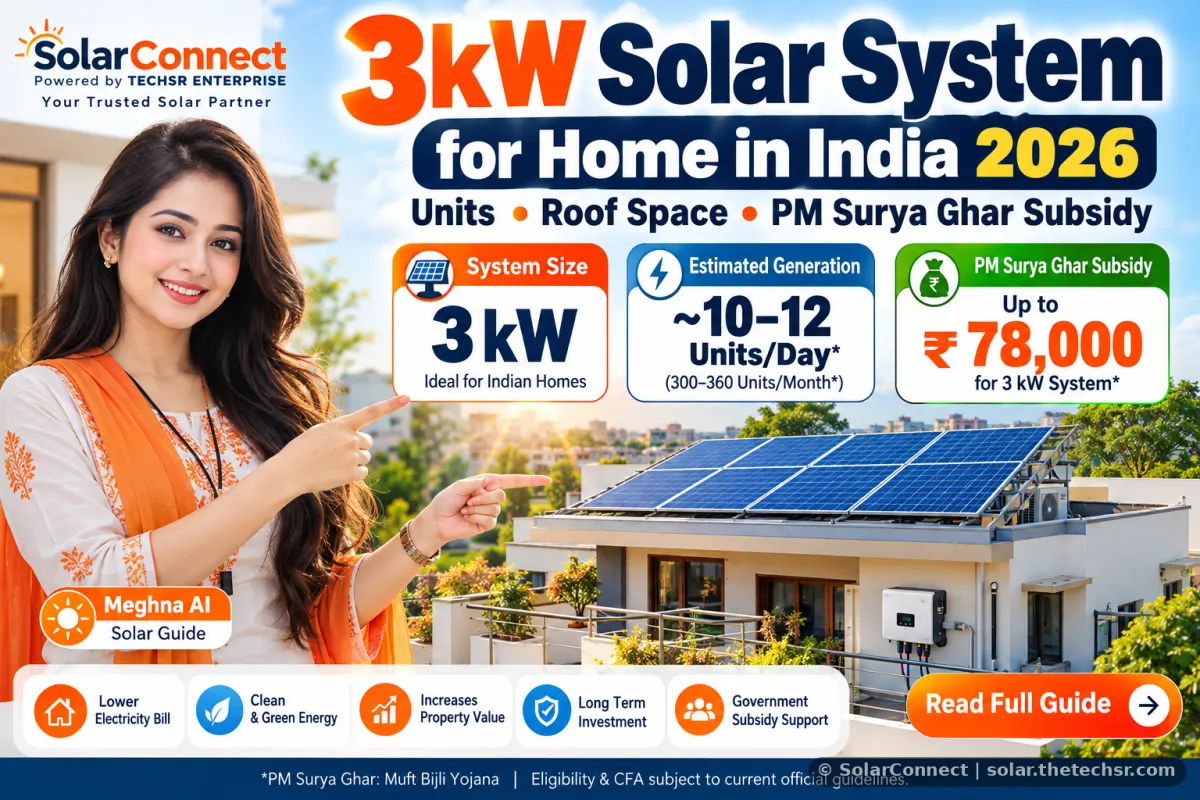
3kW Solar System for Home in India 2026: Units, Roof Space & PM Surya Ghar Subsidy
3kW solar system for home in India 2026: monthly units, roof space needed, cost after PM Surya Ghar subsidy, and who it fits. Size your system first.
A 3kW solar system is a practical rooftop option for an Indian home with regular electricity use. It can help a family produce daytime electricity and export surplus generation to the grid when net metering is available. The result depends on the roof, local sunlight, household usage and installation quality—not only on the system size.
This guide explains what a 3kW solar system for home can generate, how much roof space it needs, how on-grid and hybrid options differ, and how the PM Surya Ghar subsidy applies in 2026.
Not sure what size or subsidy fits your home? Try our free solar calculators and myth checker.
What is a 3kW solar system, and who does it suit?
A 3kW rooftop system has a solar panel array designed around approximately 3 kilowatts of capacity. The panels convert sunlight into DC electricity. An inverter converts that electricity into AC power for household appliances and, in an on-grid installation, synchronises it with the electricity grid.
In practical terms, a 3kW solar system usually suits a home using roughly 300–360 units per month. This is a planning range, not a promise that solar will exactly match every monthly bill. A home with heavy daytime loads—such as fans, refrigerators, pumps, computers or a washing machine—may use more of its solar energy directly. A home that uses most electricity at night may export more daytime generation and draw electricity from the grid later.
How many units can a 3kW solar system generate?
A typical estimate for a 3kW solar system is about 10–12 units per day, or approximately 300–360 units per month. These are estimates, not guaranteed outputs. Actual 3kW solar units per month will vary from one roof and one month to another.
Several factors affect generation:
- Location and sunlight: Solar radiation and the length of useful sunshine differ across India. Seasonal conditions also change the result.
- Shade: Trees, neighbouring buildings, tanks, parapet walls and other obstructions can reduce output, especially when shade falls on panels during productive hours.
- Panel direction and tilt: Good placement helps the array receive more sunlight through the day. The available roof shape may limit the ideal layout.
- Heat, dust and weather: High temperatures, dust, cloud, rain and humidity affect the electricity produced. Regular cleaning may be useful where dust accumulates.
- System design and equipment: Panel matching, cable selection, inverter performance, installation quality and safe commissioning all matter.
- Downtime and maintenance: Grid outages, faults, scheduled maintenance and delayed repairs can reduce the energy recorded over a month.
The 300–360-unit monthly range should therefore be used for early planning. It is not a billing guarantee, and it does not mean the home will receive the same number of units every month. A detailed proposal should account for the roof orientation, shade, local conditions and the customer’s actual consumption.
Roof space for a 3kW solar system
Plan for roughly 250–300 square feet of shade-free roof area for a 3kW solar system. This is a practical estimate that includes space for the panel layout and working clearances; the exact requirement depends on the panel dimensions, mounting design, roof shape and access needs.
Panel wattage changes the panel count. For example, 6 panels of 540W provide a 3.24kW DC array, which is commonly discussed as a 3kW-class system. Depending on the module wattage selected, a 3kW array may use roughly 6–8 panels. Lower-wattage panels need more modules, while higher-wattage panels can reach the target with fewer modules. The final count should be confirmed in the design rather than inferred from the system label alone.
The roof should be checked for shade at different times of day, safe access, structural condition, water drainage and the route for cables. Keep obstacles such as overhead tanks and parapets in the design review. A roof that looks large enough from the ground may not provide 250–300 square feet of continuously useful, shade-free area after access paths and setbacks are considered.
On-grid or hybrid: which 3kW system is right?
On-grid 3kW solar
An on-grid system works with the electricity grid and normally does not include battery storage. During the day, solar power can run household loads. When the system produces more than the home is using, eligible surplus can be exported through the approved net-metering arrangement. When solar production is lower than demand—such as at night—the home draws electricity from the grid.
On-grid is often the straightforward choice for a home that has a reliable grid connection and wants to reduce grid electricity purchases without adding battery maintenance. A key limitation is that a standard grid-connected inverter generally shuts down during a grid outage for safety. Solar panels alone should not be described as backup power during an outage.
Hybrid 3kW solar
A hybrid system combines solar with battery storage and grid support. It can be designed to keep selected loads running during an outage, depending on the inverter, battery capacity, wiring and the loads included in the backup circuit. Batteries add design considerations, space requirements, maintenance and eventual replacement planning.
Hybrid may suit a home where backup is important, while on-grid may suit a home focused mainly on daytime solar use and grid-connected bill savings. The choice should follow the customer’s outage experience, essential loads and budget—not a generic claim that one type is best for everyone.
Inverter sizing for a 3kW system
A 3kW installation normally uses an inverter selected for the array design and the home’s electrical requirements. In many projects, a 3kW-class inverter is considered, but the exact rating and model must be confirmed by the installer. Designers check the panel array’s DC voltage and current, the inverter’s allowable input range, phase and connection requirements, expected household loads, and whether the customer wants battery backup.
Net metering basics for a 3kW rooftop system
With net metering, a bi-directional meter records electricity imported from the grid and eligible electricity exported from the rooftop system. Solar energy used directly in the home reduces the amount imported. Surplus generation can flow to the grid, and the DISCOM’s approved billing rules determine how import and export are accounted for.
The process can involve an application, technical checks, installation through the required route, inspection, meter replacement or approval, and final commissioning. Requirements and timelines can vary by DISCOM and state. Read our detailed guide to solar net metering in India before treating a generation estimate as a bill estimate.
PM Surya Ghar 3kW subsidy in 2026
Under the PM Surya Ghar subsidy structure described for residential rooftop solar, the central financial assistance is ₹30,000 per kW for the first 2 kW and ₹18,000 for the 3rd kW. A 3kW eligible residential system therefore receives the full maximum central subsidy of ₹78,000 (₹30,000 + ₹30,000 + ₹18,000), subject to the scheme’s rules and successful completion of the official process.
The subsidy is not a discount that every 3kW buyer can claim automatically. Eligibility, documentation, technical requirements, inspection and DISCOM or portal verification matter. The customer should start with the official PM Surya Ghar route at SolarConnect’s PM Surya Ghar information page and follow the current instructions on the national portal.
Key eligibility and process points
- Use panels and equipment that meet the applicable scheme requirements, including ALMM/DCR panels where required for the subsidy route.
- Work through an MNRE-empanelled vendor following the applicable national-portal process.
- Keep the electricity connection and applicant details consistent with the official application and DISCOM records.
- Complete the required application, installation, inspection and commissioning steps rather than assuming that installation alone triggers payment.
- Keep invoices, documents, photographs and approval records as required by the portal and the responsible authorities.
DCR means the applicable domestic-content requirement for eligible modules in the scheme route. Panel origin and eligibility should be verified before ordering. For a plain-language explanation, see DCR vs non-DCR solar panels. Rules and portal instructions can change, so the current official requirements should control the application.
How SolarConnect helps with a 3kW home installation
SolarConnect India, Techsr Enterprise, Serampore, has its own installation team to discuss the site, plan the work and carry out installation support. For customers following the PM Surya Ghar route, SolarConnect works with partner Pro Power Energies, the registered PM Surya Ghar vendor. SolarConnect itself is not the registered vendor. This role distinction matters: the registered vendor and the national portal process handle the scheme-related responsibilities, while SolarConnect’s team supports the customer and installation work within the agreed arrangement.
SolarConnect also works with a dealer network that helps connect local homeowners with the installation team. Learn more about the SolarConnect dealer network. A partner can introduce a genuine enquiry, but no partner should promise subsidy approval, guaranteed generation or a fixed bill outcome.
Frequently asked questions
How many units does a 3kW solar system generate per month?
A typical planning estimate is about 300–360 units per month, based on roughly 10–12 units per day. These are estimates and vary with location, sunlight, shade, weather, panel orientation, cleaning, equipment and downtime.
How much roof space is needed for a 3kW solar system?
Allow roughly 250–300 square feet of shade-free roof space. The exact area depends on panel wattage, the number and dimensions of modules, roof shape, mounting clearances and access paths.
How many panels are needed for a 3kW system?
It depends on panel wattage. A 3kW-class array may use roughly 6–8 panels; for example, 6 × 540W panels make a 3.24kW DC array. The installer should confirm the final array and inverter design.
What is the PM Surya Ghar subsidy for 3kW?
The stated central subsidy is ₹30,000 per kW for the first 2 kW and ₹18,000 for the third kW. An eligible 3kW residential system can therefore receive the maximum ₹78,000, subject to the official rules, vendor, documents and portal process.
Is an on-grid system better than a hybrid system?
Neither is automatically better. On-grid is suited to homes focused on grid-connected solar and net metering. Hybrid adds batteries and can support selected backup loads, but it requires a suitable design and battery planning. The choice depends on outages, essential loads and the customer’s priorities.
Is SolarConnect the PM Surya Ghar registered vendor?
No. SolarConnect has its own installation team and works with partner Pro Power Energies, the registered PM Surya Ghar vendor, for the scheme route. Customers should follow the official national-portal process and confirm the responsible registered vendor for their application.
Discuss your 3kW solar requirement
If your home uses around 300–360 units per month and has suitable shade-free roof space, a 3kW solar system may be worth assessing. For a site discussion, call 033 3183 5203 or WhatsApp +91 92823 67700. You can also use the SolarConnect contact page. Share your recent bill and basic roof details so the team can discuss the right system type, layout and next steps.
Source: SolarConnect India – solar.thetechsr.com
Back to Solar Blog