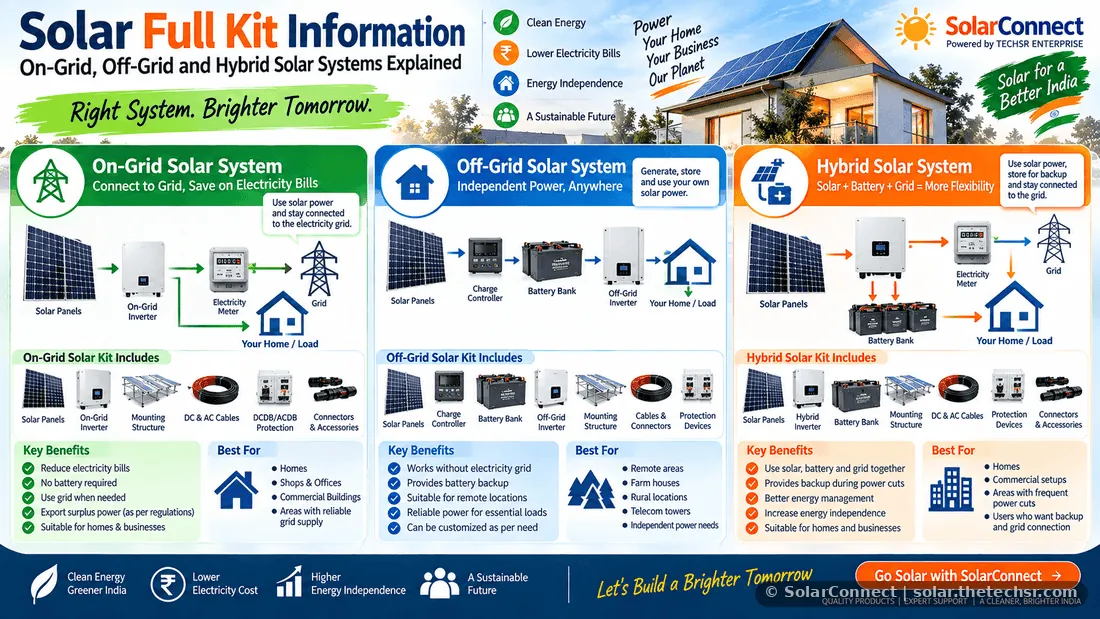
Solar Full Kit Information: On-Grid, Off-Grid and Hybrid Solar Systems Explained
Understand the complete solar kit for on-grid, off-grid and hybrid systems, including solar panels, inverters, batteries, mounting structures, cables, protection devices and other essential components. Learn how each system works, what equipment is required, and which configuration may suit different energy requirements.
Solar Full Kit Information: On-Grid, Off-Grid and Hybrid Solar Systems Explained
Choosing a solar system can be confusing when customers see terms such as On-Grid, Off-Grid and Hybrid Solar. Although all three systems use solar panels to generate electricity, their components, operation and backup arrangements are different.
This guide explains the basic solar full kit information for residential, commercial and other applications. It covers solar panels, inverters, batteries, mounting structures, cables, protection equipment and other important components.
What Is a Solar Full Kit?
A solar full kit is a combination of equipment required to install and operate a solar power system. The exact equipment depends on the type and size of the installation.
A typical solar kit may include:
- Solar PV panels
- Solar inverter
- Battery bank, where required
- Mounting structure
- DC solar cables
- AC cables
- MC4 or compatible connectors
- DCDB and ACDB
- MCB, MCCB, SPD and other protection devices as applicable
- Earthing system
- Lightning protection where required
- Generation or monitoring equipment
- Installation accessories
The final configuration should be selected according to the customer's electricity requirement, site conditions, applicable technical standards and local electricity regulations.
What Is an On-Grid Solar System?
An on-grid solar system, also called a grid-connected solar system, operates together with the utility electricity grid.
During suitable sunlight conditions, solar panels generate electricity. The solar inverter converts the generated DC electricity into AC electricity suitable for the property's electrical system.
Depending on the system design and applicable regulations, electricity generated by the solar system may be used by the property and surplus electricity may be exported to the grid through the applicable metering arrangement.
On-Grid Solar Full Kit
A typical on-grid system can include:
- Solar PV modules
- Grid-connected solar inverter
- Rooftop mounting structure
- DC cables
- AC cables
- MC4 or compatible connectors
- DC protection equipment
- AC protection equipment
- Earthing components
- AC/DC isolators where required
- Monitoring system where supported
- Grid connection and metering components as applicable
Important: A conventional grid-connected solar system generally does not provide backup power during a grid outage unless the system has specifically designed backup functionality and compatible equipment.
Advantages of On-Grid Solar
- Can reduce electricity purchased from the grid when solar generation is available.
- Normally does not require a large battery bank.
- Suitable for many homes and commercial properties with reliable grid supply.
- Can support surplus electricity export where permitted.
- Battery replacement costs can be avoided in systems without batteries.
What Is an Off-Grid Solar System?
An off-grid solar system operates independently from the utility grid or is designed for locations where grid electricity is unavailable or unreliable.
Because the system cannot depend on the grid for continuous supply, energy storage is an important part of many off-grid installations.
Off-Grid Solar Full Kit
A typical off-grid solar kit may include:
- Solar PV panels
- Off-grid or compatible battery inverter
- Solar charge controller where required by the system architecture
- Battery bank
- Solar mounting structure
- DC cables
- AC cables
- MC4 or compatible connectors
- DC protection equipment
- AC protection equipment
- Earthing system
- Battery protection and isolation equipment
- Monitoring equipment where available
The battery capacity should be calculated according to the connected load, daily energy consumption, desired backup duration, battery technology, usable capacity and operating conditions.
Advantages of Off-Grid Solar
- Can provide electricity in areas without a reliable grid connection.
- Can provide energy storage through batteries.
- Can be designed around specific backup requirements.
- Useful for remote locations and certain independent power applications.
What Is a Hybrid Solar System?
A hybrid solar system combines solar generation, battery storage and grid connectivity in a single energy-management system.
A hybrid inverter can manage energy from solar panels, batteries and the grid according to its design and configuration.
This makes hybrid systems useful when a customer wants to use solar energy while also maintaining battery backup and grid connectivity.
Hybrid Solar Full Kit
A typical hybrid solar system may include:
- Solar PV modules
- Hybrid solar inverter
- Battery bank
- Solar mounting structure
- DC solar cables
- AC cables
- MC4 or compatible connectors
- DCDB or equivalent DC protection
- ACDB or equivalent AC protection
- Battery protection equipment
- Earthing components
- Monitoring and communication equipment where supported
- Changeover or backup distribution equipment where required
Advantages of Hybrid Solar
- Combines solar generation with battery storage.
- Can provide backup functionality when designed and installed for that purpose.
- Can use grid electricity when required.
- Can store selected solar energy for later use.
- Can provide greater flexibility in energy management.
On-Grid vs Off-Grid vs Hybrid
| Feature | On-Grid | Off-Grid | Hybrid |
|---|---|---|---|
| Grid Connection | Yes | Normally no | Yes |
| Solar Panels | Yes | Yes | Yes |
| Battery | Usually not required | Generally required | Usually included |
| Backup Capability | Not normally available during grid outage | Yes, depending on battery capacity | Yes, when designed for backup |
| Energy Storage | Usually not included | Yes | Yes |
| Suitable For | Properties with grid connection | Remote or independent applications | Properties needing solar, storage and grid flexibility |
Solar Panel Information
Solar panels are one of the primary components of a solar power system. They convert sunlight into DC electricity.
When selecting panels, consider factors such as:
- Rated power
- Module efficiency
- Physical dimensions
- Technology
- Product warranty
- Performance warranty
- Applicable certifications
- Temperature characteristics
- Installation conditions
The number of panels required depends on the desired system capacity and the selected panel's rated power.
Solar Inverter Information
The inverter is a critical component because solar panels produce DC electricity while most property loads use AC electricity.
Different applications can require different inverter types.
- On-grid inverter: Designed for grid-connected solar applications.
- Off-grid inverter: Designed to operate with an independent power system and battery storage where applicable.
- Hybrid inverter: Designed to manage solar, battery and grid sources according to its specifications.
Always check the inverter's rated capacity, input voltage range, MPPT configuration, battery compatibility and applicable protection requirements before selecting a product.
Battery Information
Batteries are particularly important for off-grid and hybrid systems because they store energy for later use.
Common battery technologies used in solar applications can include lead-acid and lithium-based batteries, depending on the application and product design.
Important battery considerations include:
- Nominal voltage
- Energy capacity
- Usable capacity
- Depth of discharge
- Cycle life
- Charging requirements
- Operating temperature
- Warranty
- Compatibility with the inverter
Mounting Structure
The mounting structure supports the solar panels and connects them securely to the roof or ground installation.
The structure should be appropriate for the installation surface and local environmental conditions.
Material quality, corrosion resistance, structural strength, roof type, wind conditions and installation method should all be considered.
Solar Cables and Connectors
Solar installations require suitable cables and connectors for safe electrical connections.
DC solar cables should be selected according to current, voltage, cable length, installation environment and applicable standards.
Connectors should be compatible with the equipment and installed correctly to reduce the risk of loose or unsafe connections.
DCDB and ACDB
DCDB and ACDB are used in many solar installations to provide electrical protection, isolation and distribution functions.
The exact configuration can vary according to system design, inverter requirements and applicable standards.
Protection devices may include appropriate circuit breakers, surge protection devices, isolators and other equipment where required.
Earthing and Lightning Protection
Proper earthing is an important part of a solar installation. The earthing and bonding arrangement should be designed according to the equipment, site conditions and applicable electrical requirements.
Lightning protection may also be required depending on the installation, building and applicable standards.
How to Select the Right Solar Kit
Do not select a solar kit only by looking at the panel capacity. Start with the customer's actual energy requirement.
- Check the electricity bill.
- Calculate approximate daily energy consumption.
- Identify the connected and important loads.
- Check available rooftop or ground space.
- Assess shading and installation conditions.
- Determine whether battery backup is required.
- Check the available grid connection.
- Choose a suitable inverter.
- Calculate battery capacity if required.
- Select suitable protection and balance-of-system components.
Example: Residential Solar Kit
Suppose a homeowner wants rooftop solar mainly to reduce electricity purchased from the grid and does not require battery backup.
An appropriately designed on-grid system may be considered. The final capacity should be determined from the customer's electricity consumption, roof conditions and applicable requirements.
If the same customer requires backup during grid outages, a battery-based hybrid configuration may be considered instead.
Example: Remote Location
For a remote location without dependable grid electricity, an off-grid solar system may be considered.
In this situation, the solar array and battery system need to be designed around the site's daily energy consumption and required backup duration.
Solar Kit for Commercial Applications
Commercial properties may have higher electricity consumption and different load profiles compared with residential properties.
Before preparing a commercial solar proposal, review electricity bills, sanctioned load, operating hours, roof area, load profile, shading, electrical infrastructure and project requirements.
Depending on the objective, an on-grid or hybrid configuration may be evaluated.
Important Things to Check Before Buying a Solar Kit
- Verify the product model and specifications.
- Check manufacturer warranty terms.
- Confirm inverter and battery compatibility.
- Check applicable certifications and regulatory requirements.
- Understand installation requirements.
- Confirm what is included in the quotation.
- Check transportation and delivery conditions.
- Review payment terms.
- Understand after-sales support.
- Use qualified professionals for electrical installation and commissioning.
Conclusion
On-grid, off-grid and hybrid solar systems serve different requirements. An on-grid system focuses on grid-connected solar generation, an off-grid system is designed for independent operation with energy storage, and a hybrid system combines solar, batteries and grid connectivity.
There is no single solar kit that is suitable for every customer. The correct system depends on electricity consumption, backup requirements, roof space, grid availability, budget, equipment compatibility and applicable regulations.
For solar dealers and sales professionals, understanding the complete kit makes it easier to prepare accurate quotations and explain the system clearly to customers.
Understand the requirement first, select the right system, choose compatible components and provide a transparent quotation.
More Questions People Ask
What comes in a solar panel kit with battery and inverter?
A complete solar panel kit with battery and inverter usually includes solar panels, a hybrid or off-grid inverter, one or more batteries, a mounting structure, DC and AC cables, connectors, protection devices such as fuses, SPDs and isolators, and earthing materials. Some kits also include a monitoring app. Check the exact contents in the quotation before buying.
Do I need a battery with my solar panel kit?
Not always. On-grid systems work without batteries and export surplus power to the grid through net metering, but they do not supply power during outages. If you face frequent power cuts or have no grid connection, a kit with a battery and an off-grid or hybrid inverter is a better choice because it stores energy for night and backup use.
Which is better for a home: on-grid, off-grid or hybrid solar kit?
On-grid kits suit homes with reliable electricity that want to reduce bills. Off-grid kits suit places with weak or no grid supply. Hybrid kits combine net metering with battery backup, which is useful in areas with power cuts. The right option depends on your electricity bill, backup needs, budget and roof space.
Can a solar kit with battery get the PM Surya Ghar subsidy?
PM Surya Ghar supports grid-connected rooftop solar for residential consumers, so eligibility depends on the system meeting the scheme's technical rules. Check the latest guidelines on pmsuryaghar.gov.in before choosing a battery-based kit. Pro Power Energies is a registered PM Surya Ghar vendor and SolarConnect does installations. See our PM Surya Ghar guide for details.
How do I choose the right size of solar kit with battery and inverter?
List the appliances you want to run, how many hours each runs, and the backup hours needed. This sets the panel capacity, inverter rating and battery size. Consider battery type, warranty and service support too. A site survey gives the most accurate sizing. More answers are on our solar FAQ page.
Source: SolarConnect India – solar.thetechsr.com
Back to Solar Blog