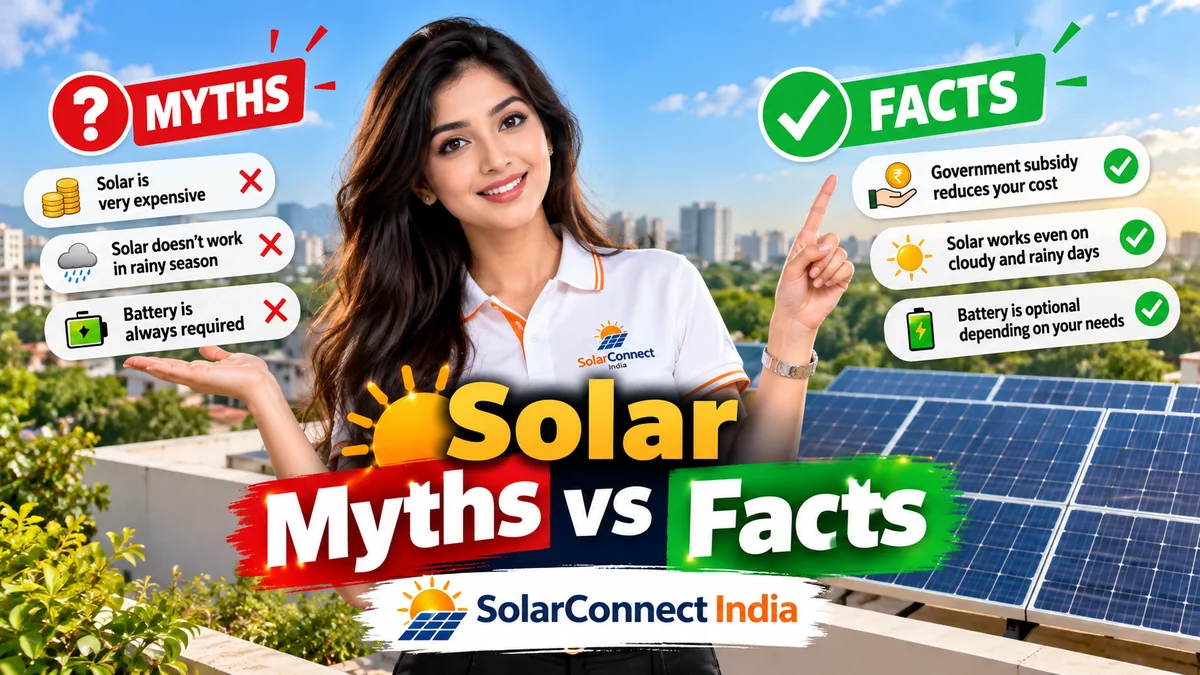
Top 10 Solar Myths in India 2026: Myth vs Fact (Cost, Subsidy, Battery & Rainy Season)
Does solar stop working in the rain? Is a battery compulsory? Does any panel get the PM Surya Ghar subsidy? We bust the 10 most common rooftop solar myths in India with clear facts and links to our detailed guides.
Rooftop solar in India is growing fast, and so are the myths around it. Many families delay solar because of something they heard from a neighbour or saw online: "it won't work in the monsoon", "you must buy a battery", or "any panel gets the subsidy". Our SolarConnect India team hears these questions every week. Here are the 10 most common solar myths, with the facts and links to our detailed guides.
Quick answer
Solar panels work on cloudy days (with lower output), a battery is optional for on-grid systems, panels need cleaning only when dusty, the PM Surya Ghar subsidy needs DCR panels and is capped at Rs 78,000, panels come with long performance warranties, and extra units go to the grid through net metering. The cheapest quote is not always the best deal.
Not sure what size or subsidy fits your home? Try our free solar calculators and myth checker.
Myth 1: Solar panels don't work in the rainy season
Fact: Panels still generate electricity on cloudy and overcast days, just less. In much of India, 1 kW of rooftop solar gives about 4 units a day on average, and output can drop to around 2 to 3 units on cloudy monsoon days. Sunny months make up for it, and net metering balances your bill across the year. See how many units a 1 kW system produces per day.
Myth 2: A battery is compulsory for rooftop solar
Fact: Most homes choose an on-grid system without a battery. The grid acts as your "storage" through net metering. A battery makes sense only if you face frequent power cuts or want backup at night. Read should you add a battery to rooftop solar.
Myth 3: On-grid solar gives power during a power cut
Fact: A standard on-grid inverter switches off when the grid fails, for the safety of line workers. If you need backup, choose a hybrid inverter with a battery, or start on-grid and upgrade later. Compare options in on-grid vs off-grid vs hybrid solar.
Myth 4: Solar panels must be cleaned every day
Fact: Daily cleaning is not needed. Clean with plain water and a soft cloth or mop when dust builds up, usually every one to three weeks depending on your area, and avoid hard brushes, detergents and cleaning on hot panels at noon. Details in our solar panel cleaning and maintenance guide.
Myth 5: Any solar panel gets the PM Surya Ghar subsidy
Fact: For residential subsidy under PM Surya Ghar, the system must use domestically manufactured (DCR) panels and be installed by a registered vendor. A non-DCR quote will not qualify. Learn more in DCR vs non-DCR solar panels.
Myth 6: A bigger system always means a bigger subsidy
Fact: Central assistance is Rs 30,000 per kW for the first 2 kW and Rs 18,000 for the third kW, with a maximum of Rs 78,000 for systems of 3 kW and above. Some states add their own top-up. See the PM Surya Ghar subsidy guide (1 kW to 3 kW).
Myth 7: Solar is only for rich families who can pay full cash
Fact: Subsidy reduces the cost for eligible homes, and banks offer residential rooftop solar loans linked to the repo rate (official scheme information has described rates of around 7%; always check the current rate with your bank). Many families pay through EMI while their bill drops. Read our rooftop solar cost and subsidy guide.
Myth 8: Solar panels last only a few years
Fact: Rooftop solar is a 25-year purchase. Good panels typically keep about 90% of their rated output at 10 to 12 years and about 80% at 25 years, depending on brand and panel type. Inverters carry their own, shorter warranty. See solar panel warranty explained.
Myth 9: The cheapest quotation is the best deal
Fact: Two quotes for the same kW can hide very different panels, inverters, structures, wiring and warranties. Compare what is actually supplied and get everything in writing. Use our 12-point quotation checklist.
Myth 10: Extra solar power during the day is wasted
Fact: With net metering, units you don't use are exported to the grid and adjusted against the units you take at night, so they reduce your bill. Read how net metering works in India. In Kolkata and Hooghly, see CESC vs WBSEDCL net metering.
Bonus for business owners: you don't need your own installation team to start a solar dealership
Many people think a solar dealership needs a large team and big investment on day one. With SolarConnect, our team supports partners with products, quotations and installation, so you can focus on customers. See how the SolarConnect pan-India dealership works.
Frequently asked questions
Do solar panels work in winter fog?
Yes, but output is lower on foggy or heavily clouded days. Yearly generation is what matters, and sunny months balance the low days.
Can I add a battery later to an on-grid system?
Yes, usually by switching to a hybrid inverter. Our guide on upgrading on-grid to hybrid explains the options.
Who applies for the PM Surya Ghar subsidy?
The application is made on the official portal with a registered vendor. SolarConnect India applies customers' subsidy through our empanelled partner, Pro Power Energies.
Talk to the SolarConnect India team
Have a myth we didn't cover, or want a clear quote for your roof? WhatsApp our team on +91 92823 67700 or call our office on 033 3183 5203. We handle site survey, installation, net metering and subsidy paperwork.
Source: SolarConnect India – solar.thetechsr.com
Back to Solar Blog