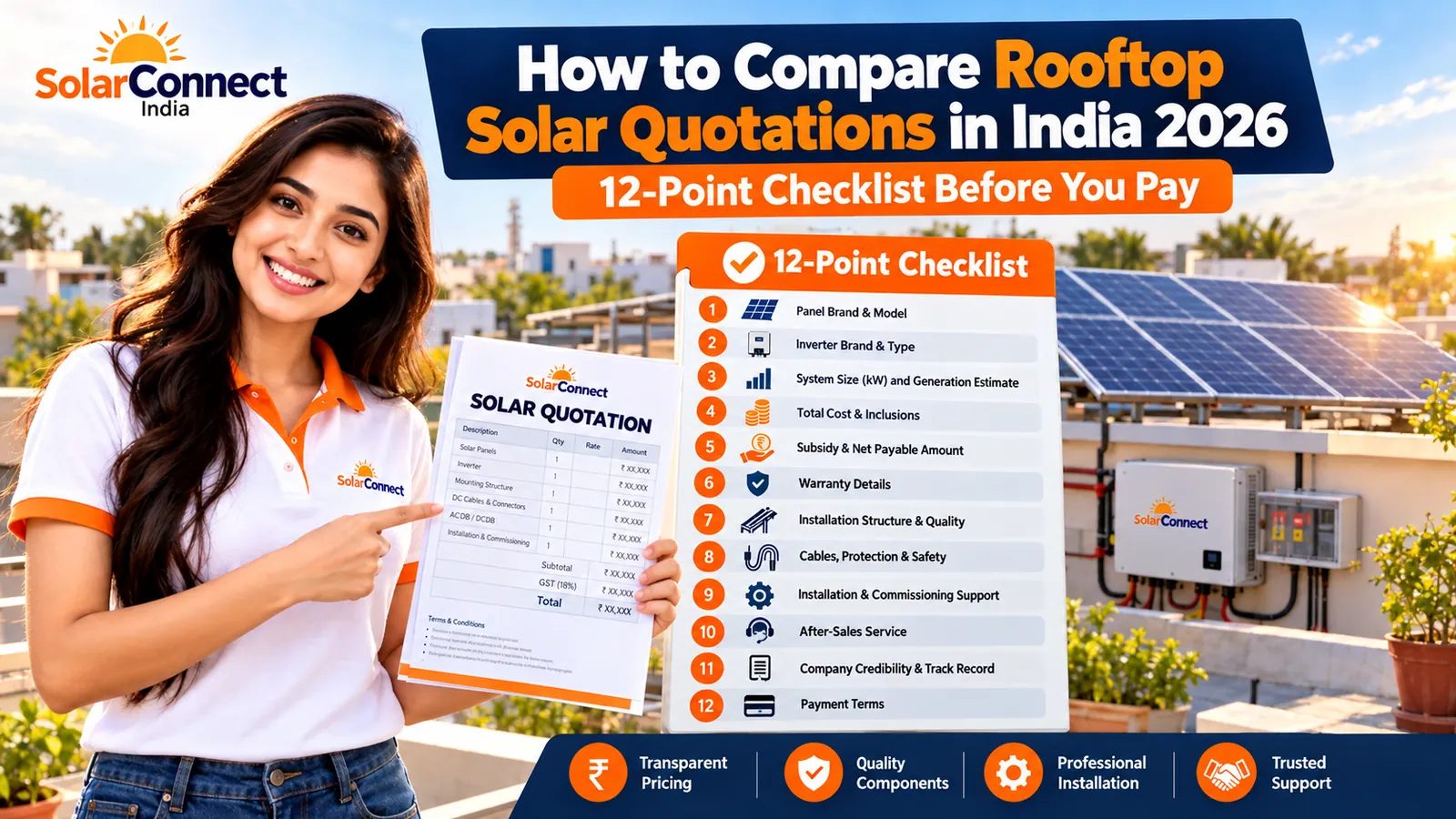
How to Compare Rooftop Solar Quotations in India 2026: 12-Point Checklist Before You Pay
Two solar quotes for the same kW can hide very different systems. Use this 12-point checklist on panels, DCR, inverter, structure, warranty, net metering and PM Surya Ghar subsidy before you pay any advance.
Two rooftop solar quotations for the same "3 kW system" can differ by tens of thousands of rupees, and the cheaper one is not always the better deal. The difference usually hides in the panel type, inverter, mounting structure, wiring, warranty and who handles net metering and the subsidy. Use this 12-point checklist to compare quotes line by line before you pay any advance.
Quick answer
Compare solar quotations on what is actually supplied, not just the price per kW. Check the panel brand, wattage and DCR status, the inverter brand and rating, structure material and height, cable and earthing specifications, warranties, net metering and subsidy support, the 5-year maintenance promise, and the payment schedule. Ask for every item in writing.
The 12-point quotation checklist
- System size in kW (DC) and expected units. The quote should state total panel capacity and an estimate of yearly generation. As a rough guide, 1 kW of rooftop solar produces about 4 units a day in much of India, depending on location, roof direction and shading. See our guide on how many units a 1 kW system produces.
- Panel brand, model, wattage and number of panels. "Tier-1 panels" is not enough. The quote should name the brand, model and wattage, for example 6 panels of a stated wattage.
- DCR or non-DCR panels. To claim the PM Surya Ghar subsidy, residential systems must use domestically manufactured (DCR) panels. If you want the subsidy and the quote says non-DCR, the subsidy will not apply. Read DCR vs non-DCR panels explained.
- Panel technology. Check whether panels are mono PERC, TOPCon or bifacial. Each has a different price and output.
- Inverter brand, rating and type. Note the inverter capacity in kW and whether it is on-grid, hybrid or off-grid. If you may add a battery later, ask whether the inverter supports it. See on-grid vs off-grid vs hybrid.
- Mounting structure. Ask for the material (hot-dip galvanised or aluminium), coating, and the height above the roof. A cheap, thin or low structure is one of the most common ways quotes cut costs.
- Cables, earthing and protection. The quote should mention DC and AC cable type, earthing, lightning arrester and the distribution box with protection devices.
- Warranties, in writing. Panels usually carry a product warranty plus a longer performance warranty, and the inverter has its own warranty. Read our solar panel warranty guide.
- Net metering and DISCOM paperwork. Who applies for the net meter, who pays the meter charges, and roughly how long it takes? See how net metering works.
- PM Surya Ghar subsidy support. Under PM Surya Ghar: Muft Bijli Yojana, central financial assistance is ₹30,000 per kW for the first 2 kW and ₹18,000 for the third kW, up to ₹78,000 for 3 kW and above for eligible homes. The subsidy is credited to the consumer's bank account after installation and inspection, so a fair quote shows the full price and the expected subsidy separately. Apply only through the official portal pmsuryaghar.gov.in.
- Maintenance. PM Surya Ghar vendors are expected to provide 5 years of maintenance. Ask what is included: visits, cleaning guidance and fault repair.
- Payment schedule and GST. Check whether GST is included, and avoid paying the full amount before material delivery. Pay only into the company's official bank account and keep all receipts.
Red flags in a solar quotation
- Only a per-kW price, with no brand or model names.
- A "free solar" or "100% subsidy" promise.
- Pressure to pay a large advance in cash or into a personal account.
- No mention of DCR panels on a subsidy quote.
- No written warranty or maintenance terms.
How SolarConnect helps
SolarConnect India (Techsr Enterprise, Serampore) gives itemised rooftop solar quotations with named panels, inverter and structure, and applies for customers' PM Surya Ghar subsidy through our empanelled partner Pro Power Energies. All terms are given in writing and payments are accepted only into the official company account. Ask SolarConnect for an itemised quote or explore the PM Surya Ghar subsidy guide.
FAQs
Why is one solar quotation much cheaper than another?
Usually because of differences in panel type (DCR or non-DCR), inverter brand, structure quality, cabling, warranty or included services such as net metering and maintenance. Compare item by item.
Should the subsidy be deducted from the quotation?
Under PM Surya Ghar, the subsidy is paid to the consumer's bank account after the system is installed and inspected, so the quote should show the full price and the expected subsidy separately.
How many quotations should I collect?
Two or three itemised quotations from registered vendors are usually enough to compare prices and components fairly.
Is the cheapest solar quotation a bad choice?
Not always. It is fine if the components, warranties and services match the other quotes. It is risky when the lower price comes from unnamed parts or missing services.
Source: SolarConnect India – solar.thetechsr.com
Back to Solar Blog