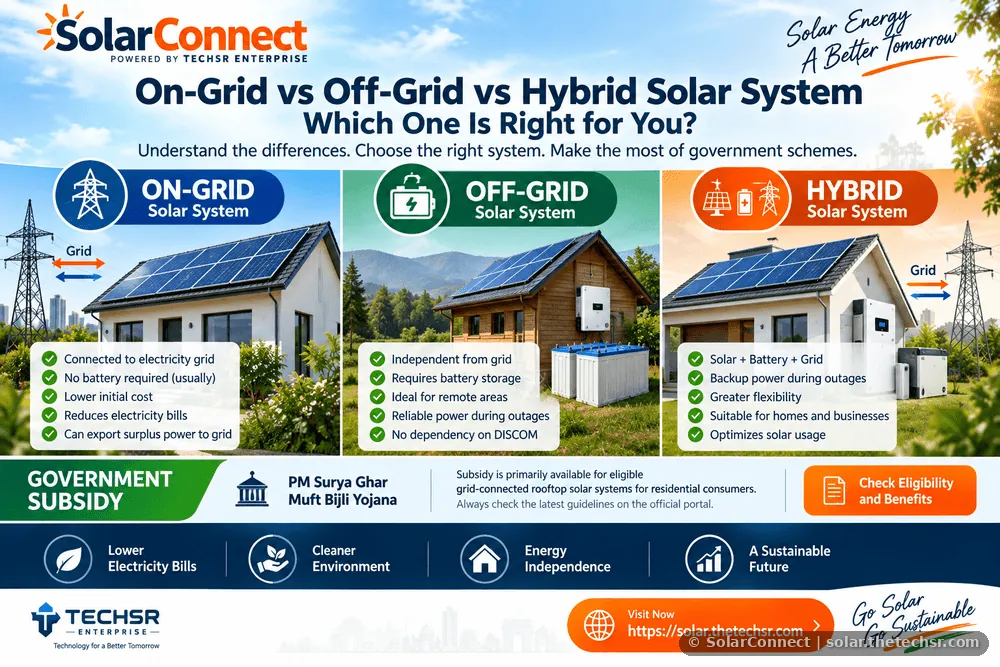
On-Grid vs Off-Grid vs Hybrid Solar System: Which One Is Right for You?
Understand the difference between on-grid, off-grid and hybrid solar systems, their benefits, applications, and which eligible rooftop systems may qualify for government subsidy in India.
On-Grid vs Off-Grid vs Hybrid Solar System: Which One Is Right for You?
Solar energy is becoming one of the most practical ways for Indian homes and businesses to reduce their dependence on conventional electricity. But before installing solar panels, one important question needs to be answered: Which type of solar system should you choose?
There are three commonly discussed solar system configurations: On-Grid, Off-Grid and Hybrid Solar Systems. Although all three use solar panels to generate electricity, their working methods, battery requirements, connection to the electricity grid and government subsidy eligibility can be very different.
Understanding these differences can help homeowners and businesses choose a solar solution according to their electricity consumption, backup requirements, location and budget.
What Is an On-Grid Solar System?
An On-Grid Solar System, also called a grid-connected solar system, is connected to the local electricity grid through the appropriate electricity distribution company (DISCOM).
Solar panels generate electricity during the daytime. The electricity can be used by the home or business, while surplus generation may be exported to the grid according to the applicable metering and regulatory arrangement.
When solar generation is not sufficient, such as during the evening or during periods of low sunlight, electricity can be supplied from the grid.
One major advantage of an on-grid system is that it normally does not require a large battery bank. This can make the initial installation simpler and more economical compared with a battery-based system.
How Does an On-Grid System Work?
- Solar panels generate DC electricity.
- The solar inverter converts the electricity into usable AC electricity.
- Solar power is used by connected household or business loads.
- Depending on the applicable arrangement, surplus electricity may be exported to the grid.
- When solar generation is insufficient, electricity can be drawn from the grid.
For customers who already have a reliable grid electricity connection and mainly want to reduce their electricity bill, an on-grid system can be a practical option.
What Is an Off-Grid Solar System?
An Off-Grid Solar System operates independently of the electricity grid. It is designed for locations where grid electricity is unavailable, unreliable or not technically or economically practical to extend.
An off-grid system normally includes solar panels, a solar inverter or charge controller, batteries and the required electrical protection equipment.
The batteries store solar energy generated during the day so that stored electricity can be used when sunlight is unavailable.
How Does an Off-Grid System Work?
- Solar panels generate electricity during sunlight hours.
- Solar power supplies the connected loads.
- Excess solar energy can be used to charge the battery.
- During the night or when solar generation is low, the battery supplies electricity.
- The system operates without depending on the main electricity grid.
Off-grid solar can be particularly useful for remote locations, farms, rural installations, telecom applications and other places where grid electricity is unavailable or unreliable.
What Is a Hybrid Solar System?
A Hybrid Solar System combines solar generation, battery storage and grid connectivity.
In a typical hybrid installation, solar panels generate electricity during the day, while the battery stores surplus energy. The grid can also be used when required.
The exact operation depends on the inverter configuration, battery capacity, load requirements and local electrical regulations.
The biggest advantage of a hybrid system is flexibility. It can provide solar power, battery backup and grid power within one integrated system.
How Does a Hybrid System Work?
- Solar panels generate electricity during the day.
- Solar power can supply the connected loads.
- Excess solar energy can charge the battery.
- Stored battery energy can be used when required.
- The grid can provide additional electricity when solar and battery power are insufficient.
A hybrid system can therefore be attractive for customers who want to reduce grid electricity consumption while also having backup power during outages.
On-Grid vs Off-Grid vs Hybrid Solar System
- On-Grid: Solar + Grid, generally without battery backup.
- Off-Grid: Solar + Battery, operates independently of the grid.
- Hybrid: Solar + Battery + Grid, providing greater flexibility.
Which System Is Best for a Normal Home?
There is no single system that is best for every home.
If your home has a reliable electricity connection and your primary objective is to reduce electricity bills, an on-grid rooftop solar system may be the most suitable option.
If your property does not have reliable grid electricity and you need an independent power source, an off-grid system may be more appropriate.
If you have a grid connection but also want battery backup during power cuts, a hybrid system may be worth considering.
Which Solar System Supports Government Subsidy?
This is one of the most important questions customers ask.
For residential rooftop solar under the PM Surya Ghar: Muft Bijli Yojana, the central financial assistance is associated with eligible grid-connected rooftop solar systems installed for residential electricity consumers through the applicable process.
MNRE states that residential consumers can apply for eligible grid-connected rooftop solar through the National Portal or the applicable State DISCOM mechanism. Installation and verification requirements also apply. 1
The PM Surya Ghar guidelines provide Central Financial Assistance for eligible residential rooftop solar capacity. The published structure provides CFA for the first 2 kW and additional eligible capacity up to 3 kW, with no additional CFA beyond 3 kW under that structure. 2
Therefore, customers should not assume that every solar system automatically qualifies for the residential rooftop subsidy. Eligibility depends on the applicable government scheme, system configuration, consumer category, grid connection, approved process, vendor requirements and other conditions.
Does an Off-Grid Home Solar System Get PM Surya Ghar Rooftop Subsidy?
Generally, the PM Surya Ghar residential rooftop subsidy should not be treated as an automatic subsidy for a standalone off-grid home system.
The PM Surya Ghar residential CFA is specifically associated with eligible grid-connected rooftop solar. Therefore, a customer should verify eligibility through the official National Portal and the concerned DISCOM before purchasing a system based on an expected subsidy.
There are, however, other government programmes that support specific off-grid solar applications. For example, MNRE's PM-KUSUM programme provides support for certain standalone solar agricultural pumps and solarisation of agricultural pumps under its applicable components. These are different from the residential rooftop subsidy under PM Surya Ghar. 3
What About Hybrid Solar Systems and Subsidy?
A hybrid system should also not be assumed to be automatically eligible for the residential rooftop subsidy simply because it can connect to the grid.
The customer should check whether the proposed configuration, equipment, installation process, vendor and grid connection satisfy the current requirements of the applicable government scheme.
Before making a purchase, it is important to confirm the subsidy eligibility with the official portal and the concerned DISCOM.
Simple Example
Imagine a family has a normal electricity connection and wants to reduce its monthly electricity bill.
If the family does not require battery backup, an on-grid rooftop system may be a suitable option to investigate.
Now imagine another family lives in an area where grid electricity is unavailable or extremely unreliable. An off-grid system with adequate battery storage may be more appropriate.
Finally, imagine a family has a grid connection but experiences frequent power cuts and wants both solar savings and backup power. A hybrid system may be a better technical solution.
Why Choosing the Right System Matters
Choosing solar panels is only one part of a solar project. The complete system should be designed according to electricity consumption, rooftop space, load profile, backup requirements, battery requirements, inverter capacity and local grid conditions.
A cheaper system is not always the best system. Similarly, installing a large battery when it is not required can unnecessarily increase the project cost.
A professional solar assessment can help determine the appropriate system size and configuration.
Important Questions to Ask Before Installing Solar
- How much electricity do I consume every month?
- How much rooftop space is available?
- Do I need backup during power cuts?
- Is my electricity connection suitable for grid-connected rooftop solar?
- Do I need batteries?
- What solar capacity should I install?
- What inverter technology is appropriate?
- What are the applicable government subsidy rules?
- Is the proposed vendor eligible under the applicable government programme?
- What warranty and after-sales service are included?
- What will be the total project cost after applicable financial assistance?
SolarConnect Can Help You Understand Your Solar Options
Choosing between on-grid, off-grid and hybrid solar should begin with understanding your actual electricity requirement rather than simply choosing the system with the lowest price.
SolarConnect, powered by TECHSR ENTERPRISE, is designed to help customers and solar businesses explore solar solutions, calculate requirements, prepare estimates and connect with the solar ecosystem.
Whether you are a homeowner, business owner, dealer or solar professional, understanding the difference between these three systems is an important first step toward making a better solar investment decision.
Final Takeaway
On-Grid Solar: Best suited for many customers with a reliable grid connection who primarily want to reduce electricity costs.
Off-Grid Solar: Suitable for locations where grid electricity is unavailable or unreliable and battery backup is required.
Hybrid Solar: Suitable for customers who want a combination of solar generation, battery backup and grid connectivity.
Government residential rooftop subsidy: The PM Surya Ghar residential CFA is associated with eligible grid-connected rooftop solar installations. It should not be assumed to apply automatically to every off-grid or hybrid installation. Always verify the latest eligibility and process through the official government portal and the relevant DISCOM before purchasing.
Explore solar tools, estimates and solar business solutions with SolarConnect.
Visit: https://solar.thetechsr.com
SolarConnect powered by TECHSR ENTERPRISE
Solar Energy. Smarter Planning. Better Connections.
Source: SolarConnect India – solar.thetechsr.com
Back to Solar Blog