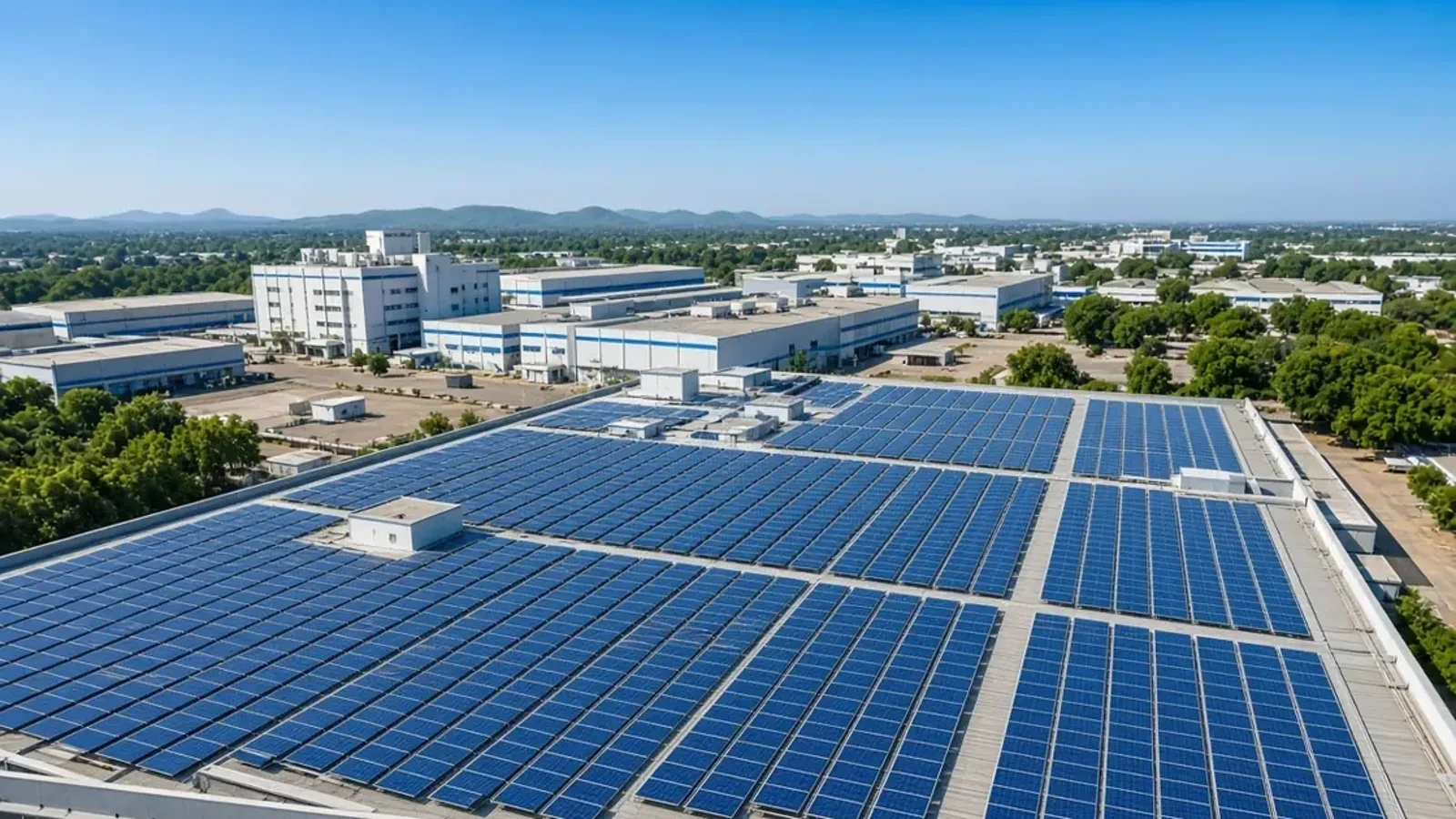
Commercial Rooftop Solar in India 2026: 8 Myths vs Facts for Factories and Businesses (Cost, RESCO, Tax Benefit)
Is commercial rooftop solar worth it for your factory or office? We bust 8 common myths on subsidy, upfront cost, RESCO/PPA, tax benefit, roof strength and open access, with real facts for Indian businesses.
Factory owners, warehouse managers, schools, hospitals and office buildings across India keep asking our SolarConnect India team whether rooftop solar really makes sense for a business. Many decisions get delayed because of old myths: "it needs a big upfront payment", "the subsidy will cover it", "our roof is not strong enough", "it will stop working in a few years". This guide busts the 8 most common commercial solar myths with plain facts, so you can decide with real numbers from your own electricity bill.
Quick answer
Commercial and industrial (C&I) rooftop solar is one of the fastest ways for an Indian business to cut its daytime electricity cost. Businesses pay a higher tariff than homes, and most of their load runs in daytime, exactly when solar produces. There is no PM Surya Ghar subsidy for commercial buildings, but businesses can use accelerated depreciation, the reduced GST on solar, and zero-investment models such as RESCO/PPA. SolarConnect India supports large commercial, industrial and corporate projects pan-India through its EPC and distribution network.
Myth 1: The PM Surya Ghar subsidy will pay for our factory's solar
Fact: PM Surya Ghar: Muft Bijli Yojana is for residential homes (and housing society common areas). Its central subsidy is up to Rs 78,000 per home. Factories, shops, offices and other commercial connections are not eligible. The good news: a business project pays back mainly through bill savings and tax benefits, not subsidy. Home owners can read our PM Surya Ghar subsidy guide.
Myth 2: Commercial solar always needs a huge upfront investment
Fact: There are two common models:
- CAPEX (own the plant): the business pays for the system, owns it, keeps all savings and claims the tax benefits.
- RESCO / OPEX (PPA): a developer installs and owns the plant on your roof, and you only pay a fixed per-unit rate for the solar power you use, usually lower than your grid tariff, for an agreed number of years. Little or no upfront payment is needed.
Bank loans for solar are also widely available. See our financing options for solar projects in India.
Myth 3: Solar only makes sense for homes, not big loads
Fact: Businesses usually benefit more than homes. Commercial and industrial tariffs are higher, and factories, cold stores, schools and offices use most of their power between 9 AM and 5 PM, which is solar's peak window. Every solar unit used directly on site replaces a costly grid unit. As a rough planning figure, 1 kW of well-installed rooftop solar in India produces about 4 units a day on average, depending on location and season.
Myth 4: There is no tax benefit for business solar
Fact: Under the Income Tax rules, solar power generating systems are eligible for accelerated depreciation (currently 40% a year on the written-down value), which lowers taxable profit in the early years for businesses that own the plant. GST on solar power systems and modules was also reduced to 5% in September 2025. Ask your chartered accountant to confirm what applies to your company.
Myth 5: Our roof cannot carry solar panels
Fact: Most RCC roofs and industrial metal-sheet roofs can carry rooftop solar. Metal sheds use lightweight rail or short-rail mounting without heavy structures. A proper site survey checks roof condition, shadow, load and wind zone before design. Typical space need is roughly 80 to 100 sq ft per kW of shadow-free roof.
Myth 6: We can only use solar up to the roof size
Fact: Rooftop is just one route. Under the Green Energy Open Access Rules, 2022, consumers with a contracted demand of 100 kW or more can buy green power from solar plants outside their premises, subject to state rules and charges. Many businesses combine rooftop solar with open access or group captive projects.
Myth 7: Commercial solar plants stop working in a few years
Fact: Quality panels from reputed brands come with long performance warranties, commonly 25 to 30 years, and inverters with their own product warranty. Output reduces slowly each year rather than stopping. Regular cleaning and annual checks keep generation high. Read our solar panel warranty guide and cleaning and maintenance guide.
Myth 8: Any installer can do a large commercial project
Fact: A 50 kW, 500 kW or MW-scale plant needs proper engineering: load study, structural check, cable sizing, protection, net or gross metering approval with your DISCOM and safety compliance. Always compare quotations line by line. Use our 12-point checklist for comparing solar quotations.
How to plan a commercial solar project
- Collect the last 12 months of electricity bills (units, contracted demand, tariff).
- Check daytime load and the shadow-free roof area.
- Choose CAPEX or RESCO/PPA based on cash flow and tax position.
- Get a site survey and a design with expected yearly units.
- Apply for net metering or the right metering option with your DISCOM.
- Install, commission and set up monitoring and maintenance.
See examples of the kind of work we support on our commercial solar projects page and the commercial solar service page. For more myths, visit our solar myths vs facts hub and the top 10 solar myths in India.
Frequently asked questions
Is there a government subsidy for commercial rooftop solar in India?
The PM Surya Ghar central subsidy is only for residential homes. Commercial and industrial users mainly benefit from bill savings, accelerated depreciation and the reduced 5% GST on solar systems.
What is the RESCO model in solar?
In the RESCO or PPA model, a developer invests in and owns the solar plant on your roof, and you pay only for the solar units you use at an agreed per-unit rate, usually lower than the grid tariff.
How many units does a 100 kW commercial solar plant produce?
At about 4 units per kW per day on average, a 100 kW plant gives roughly 400 units a day, or around 1.4 to 1.5 lakh units a year. Actual output depends on location, tilt, shadow and maintenance.
How much roof space is needed for a 100 kW solar plant?
Roughly 8,000 to 10,000 sq ft of shadow-free roof, depending on panel wattage and roof layout.
Does SolarConnect India handle commercial projects outside West Bengal?
Yes. SolarConnect India supplies partner-brand solar panels and supports commercial, industrial and corporate projects across North, West, South, East and Central India through its pan-India EPC and dealer network.
Talk to the SolarConnect India team
Planning solar for a factory, warehouse, school, hospital or office anywhere in India? Share your last electricity bill and our team will help with site survey, design, the right investment model and installation through our EPC network. Call +91 92823 67700 (WhatsApp) or 033 3183 5203. Dealers and EPC partners can also explore a pan-India solar dealership with SolarConnect.
Source: SolarConnect India – solar.thetechsr.com
Back to Solar Blog