
Rooftop Solar in Tamil Nadu 2026: Up to ₹1 Lakh Subsidy, Cost and TNPDCL Net Metering Explained
Tamil Nadu now adds up to ₹22,000 to PM Surya Ghar, so a 3 kW home system gets ₹1,00,000 subsidy. Cost, TNPDCL USRP process, net feed-in and FAQs.
By the SolarConnect India team (Techsr Enterprise, Serampore) | 14 Oct 2026
Tamil Nadu homeowners got good news in 2026: on top of the central PM Surya Ghar subsidy, the state now pays its own top-up for rooftop solar. For a 3 kW home system, the two together come to ₹1,00,000. This guide explains the subsidy, the real cost, how the TNPDCL application works, and how your bill is calculated after solar.
Note: subsidy figures are from the official Tamil Nadu Solar Homes portal of TNPDCL (tnebltd.gov.in/usrp). Prices and generation figures are approximate and vary by brand, roof and installer. Always check the latest rules and get a written quotation.
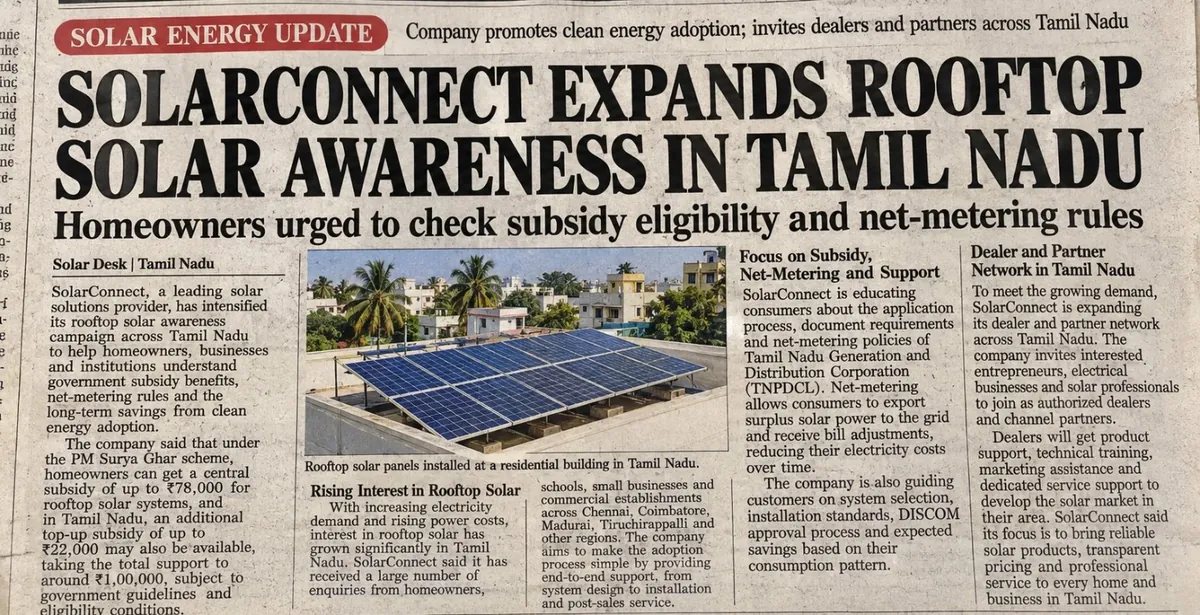
How much rooftop solar subsidy can you get in Tamil Nadu in 2026?
Residential consumers get the central subsidy (Central Financial Assistance, or CFA) under PM Surya Ghar: Muft Bijli Yojana, plus a Tamil Nadu state top-up:
| System size | Central subsidy | Tamil Nadu top-up | Total subsidy |
|---|---|---|---|
| 1 kW | ₹30,000 | ₹5,000 | ₹35,000 |
| 2 kW | ₹60,000 | ₹10,000 | ₹70,000 |
| 3 kW | ₹78,000 | ₹22,000 | ₹1,00,000 |
| Above 3 kW | ₹78,000 (max) | ₹22,000 (max) | ₹1,00,000 (max) |
Both amounts are paid by Direct Benefit Transfer (DBT) into your bank account. The state top-up is released only after installation, net metering, commissioning and payment of the central subsidy. As reported by ETEnergyWorld, the top-up applies to applications submitted from 5 August.
What does a rooftop solar system cost in Tamil Nadu after subsidy?
The TNPDCL portal itself publishes indicative market prices. Using its middle figures:
| System size | Indicative price range | Total subsidy | Approx. you pay |
|---|---|---|---|
| 1 kW | ₹70,000 to ₹85,000 | ₹35,000 | about ₹42,500 |
| 2 kW | ₹1,30,000 to ₹1,55,000 | ₹70,000 | about ₹72,500 |
| 3 kW | ₹1,80,000 to ₹2,20,000 | ₹1,00,000 | about ₹1,00,000 |
In other words, a 3 kW system in Tamil Nadu can cost the homeowner roughly half its market price. Banks also offer rooftop solar loans, so the remaining amount can be paid in EMIs. Read our rooftop solar loan and EMI guide for the options.
Who is eligible?
- Residential (domestic) electricity consumers of TNPDCL with their own roof.
- The scheme covers residential rooftop systems up to 10 kW; the subsidy is capped at the 3 kW level.
- Panels must be DCR-compliant and ALMM-listed (made in India and on the government's approved list). See why DCR panels matter for subsidy.
- Installation must be done by a TEDA-empanelled vendor (TEDA is the Tamil Nadu Energy Development Agency).
How to apply: PM Surya Ghar portal plus TNPDCL USRP
- Register on the national portal at pmsuryaghar.gov.in with your TNPDCL consumer number. You get a National Portal reference number.
- Apply on TNPDCL's Unified Solar Rooftop Portal (USRP) using "Apply Online - CFA" and that reference number, and pay the application charges on TNPDCL's payment portal.
- Feasibility approval from TNPDCL, based on your sanctioned load and the local transformer.
- Choose a TEDA-empanelled vendor, agree the price and get the system installed.
- Inspection and meter: TNPDCL inspects the system, fixes the bi-directional meter and commissions the plant.
- Subsidy: submit bank details on the national portal. The central amount comes first, then the state top-up.
If you do not want the subsidy, you can apply directly on USRP using "Apply Online - Non-CFA". For help, TNPDCL's Minnagam helpline is 1912 (24x7). Our subsidy status check guide explains how to track your payment.
Net metering or net feed-in: how your bill works
This is the part many Tamil Nadu buyers miss. According to TNPDCL's FAQ, pure net metering (paying only for imports minus exports) applies to solar applications registered before 25 March 2019. For newer connections, the net feed-in method of billing applies, under the rules of the Tamil Nadu Electricity Regulatory Commission.
TNPDCL's published salient features also list a network charge for LT prosumers of ₹1.27 per kWh (as per Tariff Order No. 8 of 2021), and for domestic systems up to 10 kW only 20% of that charge applies. Ask your installer to show you a sample bill calculation for your own consumption before you sign, and check the latest TNERC order, because these charges can be revised.
The practical lesson: in Tamil Nadu, solar pays back best when you use most of the power during the day (fans, AC, pumps, washing machine) instead of exporting it all. Our article on designing solar around your electricity habits explains why.
How many units will it produce in Tamil Nadu?
Tamil Nadu gets strong sunshine for most of the year. As a rough planning figure, a well-installed 1 kW system in South India typically produces around 4 to 4.5 units a day on average (approximate), so a 3 kW system gives roughly 360 to 400 units a month, less during the monsoon months. Shading, dust and panel tilt make a real difference; see how many units 1 kW produces per day.
Which size should a Tamil Nadu home choose?
- Up to about 150 units a month: 1 kW to 2 kW.
- 150 to 300 units a month: 2 kW to 3 kW.
- Above 300 units, or ACs at home: 3 kW or more. Since the subsidy stops growing at 3 kW, the 3 kW size gets the most subsidy per rupee. Read our 3 kW home guide.
FAQs
Is the Tamil Nadu solar top-up in addition to PM Surya Ghar?
Yes. It is added on top of the central subsidy, up to ₹22,000, for a combined maximum of ₹1,00,000.
Can I install non-DCR panels and still get the subsidy?
No. Both the central and state subsidy need DCR-compliant, ALMM-listed modules.
How long does the subsidy take?
Officials quoted by ETEnergyWorld said consumers would be reimbursed within about a month of commissioning, but timing can vary.
Does SolarConnect work in Tamil Nadu?
SolarConnect India supplies rooftop solar kits and supports dealers across India. If you are a solar installer or want to start a solar business in Tamil Nadu, see how our pan-India dealership works.
Bottom line
With up to ₹1 lakh in combined subsidy, 2026 is one of the best years yet for Tamil Nadu homes to go solar. Apply on the PM Surya Ghar portal, complete the TNPDCL USRP step, insist on DCR panels and a TEDA-empanelled installer, and size the system around your daytime use.
Sources: TNPDCL Tamil Nadu Solar Homes portal and FAQ (tnebltd.gov.in/usrp), TNPDCL rooftop solar salient features, ETEnergyWorld.
Source: SolarConnect India – solar.thetechsr.com
Back to Solar Blog