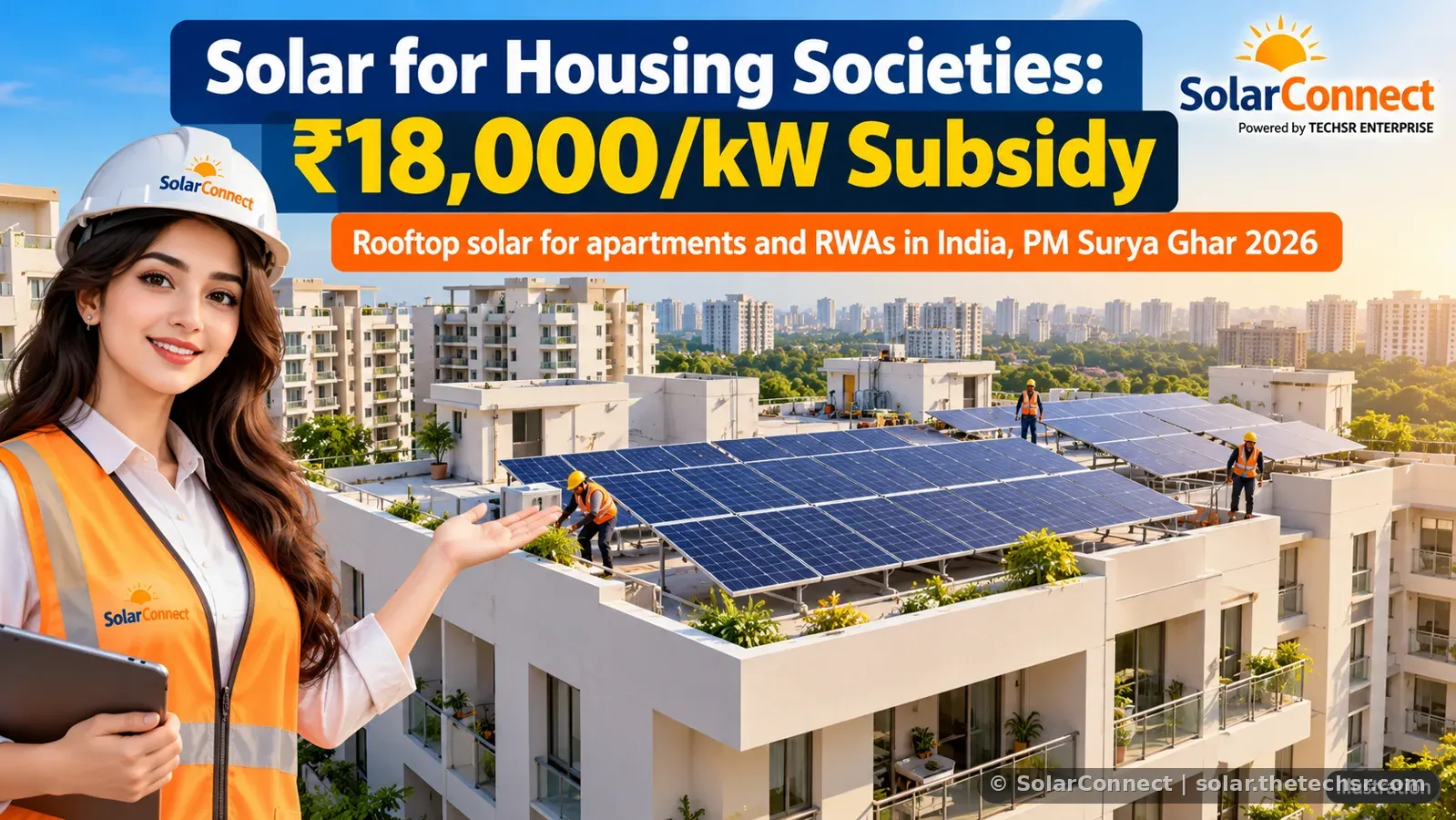
Rooftop Solar for Housing Societies and Apartments in India 2026: PM Surya Ghar RWA Subsidy Explained
Can your apartment society get solar subsidy? PM Surya Ghar gives RWAs ₹18,000/kW up to 500 kW for common areas. Size, cost, process and FAQs.
By the SolarConnect India team (Techsr Enterprise, Serampore) | Draft, 13 Oct 2026
Most rooftop solar guides talk about independent houses. But millions of Indian families live in apartments, where the roof belongs to everyone and the biggest electricity bill is the society's own: lifts, water pumps, corridor and parking lights, gate and CCTV. This guide answers the questions housing society committees and residents ask us most about putting rooftop solar on an apartment building under the PM Surya Ghar scheme.
Note: subsidy figures below are taken from the official PM Surya Ghar CFA structure. Cost and generation figures are approximate and vary by state, DISCOM, roof and installer. Always check the latest rules on pmsuryaghar.gov.in and get a written quotation.
Can a housing society or RWA get a solar subsidy under PM Surya Ghar?
Yes. PM Surya Ghar: Muft Bijli Yojana has a separate category for Group Housing Societies (GHS) and Resident Welfare Associations (RWA). Apartment Owner Associations and cooperative housing societies that look after common facilities are also covered. The subsidy (called Central Financial Assistance, or CFA) is for solar that powers common facilities, including EV charging.
How much subsidy does an apartment society get?
As per the official CFA structure:
- ₹18,000 per kW of rooftop solar capacity (₹19,800 per kW in special category states/UTs).
- Eligible capacity is capped at 3 kW per house in the society, with an overall maximum of 500 kW.
- That 500 kW limit includes any individual rooftop plants already installed by residents in the same society.
Two worked examples from the scheme's consumer manual make this clear:
| Society | Solar installed | Eligible capacity | Subsidy |
|---|---|---|---|
| 50 flats | 100 kW | 100 kW (lower of 150 kW and 100 kW) | ₹18,00,000 |
| 20 flats | 100 kW | 60 kW (lower of 60 kW and 100 kW) | ₹10,80,000 |
Your state may offer an extra subsidy on top. See our state-wise solar subsidy guide.
Can the society's solar power be supplied to individual flats?
Not under this subsidy. The scheme says the GHS/RWA connection must be dedicated only to common facilities and must not be used to supply electricity to residents' flats. Flat owners who want solar for their own meter can apply separately as individual residential consumers, where the subsidy is ₹30,000 per kW for the first 2 kW and ₹18,000 for the third kW (up to ₹78,000). Our PM Surya Ghar 1–3 kW subsidy guide explains that route.
The scheme guidelines also say installations under group net metering or virtual net metering can be eligible if the DISCOM and state regulator allow those arrangements. Rules differ by state, so ask your DISCOM.
What size of solar system does an apartment building need?
Start from the society's common-area bill, not the flats' bills. As a rough planning number, 1 kW of rooftop solar in most of India makes about 3.5 to 4.5 units a day, or roughly 110 to 135 units a month (approximate; see how many units 1 kW produces).
- If the common meter uses about 1,200 units a month, a system of around 9 to 11 kW could cover most of it (approximate).
- Roof space is usually the real limit. Plan roughly 80 to 100 sq ft of shadow-free roof per kW (approximate), keeping clear access to water tanks, lift rooms and the terrace door.
- Lifts and pumps run in the morning and evening too, so day-time solar will not cancel the bill fully unless net metering credits the extra units.
You can try rough numbers on our solar calculator.
How much does rooftop solar cost for a housing society?
Society-scale on-grid systems with DCR (made-in-India cell) panels are often quoted at roughly ₹45,000 to ₹60,000 per kW before subsidy (approximate), depending on structure height, wind-load design, cable runs from the roof to the meter room and the brand. A taller structure that lets residents still use the terrace costs more. Only DCR panels qualify for the subsidy; see DCR vs non-DCR panels.
What is the process for a society to apply?
The broad steps are below. Exact paperwork can vary by DISCOM.
- Pass a resolution in the society's general body or committee meeting approving the project, the roof area and the budget.
- Check the common-area connection: the electricity connection and consumer number must be in the society's or RWA's name.
- Apply on the national portal at pmsuryaghar.gov.in in the GHS/RWA category and choose a registered vendor.
- DISCOM feasibility approval, then installation with DCR panels.
- Net meter installation and inspection by the DISCOM. Read our net metering guide for common mistakes.
- Subsidy release to the society's bank account after commissioning. You can follow it using our subsidy status guide.
Is solar worth it for an apartment society?
For many societies, yes, because the common-area bill is paid every month by all residents through maintenance. Lower common-area bills can mean lower or more stable maintenance charges. The things that decide whether it pays off are a shadow-free roof, the society's tariff slab, how your DISCOM credits exported units, and a good maintenance contract (cleaning, inverter warranty and a yearly check). Societies that want to add backup later can read about upgrading on-grid solar to hybrid.
Common mistakes societies should avoid
- Using non-DCR panels and then finding the project is not subsidy-eligible.
- Not counting residents' existing rooftop plants against the 500 kW cap.
- Planning to supply flats from the common connection, which the scheme does not allow.
- Skipping a written annual maintenance contract.
- Blocking the terrace for water-tank cleaning or fire exits.
Frequently asked questions
Do all flat owners need to agree?
The scheme does not set a voting rule. Your society's own bye-laws decide this, which is why a recorded general body resolution is the safest first step.
Can the society also set up EV charging with solar?
Yes. The GHS/RWA subsidy category specifically covers common facilities including EV charging.
Is the subsidy different in hill and north-eastern states?
Yes. In special category states and UTs the GHS/RWA subsidy is ₹19,800 per kW instead of ₹18,000.
Can a commercial building or office complex get this subsidy?
No. PM Surya Ghar CFA is only for the residential segment. Commercial and industrial buildings are not eligible for this central subsidy.
Talk to SolarConnect
SolarConnect India works with installers and dealers across India. If your society wants a site survey or a quotation, or you want to become a solar dealer in your district, contact us or read about our pan-India solar dealership.
Sources: MNRE PM Surya Ghar CFA structure and residential CFA guidelines; PM Surya Ghar consumer manual (CAG). Figures marked approximate are planning estimates only.
Source: SolarConnect India – solar.thetechsr.com
Back to Solar Blog