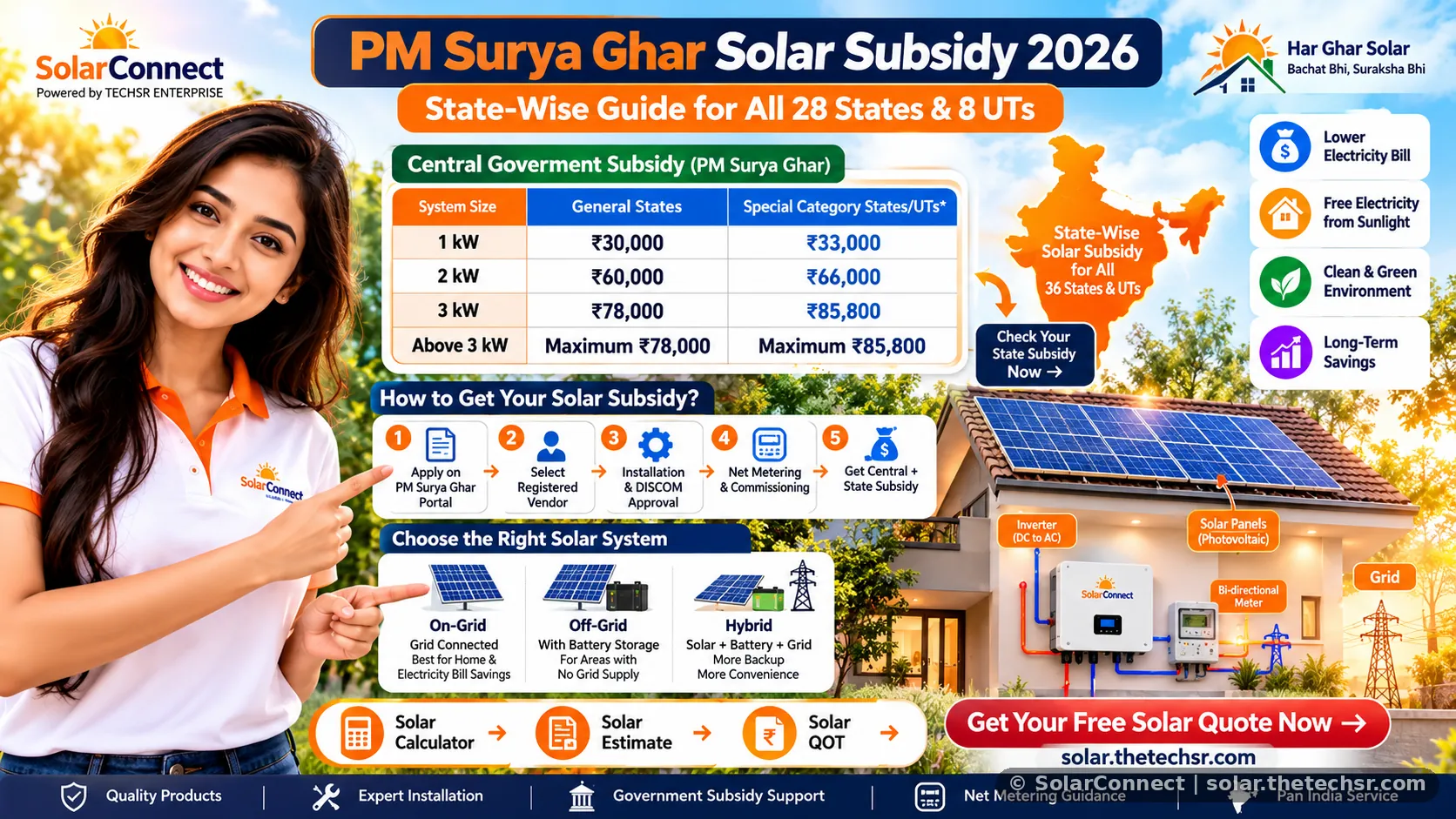
Solar Subsidy 2026 State-Wise: PM Surya Ghar up to ₹78,000
PM Surya Ghar 2026: ₹30,000/kW up to 2 kW + ₹18,000 for the 3rd kW, max ₹78,000. State-wise guide, eligibility and how to apply. Updated 21 Oct 2026.
PM Surya Ghar Solar Subsidy 2026: Complete State-Wise Guide for All 36 States & UTs
Updated: 21 Oct 2026
Quick answer: Under PM Surya Ghar: Muft Bijli Yojana, the central subsidy for homes is ₹30,000 per kW for the first 2 kW and ₹18,000 for the 3rd kW, so the maximum is ₹78,000 for 3 kW or more (special-category states/UTs get higher rates). Apply only on the official portal pmsuryaghar.gov.in.
State top-ups: state amounts listed below can change or end with budget allocation. Before signing, check your DISCOM/state portal for the current figure.
Estimate your subsidy instantly with our free solar subsidy calculator.
Tagline: One India, Different Solar Benefits: Check Your State's PM Surya Ghar Subsidy Before Installing Rooftop Solar.
Short Description: Confused about PM Surya Ghar solar subsidy in 2026? This complete state-wise guide explains Central Government subsidy, state top-up subsidy, 1kW, 2kW and 3kW benefits, special-category state rates, eligibility, application process, net metering, rooftop solar cost and electricity bill savings for all 28 States and 8 Union Territories of India.
☀️ Your State. Your Solar Subsidy. Your Savings.
PM Surya Ghar subsidy is not always the same everywhere in India. The Central Government provides a common residential rooftop solar subsidy structure, while some States and Union Territories provide additional financial support.
Before you install solar, first check your state, your electricity connection, your system capacity and the applicable subsidy.
PM Surya Ghar Solar Subsidy 2026: The Basic Central Subsidy
The PM Surya Ghar: Muft Bijli Yojana provides Central Financial Assistance (CFA) to eligible residential electricity consumers installing grid-connected rooftop solar through the applicable process.
| Solar Capacity | Central Subsidy - General States | Central Subsidy - Special Category States/UTs |
|---|---|---|
| 1 kW | ₹30,000 | ₹33,000 |
| 2 kW | ₹60,000 | ₹66,000 |
| 3 kW | ₹78,000 | ₹85,800 |
| Above 3 kW | Maximum ₹78,000 | Maximum ₹85,800 |
The Central subsidy is calculated according to the applicable capacity slabs. For the first 2 kW, the standard CFA is ₹30,000 per kW and for the additional capacity up to 3 kW it is ₹18,000 per kW. Special-category regions receive 10% higher CFA. There is no additional central CFA beyond the 3 kW residential slab. MNRE Rooftop Solar Programme
Why Is the 3 kW Solar System So Important?
For many residential consumers, 3 kW is an important capacity because the Central subsidy reaches its maximum at this point.
However, homeowners should not automatically choose 3 kW only because the subsidy is higher. The right capacity should depend on electricity consumption, roof space, shading, appliance usage, future electricity demand and the applicable DISCOM process.
Read our detailed guide:
How to Choose the Right Solar System for Your Home
State-Wise PM Surya Ghar Subsidy 2026
The following sections cover every State and Union Territory. The Central subsidy is shown separately from any identified State/UT top-up.
1. Andhra Pradesh Solar Subsidy 2026
Central subsidy: ₹30,000 for 1 kW, ₹60,000 for 2 kW and up to ₹78,000 for 3 kW or above.
Additional State top-up: No separate residential PM Surya Ghar top-up figure has been identified in the current published state-wise subsidy data.
Maximum Central benefit: ₹78,000.
Andhra Pradesh residential consumers should check the current DISCOM and National Portal process before installation.
2. Arunachal Pradesh Solar Subsidy 2026
Central subsidy: Special-category CFA of ₹33,000 for 1 kW, ₹66,000 for 2 kW and up to ₹85,800 for 3 kW or above.
Additional State top-up: No separate current residential top-up figure identified.
Maximum Central benefit: ₹85,800.
Arunachal Pradesh is part of the North-Eastern special-category group for PM Surya Ghar CFA.
3. Assam Solar Subsidy 2026
Central subsidy: Special-category CFA of ₹33,000 for 1 kW, ₹66,000 for 2 kW and ₹85,800 for 3 kW.
Assam State subsidy: ₹15,000 for 1 kW, ₹30,000 for 2 kW and ₹45,000 for 3 kW.
| Capacity | Central CFA | Assam State Top-up | Combined Support |
|---|---|---|---|
| 1 kW | ₹33,000 | ₹15,000 | ₹48,000 |
| 2 kW | ₹66,000 | ₹30,000 | ₹96,000 |
| 3 kW | ₹85,800 | ₹45,000 | ₹1,30,800 |
Assam's state policy provides additional residential rooftop solar support on top of the Central subsidy. APDCL
4. Bihar Solar Subsidy 2026
Central subsidy: ₹30,000 for 1 kW, ₹60,000 for 2 kW and ₹78,000 maximum for 3 kW or above.
Additional State support: Current published state-wise subsidy information identifies a Bihar top-up of ₹10,000 per kW, capped at ₹20,000 per consumer, subject to the applicable state scheme and eligibility.
Consumers should verify the current Bihar state component before signing an installation agreement.
5. Chhattisgarh Solar Subsidy 2026
Central subsidy: ₹30,000 for 1 kW, ₹60,000 for 2 kW and ₹78,000 for 3 kW or above.
Additional State support: Current published state-wise information identifies additional support of ₹15,000 for 1 kW and ₹30,000 for 2 kW and above, subject to the applicable state rules and allocation.
6. Goa Solar Subsidy 2026
Central subsidy: ₹30,000 for 1 kW, ₹60,000 for 2 kW and ₹78,000 for 3 kW or above.
Goa State subsidy: Goa launched a State Subsidy Scheme for rooftop solar under PM Surya Ghar in 2026. The scheme is implemented through Goa Energy Development Agency (GEDA) and provides support in addition to the Central CFA.
The current Goa Government notification states that the subsidy is linked to the MNRE benchmark cost. Because the official 2026 announcement does not specify one universal per-kW cash amount, homeowners should verify the applicable slab through GEDA before calculating their final subsidy.
7. Gujarat Solar Subsidy 2026
Central subsidy: ₹30,000 for 1 kW, ₹60,000 for 2 kW and ₹78,000 for 3 kW or above.
Additional State top-up: No separate current PM Surya Ghar residential top-up has been included in the current state-wise published list.
Gujarat remains one of India's major rooftop solar markets, so consumers should distinguish the current PM Surya Ghar CFA from older Gujarat rooftop subsidy schemes.
8. Haryana Solar Subsidy 2026
Central subsidy: ₹30,000 for 1 kW, ₹60,000 for 2 kW and ₹78,000 maximum for 3 kW or above.
Additional State support: Published state-level information identifies income-targeted support for eligible lower-income households. The amount can depend on household income/category and therefore should not be treated as a universal Haryana subsidy for every consumer.
Important: Eligibility should be checked before including any Haryana State top-up in a project quotation.
9. Himachal Pradesh Solar Subsidy 2026
Central subsidy: Special-category CFA of ₹33,000 for 1 kW, ₹66,000 for 2 kW and ₹85,800 for 3 kW or above.
Additional State top-up: No separate current universal residential top-up figure identified.
Himachal Pradesh receives the higher special-category Central CFA.
10. Jharkhand Solar Subsidy 2026
Central subsidy: ₹30,000 for 1 kW, ₹60,000 for 2 kW and ₹78,000 maximum for 3 kW or above.
Additional State support: Current published state-wise information identifies additional support for eligible low-income households, with the amount depending on income and system capacity.
11. Karnataka Solar Subsidy 2026
Central subsidy: ₹30,000 for 1 kW, ₹60,000 for 2 kW and ₹78,000 for 3 kW or above.
Additional State top-up: No separate universal residential PM Surya Ghar top-up figure identified in the current state-wise data.
Karnataka consumers should also check the applicable BESCOM, MESCOM or other DISCOM process for rooftop solar and metering.
12. Kerala Solar Subsidy 2026
Central subsidy: ₹30,000 for 1 kW, ₹60,000 for 2 kW and ₹78,000 for 3 kW or above.
Additional State top-up: No separate current universal residential PM Surya Ghar cash top-up identified.
Consumers should check the latest KSEB and ANERT procedures before installation.
13. Madhya Pradesh Solar Subsidy 2026
Central subsidy: ₹30,000 for 1 kW, ₹60,000 for 2 kW and ₹78,000 maximum for 3 kW or above.
Additional State top-up: No separate universal residential PM Surya Ghar top-up figure identified in the current state-wise list.
14. Maharashtra Solar Subsidy 2026
Central subsidy: ₹30,000 for 1 kW, ₹60,000 for 2 kW and ₹78,000 maximum for 3 kW or above.
Additional State top-up: No universal current residential top-up amount is stated in the current official PM Surya Ghar information reviewed.
Maharashtra consumers should check the current MSEDCL/MEDA implementation route before calculating the final consumer contribution.
15. Manipur Solar Subsidy 2026
Central subsidy: Special-category CFA of ₹33,000 for 1 kW, ₹66,000 for 2 kW and ₹85,800 for 3 kW or above.
Additional State top-up: No separate current universal residential top-up identified.
16. Meghalaya Solar Subsidy 2026
Central subsidy: Special-category CFA of ₹33,000 for 1 kW, ₹66,000 for 2 kW and ₹85,800 for 3 kW or above.
Additional State top-up: No separate current universal residential top-up identified.
17. Mizoram Solar Subsidy 2026
Central subsidy: Special-category CFA of ₹33,000 for 1 kW, ₹66,000 for 2 kW and ₹85,800 for 3 kW or above.
Additional State top-up: No separate current universal residential top-up identified.
18. Nagaland Solar Subsidy 2026
Central subsidy: Special-category CFA of ₹33,000 for 1 kW, ₹66,000 for 2 kW and ₹85,800 for 3 kW or above.
Additional State top-up: No separate current universal residential top-up identified.
19. Odisha Solar Subsidy 2026
Central subsidy: ₹30,000 for 1 kW, ₹60,000 for 2 kW and ₹78,000 maximum for 3 kW or above.
Additional State top-up: The state-level subsidy position has changed across different solar programmes and published materials. Consumers should verify the current OREDA/DISCOM scheme before adding any State amount to a quotation.
Do not confuse older Odisha rooftop subsidy figures with the current PM Surya Ghar Central CFA.
20. Punjab Solar Subsidy 2026
Central subsidy: ₹30,000 for 1 kW, ₹60,000 for 2 kW and ₹78,000 maximum for 3 kW or above.
Additional State top-up: No separate universal residential PM Surya Ghar top-up identified.
21. Rajasthan Solar Subsidy 2026
Central subsidy: ₹30,000 for 1 kW, ₹60,000 for 2 kW and ₹78,000 maximum for 3 kW or above.
Additional State support: Eligible beneficiaries under the Rajasthan government's applicable free electricity programme can receive additional State support. The Rajasthan Economic Review reports an additional State subsidy of ₹17,000 for eligible consumers installing rooftop solar through PM Surya Ghar.
Therefore, the Rajasthan State amount should not automatically be added to every residential consumer's subsidy calculation.
22. Sikkim Solar Subsidy 2026
Central subsidy: Special-category CFA of ₹33,000 for 1 kW, ₹66,000 for 2 kW and ₹85,800 for 3 kW or above.
Additional State top-up: No separate current universal residential top-up identified.
23. Tamil Nadu Solar Subsidy 2026
Central subsidy: ₹30,000 for 1 kW, ₹60,000 for 2 kW and ₹78,000 for 3 kW or above.
Tamil Nadu State top-up: The current Tamil Nadu rooftop solar portal states an additional State subsidy of ₹5,000 for 1 kW, ₹10,000 for 2 kW and ₹22,000 for 3 kW and above, taking the advertised maximum combined assistance to ₹1,00,000.
| Capacity | Central | Tamil Nadu | Total |
|---|---|---|---|
| 1 kW | ₹30,000 | ₹5,000 | ₹35,000 |
| 2 kW | ₹60,000 | ₹10,000 | ₹70,000 |
| 3 kW+ | ₹78,000 | ₹22,000 | ₹1,00,000 |
Source: Tamil Nadu Solar Rooftop Portal.
24. Telangana Solar Subsidy 2026
Central subsidy: ₹30,000 for 1 kW, ₹60,000 for 2 kW and ₹78,000 maximum for 3 kW or above.
Additional State top-up: No separate universal residential PM Surya Ghar top-up identified.
25. Tripura Solar Subsidy 2026
Central subsidy: Special-category CFA of ₹33,000 for 1 kW, ₹66,000 for 2 kW and ₹85,800 for 3 kW or above.
Additional State top-up: No separate current universal residential top-up identified.
26. Uttar Pradesh Solar Subsidy 2026
Central subsidy: ₹30,000 for 1 kW, ₹60,000 for 2 kW and ₹78,000 for 3 kW or above.
Uttar Pradesh State subsidy: ₹15,000 per kW, capped at ₹30,000 per consumer under the applicable State rooftop solar support.
| Capacity | Central | UP State | Combined |
|---|---|---|---|
| 1 kW | ₹30,000 | ₹15,000 | ₹45,000 |
| 2 kW | ₹60,000 | ₹30,000 | ₹90,000 |
| 3 kW+ | ₹78,000 | ₹30,000 cap | ₹1,08,000 |
Source: Uttar Pradesh government solar policy information and UPNEDA-related policy documents.
27. Uttarakhand Solar Subsidy 2026
Central subsidy: Special-category CFA of ₹33,000 for 1 kW, ₹66,000 for 2 kW and ₹85,800 for 3 kW or above.
Additional State top-up: Uttarakhand has a State subsidy mechanism under PM Surya Ghar, and UREDA currently publishes State subsidy disbursement information. The exact amount should be verified against the latest UREDA order before finalising a quotation.
Source: UREDA.
28. West Bengal Solar Subsidy 2026
Central subsidy: ₹30,000 for 1 kW, ₹60,000 for 2 kW and ₹78,000 maximum for 3 kW or above.
Additional State support: Current published state-wise information identifies a West Bengal top-up of ₹5,000 per kW up to 3 kW, with an additional support provision reported for eligible SC/ST families. Because State-level eligibility and implementation can change, consumers should confirm the current WBREDA/DISCOM notification before including the amount in a project quotation.
This is particularly relevant for homeowners searching for solar subsidy in West Bengal, rooftop solar subsidy in Kolkata, PM Surya Ghar subsidy West Bengal and solar panel subsidy in Hooghly.
Union Territories: PM Surya Ghar Subsidy 2026
29. Andaman & Nicobar Islands Solar Subsidy 2026
Central subsidy: Special-category CFA of ₹33,000 for 1 kW, ₹66,000 for 2 kW and ₹85,800 for 3 kW or above.
Additional UT top-up: No separate current universal residential top-up identified.
30. Chandigarh Solar Subsidy 2026
Central subsidy: ₹30,000 for 1 kW, ₹60,000 for 2 kW and ₹78,000 maximum for 3 kW or above.
Additional UT top-up: No separate current universal PM Surya Ghar residential top-up identified.
31. Dadra & Nagar Haveli and Daman & Diu Solar Subsidy 2026
Central subsidy: ₹30,000 for 1 kW, ₹60,000 for 2 kW and ₹78,000 maximum for 3 kW or above.
Additional UT support: Earlier published policy material identifies a State/UT top-up structure, but consumers should verify the current UT implementation before using a numeric amount in a quotation.
32. Delhi Solar Subsidy 2026
Central subsidy: ₹30,000 per kW for the first 2 kW, ₹18,000 for the additional kW up to 3 kW, with a maximum Central subsidy of ₹78,000.
Delhi State subsidy: Delhi's current Solar Portal has updated the State Capital Subsidy structure. The portal states a residential State subsidy of up to ₹26,000 per kW subject to the applicable project/bidding mechanism and maximum limits. Older Delhi policy documents show ₹10,000 per kW up to 3 kW, while the current portal should be treated as the latest reference for applications.
Delhi also has a Generation-Based Incentive structure under its Solar Policy. The current Delhi policy information lists ₹3/kWh for residential systems up to 3 kW and ₹2/kWh for residential systems above 3 kW and up to 10 kW, subject to the applicable policy conditions.
Always check the Delhi Solar Portal before calculating the final benefit.
33. Jammu & Kashmir Solar Subsidy 2026
Central subsidy: Special-category CFA of ₹33,000 for 1 kW, ₹66,000 for 2 kW and ₹85,800 for 3 kW or above.
Additional UT support: Current published state-wise information identifies a J&K top-up of ₹3,000 per kW up to 3 kW, subject to the applicable UT programme.
34. Ladakh Solar Subsidy 2026
Central subsidy: ₹33,000 per kW for the first 2 kW and ₹19,800 for the third kW, giving a maximum Central CFA of ₹85,800.
Ladakh UT top-up: ₹20,000/kW for the first 2 kW and ₹10,000/kW for the additional third kW.
| Capacity | Central CFA | Ladakh Top-up | Combined |
|---|---|---|---|
| 1 kW | ₹33,000 | ₹20,000 | ₹53,000 |
| 2 kW | ₹66,000 | ₹40,000 | ₹1,06,000 |
| 3 kW | ₹85,800 | ₹50,000 | ₹1,35,800 |
The Ladakh Administration officially approved this top-up structure under PM Surya Ghar. Ladakh Government
35. Lakshadweep Solar Subsidy 2026
Central subsidy: Special-category CFA of ₹33,000 for 1 kW, ₹66,000 for 2 kW and ₹85,800 for 3 kW or above.
Additional UT top-up: No separate current universal residential top-up identified.
36. Puducherry Solar Subsidy 2026
Central subsidy: ₹30,000 for 1 kW, ₹60,000 for 2 kW and ₹78,000 maximum for 3 kW or above.
Additional UT support: Current published state-wise information identifies a Puducherry top-up of up to ₹10,000 per kW, capped at ₹30,000 for 3 kW, subject to the current Electricity Department rules and allocation.
Special Category States: Why Is the Central Subsidy Higher?
Homeowners often see different PM Surya Ghar subsidy amounts online and assume that the scheme has changed. In reality, the Central scheme provides a higher CFA for specified special-category States and Union Territories.
The special-category group includes:
- Arunachal Pradesh
- Assam
- Himachal Pradesh
- Jammu & Kashmir
- Ladakh
- Manipur
- Meghalaya
- Mizoram
- Nagaland
- Sikkim
- Tripura
- Uttarakhand
- Andaman & Nicobar Islands
- Lakshadweep
For these areas, the Central CFA is 10% higher than the standard rate. MNRE official rooftop solar information
1 kW vs 2 kW vs 3 kW Solar Subsidy
| System | General Central CFA | Special Category Central CFA |
|---|---|---|
| 1 kW | ₹30,000 | ₹33,000 |
| 2 kW | ₹60,000 | ₹66,000 |
| 3 kW | ₹78,000 | ₹85,800 |
| 4 kW | ₹78,000 maximum | ₹85,800 maximum |
| 5 kW | ₹78,000 maximum | ₹85,800 maximum |
| 10 kW | ₹78,000 maximum | ₹85,800 maximum |
Can You Get More Than the Central Subsidy?
Yes, in some States and Union Territories, the State/UT government can provide an additional subsidy on top of the Central Financial Assistance.
But this is the section where consumers need to be careful. A State subsidy may depend on:
- Income category
- Electricity consumer category
- System capacity
- State budget allocation
- Application date
- DISCOM
- State renewable-energy agency
- Registered vendor
- Net-metering or commissioning status
Therefore, a solar vendor should not simply add a State subsidy to a quotation without checking the current State notification.
PM Surya Ghar Eligibility: Who Can Apply?
Residential electricity consumers with an eligible electricity connection can apply for rooftop solar under the PM Surya Ghar framework, subject to the scheme guidelines and applicable DISCOM requirements.
The system generally needs to follow the applicable technical, vendor, metering and installation requirements.
Consumers should use the official PM Surya Ghar process and select an eligible/empanelled vendor as applicable.
What Documents Are Usually Required?
- Electricity consumer number
- Recent electricity bill
- Identity/KYC information
- Bank account information
- Property/roof-related information where required
- Vendor and installation details
- Required photographs/documents
- Net-metering related documents where applicable
Exact requirements can vary according to the State, DISCOM and portal workflow.
How Much Does Rooftop Solar Cost Before Subsidy?
There is no single India-wide retail price for rooftop solar. The final price can vary according to:
- System capacity
- Solar panel technology
- Panel brand
- Inverter
- Mounting structure
- Electrical protection
- Roof type
- Installation complexity
- Wiring distance
- Metering requirements
- Taxes
- Warranty and after-sales service
This is why consumers should compare the complete solar system quotation rather than comparing only the price per watt.
On-Grid, Off-Grid or Hybrid Solar: Which System?
On-grid solar is connected to the electricity grid and is commonly used for residential rooftop installations where grid connectivity and net metering are available.
Off-grid solar generally uses battery storage and can operate independently of the grid.
Hybrid solar combines solar generation, grid connectivity and battery storage.
Read our detailed guide:
On-Grid vs Off-Grid vs Hybrid Solar System: Which One Is Right for You?
What Is Solar Net Metering?
Net metering is an important part of many grid-connected rooftop solar installations. It allows electricity generated by the rooftop system to be consumed by the household, while applicable surplus electricity can be exported to the grid according to the State's regulations and DISCOM process.
Read our complete guide:
Solar Net Metering in India: How It Works, Application Process and Common Mistakes
Which Solar Panels Should You Choose?
The subsidy amount does not mean that every solar panel is the same.
Consumers should compare panel technology, efficiency, warranty, degradation characteristics, available roof space and the complete system design.
Learn more:
Solar Panel Types and Benefits: Complete Guide
For technology comparison:
Bifacial vs TOPCon Solar Panels Explained
Before You Install Rooftop Solar, Check These 7 Things
- Check your electricity consumption.
- Check your available rooftop area.
- Check shading and roof orientation.
- Choose the correct solar capacity.
- Compare the complete quotation.
- Verify Central and State subsidy eligibility.
- Understand net metering and DISCOM requirements.
Our detailed checklist is available here:
Before You Install Rooftop Solar in India: Check These 7 Things First
Solar Full Kit: What Is Included?
A rooftop solar system is not just solar panels.
A complete solar kit may include solar modules, inverter, mounting structure, DC and AC protection, cables, connectors, earthing, installation and other system components depending on the project.
Read:
Solar Full Kit Information: On-Grid, Off-Grid and Hybrid Solar Systems Explained
Solar Calculator, Solar Estimate and Solar QOT
Before making a final decision, homeowners and solar professionals can use SolarConnect's digital tools to understand system requirements and prepare estimates.
- Solar Calculator - Explore estimated solar requirements.
- Solar Estimate - Prepare a solar estimate.
- Solar QOT - Explore solar quotation-related requirements.
- Solar FAQ - Find answers to common solar questions.
- SolarConnect Solar Blog - Explore the complete solar knowledge centre.
Related SolarConnect Guides
- PM Surya Ghar Solar Subsidy Guide 2026
- Rooftop Solar in India 2026: Price, Installation Cost & Subsidy
- Solar Subsidy and Loan Process in India
- Solar Finance in India: Government Subsidy, Loans and EMI Options
- How to Choose the Right Solar System for Your Home
- Solar Net Metering in India
- Solar Panel Types and Benefits
- Bifacial vs TOPCon Solar Panels
- Solar System and Electricity Usage Timing
High-Intent Solar Keywords Covered in This Guide
PM Surya Ghar subsidy 2026, PM Surya Ghar solar subsidy, solar subsidy 2026, rooftop solar subsidy India, solar panel subsidy India, solar subsidy by state, state wise solar subsidy 2026, PM Surya Ghar subsidy state wise, 1kW solar subsidy, 2kW solar subsidy, 3kW solar subsidy, ₹78,000 solar subsidy, ₹85,800 solar subsidy, rooftop solar cost India, solar panel price India, rooftop solar installation cost, PM Surya Ghar eligibility, PM Surya Ghar online application, PM Surya Ghar subsidy eligibility, solar subsidy West Bengal, solar subsidy Kolkata, solar subsidy Uttar Pradesh, solar subsidy Assam, solar subsidy Delhi, solar subsidy Rajasthan, solar subsidy Tamil Nadu, solar subsidy Ladakh, solar subsidy Jammu Kashmir, solar subsidy Maharashtra, solar subsidy Gujarat, solar subsidy Bihar, solar subsidy Chhattisgarh, solar subsidy Jharkhand, solar subsidy Goa, solar subsidy Odisha, solar subsidy Uttarakhand, solar subsidy Kerala, solar subsidy Karnataka, solar net metering, rooftop solar net metering, on grid solar subsidy, rooftop solar India 2026, PM Surya Ghar Muft Bijli Yojana, solar electricity bill savings, rooftop solar for home, best solar system for home.
Important: State Subsidy Can Change
Central PM Surya Ghar CFA is governed by MNRE guidelines, while additional State/UT support can depend on individual government notifications, budget allocation, eligibility criteria and implementation arrangements.
Therefore, consumers should always verify the latest State/UT notification and DISCOM process before signing a solar installation agreement or calculating the final consumer contribution.
Final Thoughts
India's rooftop solar subsidy system is not simply one number for every homeowner. The Central Government provides a common PM Surya Ghar framework, while special-category regions receive higher Central CFA and several States/UTs provide additional support.
The most important step is therefore to identify your State, electricity connection, system capacity and eligibility category before calculating your final solar cost.
For a homeowner comparing a 1 kW, 2 kW or 3 kW rooftop solar system, the real question is not only “How much subsidy do I get?” but also “How much will I pay after subsidy, how much electricity can my system generate, and what will happen to my electricity bill?”
Explore the complete SolarConnect solar resources, calculators, estimates, quotation tools and educational guides to plan your rooftop solar journey.
SolarConnect | Rooftop Solar India
Official verification: For current Central subsidy rules, visit the Ministry of New and Renewable Energy and PM Surya Ghar portal. For State/UT top-ups, verify the latest notification from the respective State Renewable Energy Agency or DISCOM before finalising a solar project.
MNRE Rooftop Solar Programme | PM Surya Ghar Official Portal
Next steps: Compare rooftop costs in our solar panel price in India guide, size your system with the free solar calculator, and after applying, use the subsidy status check guide. Running a solar business? Partner with SolarConnect.
Source: SolarConnect India – solar.thetechsr.com
Back to Solar Blog