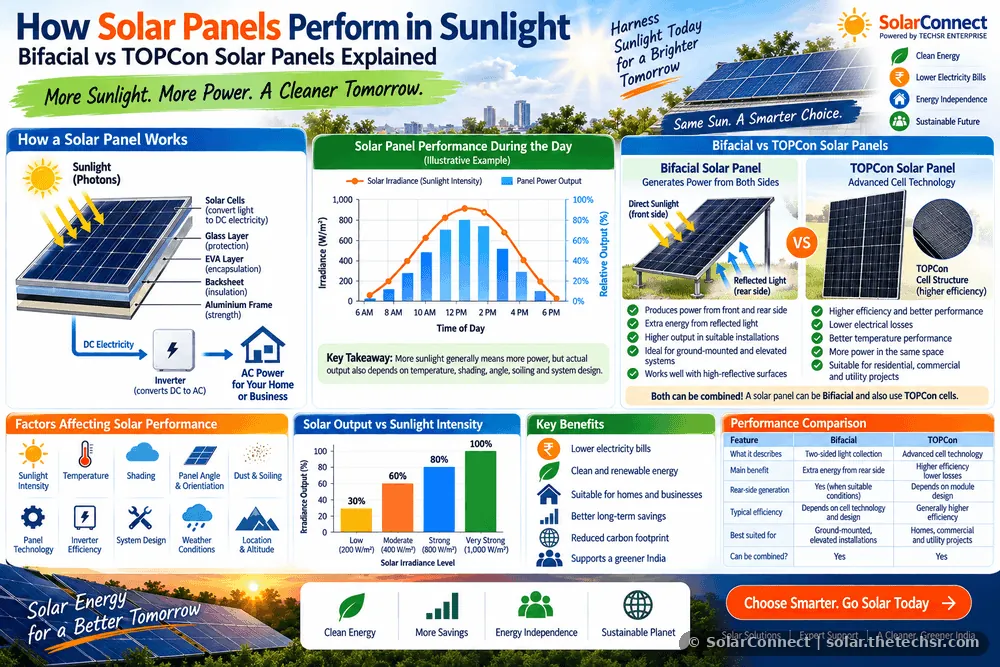
How Solar Panels Perform in Sunlight: Bifacial vs TOPCon Solar Panels Explained
Learn how solar panels generate electricity from sunlight and how factors such as irradiance, temperature, shading and installation angle affect performance. Compare Bifacial and TOPCon solar panels, understand their key benefits, suitable applications, and the factors to consider when selecting modern solar modules.
How Solar Panels Perform in Sunlight: Bifacial vs TOPCon Solar Panels Explained
Solar panels work by converting sunlight into electrical energy through photovoltaic cells. But not every solar panel performs in exactly the same way. Panel technology, sunlight intensity, temperature, shading, installation angle, roof conditions and system design can all affect the amount of electricity generated.
Two technologies that are frequently discussed in modern solar projects are Bifacial solar panels and TOPCon solar panels. They are not necessarily competing categories because a module can use TOPCon cells and also have a bifacial design.
This guide explains how solar panels perform in sunlight, what affects solar generation, how bifacial technology works, what TOPCon means, and how to compare the technologies for different applications.
How Does a Solar Panel Work in Sunlight?
Solar panels contain photovoltaic cells that absorb sunlight and convert part of that solar energy into DC electricity.
The basic process is:
- Sunlight reaches the solar module.
- Photovoltaic cells absorb solar radiation.
- The cells generate DC electrical power.
- Multiple panels are connected to create a solar array.
- An inverter converts the electricity into usable AC power for suitable applications.
The amount of electricity generated changes throughout the day because sunlight intensity and environmental conditions change continuously.
Does More Sunlight Always Mean More Power?
Generally, greater solar irradiance provides more available energy for the photovoltaic module, but actual output is also affected by module temperature, electrical characteristics, shading, orientation, soiling, inverter operation and other system conditions.
A solar panel normally produces less power during weak sunlight conditions and more power when stronger sunlight is available, up to the limits of the module and system.
Solar Performance During the Day
Solar generation normally changes from morning to evening.
In the morning, sunlight intensity gradually increases. Around the stronger sunlight period of the day, the system can produce substantially more power. In the evening, generation decreases as sunlight becomes weaker.
The exact generation curve depends on location, season, weather, panel orientation, tilt, shading and system design.
Illustrative Solar Performance Graph
The following simple graph is an illustrative example showing how solar output may change with increasing sunlight intensity. It is not a guaranteed generation curve for a particular panel or location.
Illustrative Relative Output
Low sunlight ████████░░░░ 30%
Moderate sunlight ██████████████░░ 60%
Strong sunlight ██████████████████ 80%
Very strong sunlight ████████████████████ 100%
This illustrates a general principle: available sunlight is an important driver of solar generation, but real-world output cannot be determined from sunlight alone.
What Factors Affect Solar Panel Performance?
- Solar irradiance: The amount of sunlight reaching the module.
- Temperature: Cell temperature affects electrical output.
- Shading: Shadows from trees, buildings or other objects can reduce production.
- Panel orientation: The direction of the module affects sunlight exposure.
- Tilt angle: Appropriate tilt can improve the solar resource available to the module.
- Dust and dirt: Surface contamination can reduce the sunlight reaching the cells.
- Module technology: Different cell technologies have different electrical characteristics.
- Inverter efficiency: Conversion losses affect usable AC output.
- System design: String configuration, cable losses and equipment selection also matter.
- Weather: Clouds, rain, haze and other conditions affect solar irradiance.
What Is a Bifacial Solar Panel?
A bifacial solar panel is designed to generate electricity from sunlight reaching both the front and rear sides of the module.
The front side receives direct sunlight, while the rear side can receive reflected and scattered light from the surrounding surface.
The additional energy produced from the rear side depends heavily on the installation environment.
How Does Bifacial Solar Technology Work?
A simplified bifacial system works like this:
- Direct sunlight reaches the front of the module.
- The photovoltaic cells convert available sunlight into electricity.
- Some sunlight reaches the ground or surrounding surface.
- Part of that light is reflected toward the rear side of the module.
- The rear side can convert suitable incoming light into additional electricity.
The amount of additional rear-side generation varies significantly according to installation conditions.
What Affects Bifacial Gain?
Bifacial performance is not simply determined by the panel itself. The complete installation environment is extremely important.
- Ground or roof reflectivity.
- Distance between the module and surface.
- Mounting height.
- Row spacing.
- Panel orientation and tilt.
- Rear-side shading.
- Surrounding structures.
- Weather and seasonal conditions.
A highly reflective surface and an appropriately designed elevated installation can provide more useful rear-side light than a tightly mounted system over a dark surface.
Benefits of Bifacial Solar Panels
- Can generate electricity from both sides of the module.
- Can make better use of reflected sunlight in suitable installations.
- Can be useful for ground-mounted solar projects.
- Can be suitable for elevated commercial or industrial structures.
- Can provide additional energy without increasing the module footprint.
- Can work particularly well when the project design provides good rear-side light exposure.
What Is TOPCon Solar Technology?
TOPCon stands for Tunnel Oxide Passivated Contact. It is a high-efficiency crystalline silicon cell technology designed to reduce certain electrical losses within the solar cell.
TOPCon modules are available in modern solar products for residential, commercial and utility-scale applications.
TOPCon is a cell technology, while bifacial describes a module's ability to receive useful light from both sides. Therefore, a solar module can use TOPCon cells and also be bifacial.
Benefits of TOPCon Solar Panels
- High-efficiency module options are available.
- Designed to reduce electrical losses through advanced cell architecture.
- Suitable for projects where power density is important.
- Available in modern high-power module formats.
- Can be combined with bifacial module designs.
- Can be used across residential, commercial and utility-scale applications.
Bifacial vs TOPCon: What Is the Difference?
| Feature | Bifacial | TOPCon |
|---|---|---|
| What it describes | Two-sided light collection capability | Solar cell technology |
| Main concept | Front and rear-side energy generation | Advanced crystalline silicon cell architecture |
| Rear-side generation | Yes, when suitable light reaches the rear | Depends on whether the module is designed as bifacial |
| Efficiency | Depends on the underlying cell technology and module design | Designed for high cell/module efficiency |
| Installation sensitivity | Highly dependent on rear-side conditions | Depends on module and system design |
| Can they be combined? | Yes | Yes, TOPCon modules can be bifacial |
Important: Bifacial and TOPCon Are Not Direct Alternatives
This is an important point when comparing solar panels.
Bifacial describes how a module can collect light from its front and rear surfaces. TOPCon describes the cell technology used inside the module.
Therefore, asking "Bifacial or TOPCon?" is similar to comparing two different characteristics.
A product can be a bifacial TOPCon solar panel, combining both technologies.
Illustrative Technology Comparison
The following visual is a conceptual comparison, not a measured laboratory or field performance result.
Front-side generation potential
Conventional module ████████████████
Modern high-efficiency module ███████████████████
Rear-side energy potential
Single-sided module ░░░░░░░░░░░░░░░░
Bifacial module ████████████████
Actual results depend on the exact module, irradiance, temperature, installation design and operating conditions.
Why Temperature Matters
Solar modules operate outdoors and their cell temperature can become significantly higher than the surrounding air temperature.
Electrical output can change as cell temperature changes. The manufacturer's temperature coefficient provides useful information for understanding this behavior.
For projects in hot climates, temperature performance can therefore be an important specification to compare.
Solar Panel Performance in Cloudy Weather
Solar panels can still generate electricity under cloudy conditions because diffuse sunlight reaches the module. However, output is generally lower when available solar irradiance is lower.
The actual output depends on cloud thickness, atmospheric conditions, panel orientation, technology and other factors.
Solar Panel Performance in Low Light
Solar modules can produce electricity under lower-light conditions, but lower irradiance generally results in lower power output.
When comparing products, look beyond marketing statements and review the manufacturer's electrical specifications and independent test information where available.
Why Shading Is Important
Even a small shaded area can affect the performance of a solar array depending on the module design and electrical configuration.
Potential sources of shading include:
- Trees
- Water tanks
- Nearby buildings
- Parapet walls
- Antennas
- Other solar panel rows
- Temporary objects
A proper site survey should identify shading throughout the relevant periods of the day and year.
Bifacial Panels and Rooftop Installations
Bifacial panels can be used on rooftops, but the potential rear-side contribution depends on how much useful light can reach the back of the module.
If the rear side is very close to an opaque surface, the additional bifacial benefit may be limited.
Elevated mounting arrangements can provide better rear-side exposure when the site design permits it.
Bifacial Panels for Ground-Mounted Projects
Ground-mounted solar projects can provide favorable conditions for bifacial modules because the rear side can receive reflected light from the ground.
The actual benefit depends on ground reflectivity, module height, row spacing, tracker or fixed-tilt design, shading and other project parameters.
TOPCon for Residential Solar
TOPCon modules can be attractive for residential projects where high power output from a limited roof area is important.
Homeowners should compare module efficiency, dimensions, warranty, temperature characteristics, inverter compatibility and total installed cost rather than selecting a module based only on the TOPCon name.
TOPCon for Commercial Solar
Commercial rooftops often have significant electricity consumption and limited usable roof area. High-efficiency modules can help make better use of the available installation space.
For commercial projects, the complete system should be evaluated, including module technology, inverter selection, mounting structure, electrical design, roof condition and project economics.
Benefits of Combining TOPCon and Bifacial Technology
A modern module can combine TOPCon cell technology with a bifacial design.
This combination can provide:
- High-efficiency cell technology.
- Potential rear-side energy generation.
- Good power density.
- Suitability for certain rooftop and ground-mounted applications.
- Flexible options for modern solar project design.
However, the actual energy advantage should be calculated using the specific module datasheet and project conditions.
What Should You Check Before Buying?
- Module efficiency.
- Rated power.
- Dimensions.
- Weight.
- Temperature coefficient.
- Warranty terms.
- Expected degradation characteristics.
- Bifaciality information if applicable.
- Electrical voltage and current.
- Applicable certifications.
- Inverter compatibility.
- Manufacturer support.
Which Is Better for Your Solar Project?
There is no single answer for every project because panel selection depends on the site and system design.
For limited rooftop space, efficiency and power density can be important. For ground-mounted projects with favorable rear-side conditions, bifacial modules can provide additional generation potential. For projects seeking modern high-efficiency crystalline silicon technology, TOPCon can be considered.
In many cases, the most relevant product may be a high-efficiency bifacial TOPCon module, but the final choice should be based on the manufacturer's specifications, installation conditions, price, warranty and expected project performance.
Solar Panel Selection Checklist
- Check the customer's electricity requirement.
- Measure the usable installation area.
- Analyze shading.
- Check roof or ground conditions.
- Compare module efficiency.
- Compare rated wattage and physical dimensions.
- Check whether bifacial generation can be effectively utilized.
- Review TOPCon or other cell technology specifications.
- Compare warranty terms.
- Check inverter compatibility.
- Calculate the complete project cost.
- Estimate expected energy production using site-specific conditions.
Conclusion
Solar panel performance depends on much more than the amount of sunlight visible in the sky. Solar irradiance, temperature, shading, orientation, tilt, soiling, panel technology and system design all influence actual energy production.
Bifacial technology allows a suitable module to capture useful light from both sides, while TOPCon is an advanced crystalline silicon cell technology designed for high efficiency and reduced electrical losses.
These technologies can also be combined. A bifacial TOPCon module can therefore provide both advanced cell technology and rear-side generation capability when the installation conditions are suitable.
The best approach is to compare the complete module datasheet and evaluate the actual project conditions rather than choosing a panel based only on a technology name.
Right technology + right installation + right system design = better solar performance.
Source: SolarConnect India – solar.thetechsr.com
Back to Solar Blog