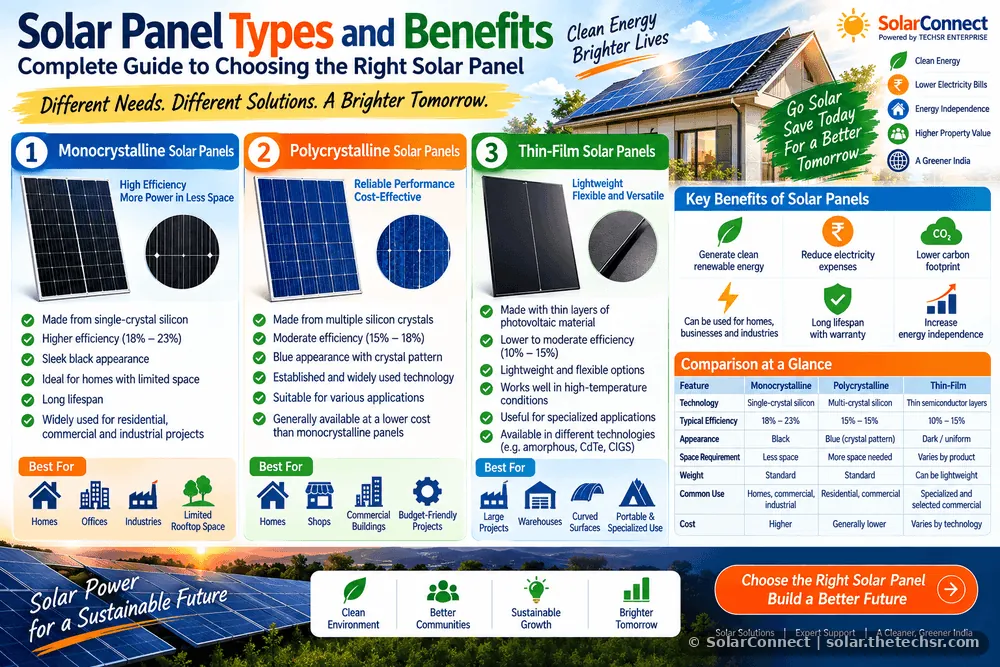
Solar Panel Types and Benefits: Complete Guide to Choosing the Right Solar Panel
Learn about the major types of solar panels, including monocrystalline, polycrystalline and thin-film panels. Understand their features, efficiency, space requirements, applications, advantages and important factors to consider before selecting a solar panel for your home or business.
Solar Panel Types and Benefits: Complete Guide to Choosing the Right Solar Panel
Solar panels are one of the most important components of a solar power system. They convert sunlight into electricity that can be used for homes, offices, factories, shops, agricultural applications and other projects.
There are different types of solar panels available in the market, and each technology has different characteristics. Choosing the right panel depends on factors such as available space, electricity requirements, budget, environmental conditions, product specifications and the type of solar project.
What Is a Solar Panel?
A solar panel is a collection of photovoltaic cells that converts sunlight into electrical energy. The electricity generated by the panel is normally DC electricity, which can then be used or converted into AC electricity through an appropriate inverter.
Solar panels can be connected together to create a solar array with the required capacity.
Main Types of Solar Panels
The most commonly discussed solar panel technologies include:
- Monocrystalline solar panels
- Polycrystalline solar panels
- Thin-film solar panels
Modern solar products also include newer cell technologies and module designs. Product availability and specifications can vary between manufacturers and markets.
1. Monocrystalline Solar Panels
Monocrystalline solar panels are manufactured using monocrystalline silicon cells. They are widely used in residential, commercial and industrial solar installations.
These panels are generally recognized by their uniform dark appearance and are available in many modern high-power module formats.
Benefits of Monocrystalline Solar Panels
- Generally high efficiency compared with many conventional panel technologies.
- Good power output for a given installation area.
- Suitable where rooftop space is limited.
- Widely available for residential and commercial applications.
- Available in many high-wattage module formats.
For customers with limited rooftop space, panel efficiency and power density can be important factors when comparing products.
2. Polycrystalline Solar Panels
Polycrystalline solar panels are also based on silicon photovoltaic cells, but the manufacturing process differs from monocrystalline technology.
Polycrystalline modules have historically been popular in many solar markets because of their cost and availability. However, product availability and market preferences have changed as newer and more efficient module technologies have become widely available.
Benefits of Polycrystalline Solar Panels
- Established solar technology.
- Historically available at competitive prices.
- Suitable for various solar applications.
- Can be used for residential, commercial and other installations depending on product specifications.
3. Thin-Film Solar Panels
Thin-film solar panels use thin layers of photovoltaic material deposited on a suitable substrate rather than conventional crystalline silicon wafer structures.
Different thin-film technologies are available, and their performance characteristics can differ significantly.
Benefits of Thin-Film Solar Panels
- Can be lightweight depending on the product design.
- Some designs can be flexible.
- Can be useful for specialized applications.
- Can perform differently from crystalline silicon modules under certain environmental conditions.
- May be suitable for applications where weight or module flexibility is important.
Monocrystalline vs Polycrystalline vs Thin-Film
| Feature | Monocrystalline | Polycrystalline | Thin-Film |
|---|---|---|---|
| Technology | Crystalline silicon | Crystalline silicon | Thin semiconductor layers |
| Typical Efficiency | Generally high | Generally lower than modern monocrystalline products | Varies by technology |
| Space Requirement | Good power output per area | May require more area for the same output | Varies by product |
| Common Applications | Homes, commercial and industrial projects | Various traditional solar applications | Specialized and selected commercial applications |
| Weight | Depends on module construction | Depends on module construction | Some products can be lightweight |
The table provides general characteristics. Actual performance should always be evaluated using the specific manufacturer's datasheet rather than technology name alone.
What Are the Benefits of Solar Panels?
Solar panels can provide several benefits when properly designed and installed.
- Generate renewable electricity from sunlight.
- Can reduce dependence on electricity purchased from the grid.
- Can help manage long-term electricity expenses.
- Can be used for residential and commercial energy applications.
- Can support cleaner electricity generation.
- Can be combined with battery storage in suitable systems.
- Can be installed on rooftops, ground-mounted structures and other suitable locations.
Solar Panel Efficiency
Solar panel efficiency describes how effectively a panel converts available sunlight into electrical power under specified test conditions.
A higher-efficiency panel can produce more power from a given amount of panel area, although efficiency is not the only factor that should determine a purchase decision.
When comparing panels, also consider rated power, physical dimensions, temperature coefficient, degradation characteristics, warranty and product quality.
Solar Panel Wattage
Solar panels are available in different power ratings. Modern modules can have substantially higher wattage than older-generation panels.
For example, if a project requires a particular total solar capacity, the number of panels depends on the wattage of the selected module.
Basic calculation:
Number of panels = Required Solar Capacity ÷ Panel Capacity
The final system design should also consider inverter capacity, string configuration, voltage limits and site conditions.
How to Choose Solar Panels for Your Home
Homeowners should consider several factors before purchasing solar panels.
- Available rooftop area.
- Monthly electricity consumption.
- Roof orientation and tilt.
- Shading from trees or buildings.
- Panel efficiency.
- Panel wattage.
- Manufacturer warranty.
- Performance warranty.
- Product certifications.
- Installer experience.
- Compatibility with the selected inverter.
How to Choose Solar Panels for a Business
Commercial solar projects require additional planning because electricity consumption can be significantly higher than residential consumption.
Businesses should review electricity bills, operating hours, load requirements, available installation area, roof condition, structural considerations and future electricity demand.
The panel selection should be evaluated together with the inverter, mounting system, protection equipment and overall project design.
Solar Panels for Limited Rooftop Space
If rooftop space is limited, higher power density can become important.
In such cases, compare the panel's rated power and physical dimensions. A panel with a higher wattage does not automatically mean it is physically more efficient, so compare the actual module efficiency and dimensions from the manufacturer's datasheet.
Solar Panels and Temperature
Solar panels operate outdoors and are exposed to changing temperatures. Panel output can vary with temperature.
The temperature coefficient shown on a panel datasheet provides information about how electrical performance changes as cell temperature increases.
For projects in hot climates, temperature performance can therefore be one factor worth considering when comparing modules.
Solar Panel Warranty
Warranty terms are important when purchasing solar panels for a long-term project.
Check both:
- Product warranty: Covers specified product-related defects according to the manufacturer's terms.
- Performance warranty: Specifies the manufacturer's stated performance conditions over a defined period.
Always read the actual warranty document because terms, exclusions and claim procedures differ between manufacturers.
Solar Panel Degradation
Solar modules can experience gradual performance degradation over time. Manufacturers normally specify expected performance under their warranty conditions.
When comparing products, review the manufacturer's degradation warranty and understand the conditions under which it applies.
Bifacial Solar Panels
Bifacial solar panels can generate electricity from light received on both sides of the module when the system design and installation conditions allow it.
The potential additional energy depends on factors such as ground or roof reflectivity, mounting height, spacing, shading, orientation and installation design.
Bifacial technology can therefore be particularly relevant for suitable ground-mounted and elevated installations.
Half-Cut Solar Cells
Many modern solar modules use half-cut cell technology. The cells are divided into smaller sections, which can improve electrical characteristics and help manage losses within the module design.
However, the complete module design and manufacturer's datasheet should be reviewed when comparing products.
Solar Panel Selection for Different Applications
Residential Rooftop
For homes, homeowners may prioritize efficiency, available roof space, appearance, warranty and overall system cost.
Commercial Rooftop
Businesses may focus on energy production, system size, roof utilization, equipment reliability, project economics and long-term service requirements.
Industrial Solar
Large industrial projects may require detailed engineering analysis, structural assessment, electrical design, monitoring and project-specific equipment selection.
Agricultural Solar
Solar systems can also support agricultural applications such as water pumping and other electricity requirements, subject to the appropriate system design.
Common Mistakes When Buying Solar Panels
- Choosing a panel only because it has a high wattage.
- Ignoring the physical size of the module.
- Not checking the manufacturer's warranty.
- Ignoring temperature performance.
- Not checking compatibility with the inverter.
- Comparing products only on price.
- Ignoring installation quality.
- Not checking applicable certifications and documentation.
- Making purchase decisions without considering rooftop conditions.
Solar Panel Buying Checklist
- Check manufacturer and model.
- Check rated power.
- Check module efficiency.
- Check dimensions and weight.
- Check operating voltage and current.
- Review temperature coefficient.
- Review product and performance warranties.
- Check applicable certifications.
- Confirm compatibility with the inverter.
- Compare total installed project cost.
Conclusion
Solar panel technology has developed significantly, giving customers more options for residential, commercial and industrial applications.
Monocrystalline, polycrystalline and thin-film panels have different characteristics, and modern module technologies provide additional choices for specific project requirements.
The right solar panel should not be selected only by looking at price or wattage. Consider efficiency, available space, product specifications, warranty, temperature performance, compatibility and installation conditions.
Choose the panel according to the project requirement, compare the manufacturer's datasheets carefully and use a properly designed solar system for the best long-term result.
Source: SolarConnect India – solar.thetechsr.com
Back to Solar Blog