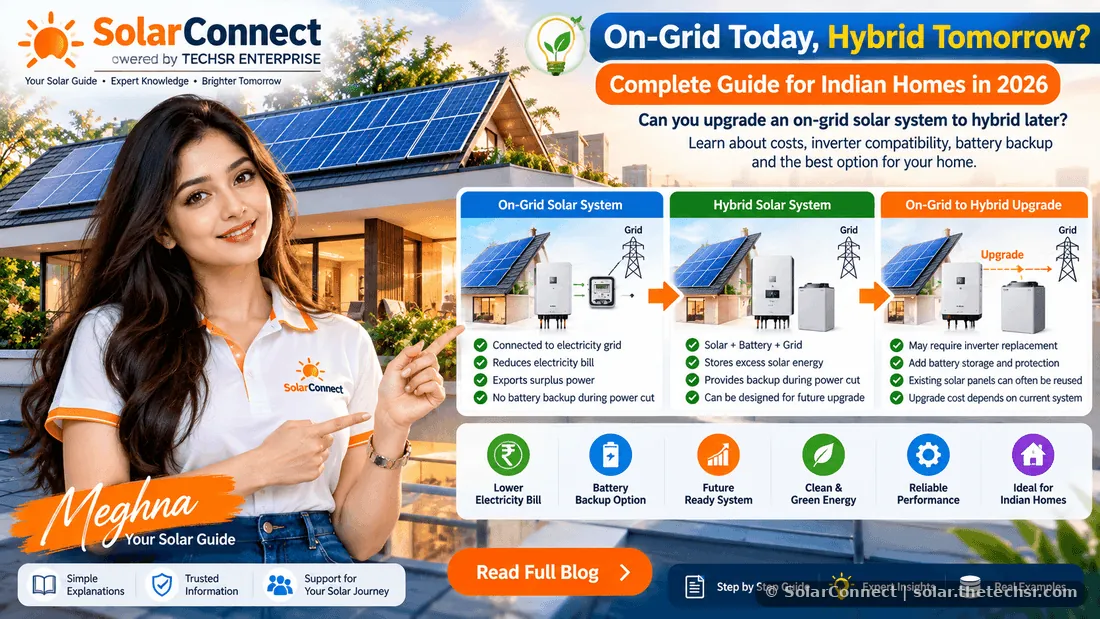
On-Grid to Hybrid Solar Upgrade: Can You Add Battery Later? Complete Guide for Indian Homes in 2026
Can an existing on-grid solar system be upgraded to hybrid solar later? Learn how inverter compatibility, battery storage, installation requirements, and upgrade costs differ from choosing a hybrid-ready solar system from the beginning.
Should You Start With On-Grid Solar or Go Hybrid-Ready? The Upgrade Question Every Homeowner Should Ask
Many homeowners in India begin their rooftop solar journey with a simple goal: reduce their electricity bill. For this requirement, an on-grid solar system can be an attractive option because solar generation can be used during the day while surplus electricity may be exported to the grid under applicable net-metering or state electricity regulations.
But there is another question that often comes later:
“If I install on-grid solar today, can I upgrade it to a hybrid solar system with battery backup in the future?”
The short answer is: in many cases, yes, but the upgrade depends heavily on the existing inverter, system architecture, electrical design, and applicable utility requirements.
That is why understanding the difference between an on-grid and hybrid solar system before installation can help a homeowner avoid unnecessary replacement costs later.
What Is an On-Grid Solar System?
An on-grid or grid-tied solar system is connected directly to the electricity grid. Solar panels generate DC electricity, the solar inverter converts it into AC electricity, and the generated power is used by the property's electrical loads.
When solar generation is higher than the property's immediate consumption, surplus electricity may be exported to the grid according to the applicable electricity regulations and net-metering arrangement.
One important limitation is that a conventional grid-tied inverter normally does not provide backup power during a grid outage. Government technical material describes grid-tied systems as systems without battery backup, where the inverter disconnects when the grid is shut down.
In simple terms: an on-grid system is primarily designed for solar generation, self-consumption and grid interaction, not backup during a power cut.
What Is a Hybrid Solar System?
A hybrid solar system combines solar generation with energy storage and grid interaction. A hybrid inverter can coordinate solar power, the electricity grid and a battery, depending on the system design and operating settings.
During the day, solar power can supply the home's loads. Excess solar energy can be directed toward battery charging where supported. When the grid fails, a properly designed backup circuit can continue supplying selected loads from stored energy.
Tata Power's current battery-storage offering, for example, describes energy storage that can capture surplus solar energy, draw from the grid when required and provide backup during outages.
Can an Existing On-Grid Solar System Be Upgraded to Hybrid?
Yes, an existing solar installation may be upgradeable, but it is not automatically a simple battery-addition job.
The first component to check is the existing inverter.
A conventional grid-tied inverter may not have a battery connection or the control logic required for battery charging, battery discharge and backup operation. In that situation, simply adding a battery will not convert the system into a complete hybrid solar system.
Depending on the existing architecture, an upgrade may involve:
- Replacing the existing on-grid inverter with a compatible hybrid inverter
- Adding a suitable battery energy storage system
- Modifying AC and DC electrical connections
- Adding appropriate protection and changeover equipment
- Creating a dedicated backup-load circuit where required
- Checking whether existing solar panels are compatible with the new inverter
- Reviewing the existing net-metering and DISCOM requirements
- Commissioning and testing the upgraded system
Some retrofit architectures can also use AC-coupled storage or other configurations, but the appropriate solution depends on the equipment and project design.
Why the Existing Inverter Matters
Imagine a homeowner installs a conventional 3 kW on-grid inverter today and decides three years later that battery backup is required.
If the original inverter is not compatible with the desired battery architecture, the homeowner may need to replace the inverter rather than simply adding a battery.
That means part of the original investment may no longer be used in the final system.
This is one of the most important points to explain before selling a solar system:
Solar panels may remain useful during an upgrade, but the inverter architecture can determine how economical the upgrade will be.
Is It Cheaper to Start With On-Grid and Upgrade Later?
Not necessarily.
An on-grid system generally has a lower initial equipment cost because it does not require battery storage and a battery-capable architecture. A hybrid system with storage requires additional equipment and therefore normally requires a higher initial investment.
However, if a customer installs a conventional on-grid inverter today and replaces that inverter later with a hybrid inverter, the customer may pay for two inverter stages over the life of the project.
The financial comparison should therefore consider the total lifecycle cost, not only today's installation price.
| Factor | Start With On-Grid | Start With Hybrid-Ready |
|---|---|---|
| Initial investment | Generally lower | Generally higher |
| Battery backup | Normally not available with a conventional grid-tied inverter | Can be incorporated according to system design |
| Future upgrade | May require inverter replacement or additional equipment | Usually easier if the system was designed for future storage |
| Power-cut backup | Normally unavailable | Available when battery and backup circuitry are properly configured |
| Best suited for | Bill reduction and grid-connected solar generation | Bill reduction plus energy storage and backup requirements |
What If the Customer Does Not Want a Battery Today?
This is where a battery-ready or hybrid-compatible approach can become relevant.
A homeowner may not want to purchase a battery immediately because of the additional cost. However, if the homeowner expects to require backup power in the future, it is worth discussing whether the initial inverter and system architecture can support a future storage upgrade.
This can potentially reduce the need for a complete system redesign later.
The exact compatibility must always be confirmed from the manufacturer's specifications and the installed system design. A salesperson should never promise a future upgrade simply because an inverter is described as “solar ready”.
What About Tata Power Solar?
Tata Power currently offers rooftop solar solutions as well as battery energy storage solutions. Its 2026 communications describe integrated rooftop solar and battery storage for residential, commercial and institutional applications, including LFP-based storage and automatic backup functionality.
Therefore, when considering a Tata Power system, the customer should ask the authorised provider a very specific question:
“If I install this on-grid system today, what exactly will I need to replace or add if I want battery backup in the future?”
The answer should be based on the exact inverter model, system configuration and applicable local requirements, rather than simply the brand name.
On-Grid vs Hybrid: Which Type Fits the Requirement?
There is no single configuration that fits every household.
If the main objective is reducing electricity consumption from the grid and the local electricity supply is reliable, an on-grid system may meet the customer's requirements.
If the customer regularly experiences power cuts, operates important appliances during outages, works from home, runs a small business, or specifically wants stored solar energy for backup, a hybrid system with appropriately sized battery storage may be more suitable for that requirement.
The important point is to match the system architecture with the customer's actual energy requirement.
Can the Same Solar Panels Be Reused?
In many upgrade scenarios, existing solar panels can potentially continue to be used, provided their electrical characteristics, total capacity, voltage range, current range and physical condition are compatible with the new system.
However, this should be checked before selecting the replacement inverter.
The solar array, inverter MPPT range, DC voltage, maximum current, battery voltage and backup-load requirements all need to be considered together.
What Happens During a Power Cut?
This is one of the biggest differences between conventional on-grid and hybrid systems.
A standard grid-tied inverter generally shuts down when the utility grid goes down because of anti-islanding and grid-safety requirements.
A properly configured hybrid system can isolate the backup circuit from the utility grid and supply selected loads from the battery and solar generation.
This means a hybrid system is not simply an on-grid system with a battery attached. It requires appropriate control, protection and backup architecture.
What Should a Customer Ask Before Buying Solar?
- What exact inverter model is being installed?
- Is the inverter battery compatible?
- Can the inverter operate as a hybrid system in the future?
- Can existing solar panels be reused during an upgrade?
- What battery technologies are compatible?
- Will the inverter need to be replaced later?
- Which household loads will receive backup power?
- What changes will be required in the electrical panel?
- Will the upgrade affect the existing net-metering arrangement?
- What approvals or documentation will be required from the local DISCOM?
Useful SolarConnect Resources
If you are researching rooftop solar, subsidies, solar system types, battery storage or installation planning, explore the SolarConnect Complete Solar Knowledge Hub for related guides and resources.
You can also read our guide on the PM Surya Ghar Solar Subsidy for 1 kW, 2 kW and 3 kW Rooftop Solar to understand the subsidy-related aspects of residential rooftop solar.
For customers comparing system configurations, it is also useful to understand the difference between on-grid, off-grid and hybrid solar systems before selecting an installation.
Final Takeaway
Choosing an on-grid solar system today does not necessarily mean that a future hybrid upgrade is impossible. However, the upgrade path depends on the inverter, solar array, battery compatibility, electrical architecture and applicable utility requirements.
The biggest mistake is to assume that every conventional on-grid inverter can simply accept a battery later.
If a homeowner already knows that battery backup will probably be required in the future, discussing a hybrid-compatible or battery-ready architecture at the initial installation stage can be worthwhile.
On the other hand, if the immediate requirement is simply rooftop solar generation and electricity-bill reduction, a conventional on-grid configuration may be sufficient, subject to the applicable local regulations and system design.
The right question is therefore not only “What is cheaper today?” but also “What will this system allow me to do tomorrow?”
Disclaimer: Solar system compatibility, net-metering requirements, subsidy eligibility, inverter specifications and upgrade procedures can vary by manufacturer, DISCOM, state and project configuration. Always verify the exact equipment model and applicable rules with the authorised installer and relevant electricity authority before making a purchase or modification.
Source: SolarConnect India – solar.thetechsr.com
Back to Solar Blog