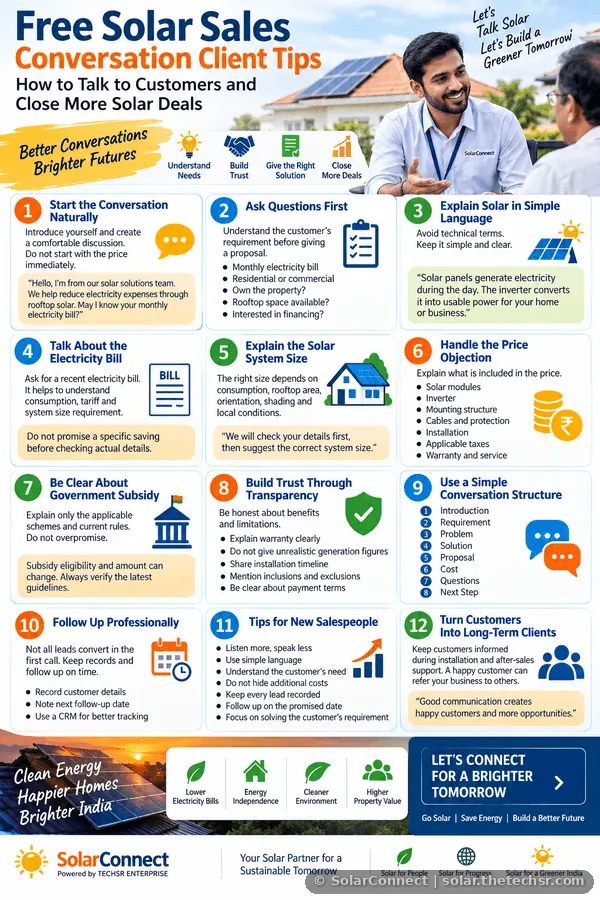
Free Solar Sales Conversation Client Tips: How to Talk to Customers and Close More Solar Deals
Learn practical and free solar sales conversation tips to understand customer needs, explain solar benefits clearly, handle common objections, build trust, and convert more B2C and B2B solar leads into clients.
Free Solar Sales Conversation Client Tips: How to Talk to Customers and Close More Solar Deals
Selling solar is not only about explaining panels, prices, and government subsidies. A successful solar sales conversation starts with understanding the customer's electricity needs, budget, concerns, and long-term goals.
This guide provides simple and practical free solar sales conversation tips that sales executives, dealers, channel partners, and solar businesses can use to communicate better with potential customers and improve their sales process.
1. Start the Conversation Naturally
Do not immediately start talking about product prices. First, introduce yourself and create a comfortable conversation.
Example:
"Hello, I am calling from our solar solutions team. We help homeowners and businesses reduce their electricity expenses through rooftop solar. May I know approximately how much you pay for electricity every month?"
This type of question opens the conversation and gives you useful information about the customer's current situation.
2. Ask Questions Before Giving a Proposal
A good solar salesperson listens before making a recommendation. Ask a few simple questions to understand the customer's requirement.
- What is your average monthly electricity bill?
- Is the property residential or commercial?
- Do you own the property?
- How much rooftop space is available?
- Do you know your approximate monthly electricity consumption?
- Are you interested in reducing your electricity bill or becoming more energy independent?
- Are you considering financing or purchasing the system directly?
The answers can help you prepare a more relevant solar proposal.
3. Explain Solar in Simple Language
A customer may not understand technical terms such as photovoltaic modules, inverter efficiency, DC capacity, or generation estimates.
Instead of using complicated technical language, explain the concept simply.
Example: "The solar panels generate electricity during the day. The inverter converts that electricity into usable power for your home or business. Depending on the system and applicable rules, excess electricity may also be handled through the grid as permitted by the local electricity regulations."
Simple explanations help customers understand the value of the system without feeling overwhelmed.
4. Talk About the Customer's Electricity Bill
The electricity bill is often one of the most important starting points for a solar discussion.
Ask the customer to share a recent electricity bill if they are comfortable doing so. The bill can provide useful information about consumption, sanctioned load, tariff details, and other factors required for preparing a proposal.
Do not promise a specific saving amount before checking the customer's actual consumption, tariff, system size, location, and applicable regulations.
5. Explain the Solar System Size
Customers often ask, "How many kilowatts of solar do I need?"
Explain that the recommended capacity depends on several factors, including electricity consumption, available rooftop area, roof orientation, shading, local solar conditions, and applicable technical requirements.
Example: "First we will check your electricity consumption and rooftop conditions. Then we can suggest an appropriate system size instead of simply recommending the same capacity to every customer."
6. Handle the Price Objection
One of the most common questions in solar sales is, "What is the price?"
Instead of only giving a number, explain what is included in the proposal.
- Solar modules
- Solar inverter
- Mounting structure
- Cables and protection equipment
- Installation
- Applicable taxes
- Documentation and applicable service components
- Warranty terms
The exact package should be clearly mentioned in the quotation so the customer knows what they are paying for.
7. Do Not Overpromise Government Subsidies
Government solar subsidy schemes can be an important part of the customer's decision. However, eligibility, subsidy amount, application process, installation requirements, and regulations can change.
Salespeople should explain only the subsidy information that is applicable to the customer's situation and should encourage customers to verify the latest official requirements.
Avoid statements such as "Everyone will definitely receive this subsidy" unless the customer's eligibility has actually been established.
8. Build Trust Through Transparency
Solar is a long-term investment. Customers may have questions about product quality, installation, warranty, maintenance, generation, financing, and after-sales service.
Be transparent about both benefits and limitations.
- Explain warranty conditions clearly.
- Do not guarantee a fixed electricity generation figure without proper calculation.
- Explain maintenance requirements.
- Clearly mention what is included and excluded from the quotation.
- Provide realistic installation timelines.
- Explain payment terms before collecting money.
9. Use a Simple Sales Conversation Structure
A simple sales conversation can follow this structure:
- Introduction: Introduce yourself and your company.
- Requirement: Ask about the customer's electricity consumption.
- Problem: Understand the customer's electricity-cost concern.
- Solution: Explain how rooftop solar may address the requirement.
- Proposal: Present an appropriate system configuration.
- Cost: Explain the complete price and inclusions.
- Questions: Address customer concerns.
- Next Step: Arrange a site survey, document collection, or quotation discussion.
10. Example Solar Sales Conversation
Sales Executive: Hello, may I know approximately how much your monthly electricity bill is?
Customer: Around ₹5,000 per month.
Sales Executive: Thank you. Is this for a residential property or a business?
Customer: Residential.
Sales Executive: Understood. If you can share a recent electricity bill and some basic information about your rooftop, we can estimate a suitable solar system size and prepare a quotation.
Customer: How much will it cost?
Sales Executive: The price depends on the required capacity, equipment selection, installation conditions, and applicable taxes or scheme benefits. Instead of giving you an inaccurate figure, we can calculate it based on your actual consumption and rooftop requirements.
This approach keeps the conversation focused on the customer's requirement instead of pushing a product immediately.
11. Follow Up Without Annoying the Customer
Many solar leads do not convert after the first conversation. A professional follow-up process can help maintain communication.
After the initial discussion, record:
- Customer name
- Phone number
- Monthly electricity bill
- Required system size
- Location
- Customer interest level
- Quotation status
- Next follow-up date
- Customer objections
A CRM system can make this process easier by keeping lead information, calls, follow-ups, quotations, and sales activities organized.
12. Free Solar Sales Tips for New Salespeople
- Listen more than you speak.
- Ask questions before recommending a system.
- Use simple language.
- Understand the electricity bill.
- Never hide additional costs.
- Do not make unrealistic savings promises.
- Explain warranty terms clearly.
- Keep every lead properly recorded.
- Follow up on the promised date.
- Focus on solving the customer's requirement.
13. Turn Solar Leads Into Long-Term Customers
A solar sale should not end when the customer pays for the system. Good communication before, during, and after installation can help build a stronger relationship.
Keep customers informed about the next steps, installation schedule, documentation, commissioning, and available support. A satisfied customer may also recommend your solar business to friends, relatives, or other business owners.
Conclusion
Effective solar selling does not require complicated sales techniques. It requires good listening, accurate information, clear communication, transparent pricing, and consistent follow-up.
Whether you are a solar dealer, sales executive, installer, channel partner, or solar entrepreneur, these free solar sales conversation tips can help you create more professional customer interactions and build a structured sales process.
The key principle is simple: understand the customer's requirement first, then present the right solar solution.
Source: SolarConnect India – solar.thetechsr.com
Back to Solar Blog