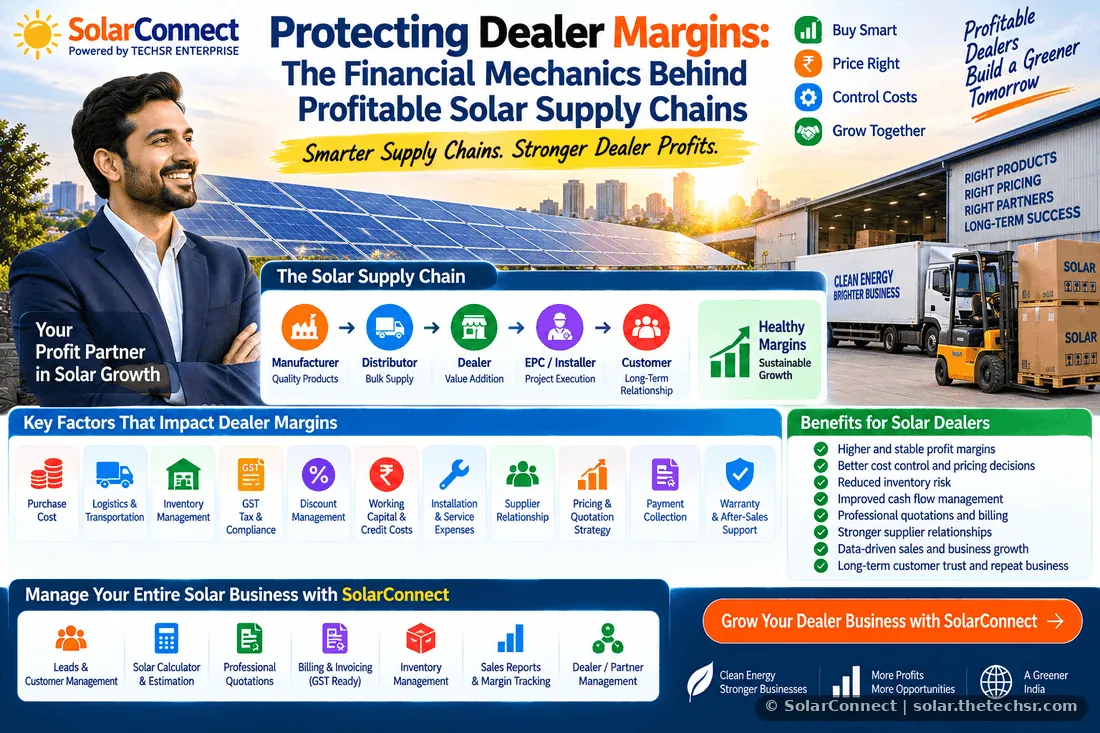
Protecting Dealer Margins: The Financial Mechanics Behind Profitable Solar Supply Chains
Learn how solar dealers can protect profit margins by managing purchase costs, logistics, GST, inventory, credit, pricing, quotations and supplier relationships across the solar supply chain.
Protecting Dealer Margins: The Financial Mechanics Behind Profitable Solar Supply Chains
In the solar industry, generating sales is only one part of building a profitable business. A dealer may sell a large number of solar panels and complete systems, but if purchasing costs, logistics, credit costs, discounts, inventory losses and operational expenses are not properly controlled, the final profit can be much lower than expected.
For solar dealers, distributors, EPC companies and channel partners, margin management is therefore a critical part of business management.
A profitable solar supply chain is not simply about purchasing products at the lowest possible price. It is about understanding the complete financial movement from supplier to warehouse, from warehouse to customer, and from quotation to final payment.
This article explains how solar businesses can understand their real margins, control hidden costs and create a more disciplined pricing and supply-chain process.
What Is a Solar Dealer Margin?
Dealer margin is the difference between the selling price and the relevant cost of acquiring and delivering a product or project.
A simple example is:
Dealer Margin = Selling Price − Product Cost
However, this calculation is incomplete for a real solar business.
The actual cost may also include:
- Product purchase cost
- Transportation
- Loading and unloading
- Warehouse expenses
- Packaging or handling
- Insurance where applicable
- Sales commission
- Financing or credit cost
- Installation expenses
- Marketing expenses
- Payment collection costs
- Warranty and service-related expenses
- Inventory losses
Therefore, a dealer should distinguish between gross margin and the actual contribution remaining after relevant operating costs.
Why Solar Dealers Lose Margin Without Realizing It
Solar products can have relatively high transaction values. A small percentage difference in purchase cost, discount or logistics can therefore have a significant effect on the final profitability of an order.
Common causes of margin leakage include:
- Buying at inconsistent prices
- Quoting without checking current purchase cost
- Giving excessive customer discounts
- Ignoring transportation costs
- Holding slow-moving inventory
- Offering long customer credit periods
- Failing to include installation costs
- Not tracking payment delays
- Using outdated product prices
- Not accounting for sales commissions
- Underestimating service expenses
These small issues can accumulate and reduce the profitability of an otherwise successful solar business.
The Complete Solar Supply Chain
A solar dealer's financial model becomes easier to understand when the entire supply chain is mapped.
Manufacturer → Distributor → Dealer → EPC / Installer → Customer
Depending on the business model, additional participants may include logistics providers, financing institutions, warehouses, consultants and channel partners.
Every stage can introduce a cost, discount or financial risk.
Step 1: Understand Your Landed Cost
One of the most important concepts for a solar dealer is landed cost.
Landed cost represents the effective cost of getting the product ready for sale at the dealer's required location.
A simplified calculation is:
Landed Cost = Purchase Cost + Logistics + Handling + Other Direct Acquisition Costs
For example, a dealer may purchase modules at one price, but the final cost at the warehouse may be higher after freight and handling.
Therefore, pricing decisions should be based on the effective landed cost rather than only the supplier's quoted product price.
Product Cost Is Not the Same as Project Cost
A solar project contains much more than solar modules.
A typical system may include:
- Solar modules
- Inverter
- Mounting structure
- DC cables
- AC cables
- DC protection equipment
- AC protection equipment
- Earthing components
- Connectors
- Monitoring equipment
- Installation labour
- Transportation
- Testing and commissioning
- Other balance-of-system components
If a dealer calculates margin only on the panel price, the actual project profitability may be misunderstood.
Build a Product-Level Cost Sheet
A professional solar business should maintain a structured cost sheet for important products and system packages.
| Cost Component | Example Information |
|---|---|
| Solar Module | Brand, model, wattage and purchase price |
| Inverter | Brand, model, capacity and purchase price |
| Structure | Material, quantity and installation cost |
| Electrical BOS | Cables, protection and accessories |
| Logistics | Supplier-to-site transportation |
| Installation | Labour and commissioning |
| Taxes | Applicable tax treatment |
| Sales Cost | Commission and acquisition expense |
| Finance Cost | Applicable working-capital cost |
The exact tax treatment should be determined according to the applicable GST rules, product classification and transaction structure.
Protecting Margin Starts Before the Quotation
One of the most common mistakes is preparing a quotation first and calculating profitability later.
The better approach is:
Purchase Cost → Landed Cost → Project Cost → Desired Margin → Selling Price → Customer Quotation
This allows the dealer to understand the commercial impact before sending the proposal to the customer.
Use a Minimum Margin Rule
Solar businesses can establish internal pricing rules that define the minimum acceptable contribution for different product categories or project types.
For example, management may create separate rules for:
- Module-only sales
- Inverter sales
- Complete solar kits
- Residential rooftop projects
- Commercial projects
- Industrial projects
- Dealer-to-dealer sales
- EPC projects
The exact margin target should be determined by the company's costs, market conditions, competition and business strategy.
Discount Management Is Critical
Discounts are often one of the biggest sources of margin leakage.
A salesperson may offer a small additional discount to close an order. However, if the discount is given without checking the minimum acceptable margin, the company may win the sale while losing profitability.
A controlled quotation system can require approval when a discount exceeds a predefined threshold.
This creates a simple process:
Standard Price → Authorized Discount → Margin Check → Approval → Final Quotation
Supplier Negotiation: Price Is Only One Factor
When negotiating with suppliers, dealers should evaluate the complete commercial package instead of focusing only on the headline product price.
Important factors include:
- Purchase price
- Payment terms
- Credit period
- Minimum order quantity
- Freight arrangements
- Delivery timeline
- Replacement policy
- Warranty process
- Product availability
- Order flexibility
- Documentation
A supplier offering a slightly higher unit price may sometimes produce a different overall financial result if the payment, logistics and service conditions are more suitable.
Working Capital Can Change Your Real Profit
Solar businesses frequently need working capital because products may need to be purchased before customer payment is received.
Consider a simplified sequence:
Supplier Payment → Inventory → Customer Installation → Customer Invoice → Customer Payment
The longer the money remains locked in this cycle, the greater the working-capital requirement can become.
Therefore, dealers should monitor:
- Supplier payment period
- Customer credit period
- Inventory holding period
- Payment collection time
- Outstanding receivables
- Working-capital financing cost
Inventory Management Protects Margin
Solar technology and product pricing can change over time. Holding excessive inventory can therefore create commercial risk.
Inventory management should track:
- Opening stock
- Purchases
- Sales
- Current stock
- Reserved stock
- Slow-moving stock
- Damaged stock
- Stock age
A dealer should avoid purchasing large quantities simply because a supplier offers a temporary discount unless the expected sales and cash-flow requirements justify the decision.
Price Volatility and Solar Procurement
Solar product pricing can change because of supply-demand conditions, raw-material costs, manufacturing capacity, logistics, currency movements, policy requirements and other market factors.
For this reason, quotations should include a reasonable validity period.
A quotation that remains open indefinitely can expose the dealer to changes in procurement cost.
Quotation Validity Protects Commercial Planning
A professional quotation should clearly state:
- Quotation date
- Quotation validity
- Product model
- System configuration
- Price basis
- Tax treatment
- Payment terms
- Delivery terms
- Installation scope
- Exclusions
This reduces ambiguity and helps the customer understand the commercial assumptions behind the proposal.
Protect Your Margin With a Solar Calculator
A solar calculator should not only estimate technical requirements. When integrated with a commercial system, it can also help connect system size with project pricing.
A practical workflow can be:
Electricity Requirement → System Size → Panel Quantity → Inverter Configuration → BOS → Installation → Project Cost → Selling Price
This makes it easier for the sales team to prepare a consistent proposal.
Quotation Software Can Reduce Pricing Errors
Manual quotation preparation creates several risks. Employees may use old prices, enter incorrect quantities or forget additional project costs.
A quotation module can standardize the process by maintaining:
- Product catalogue
- Current pricing
- System packages
- Tax configuration
- Discount controls
- Customer information
- Quotation numbering
- Terms and conditions
Prices should still be reviewed regularly because supplier pricing and commercial conditions can change.
Billing and Margin Verification
The final invoice should be connected to the accepted quotation wherever possible.
This creates a useful commercial chain:
Quotation → Order → Delivery → Installation → Invoice → Payment
Management can then compare the original estimated margin with the actual commercial result.
Track Estimated vs Actual Profit
A professional solar business should not stop margin analysis when the quotation is accepted.
After project completion, compare:
| Metric | Before Sale | After Completion |
|---|---|---|
| Product Cost | Estimated | Actual |
| Logistics | Estimated | Actual |
| Installation | Estimated | Actual |
| Discount | Planned | Actual |
| Customer Price | Quoted | Invoiced |
| Margin | Expected | Actual |
This information can help management identify where margin is being lost.
Dealer Margin Is Different From Cash Flow
A project can appear profitable on paper but still create cash-flow pressure.
For example, a dealer may have a healthy project margin but need to pay the supplier immediately while the customer pays after installation or after a defined credit period.
Therefore:
Profitability ≠ Cash Flow
Both should be monitored separately.
Use Customer Advances Carefully
Where commercially appropriate, customer advances can reduce working-capital pressure.
Payment milestones may be structured around activities such as:
- Order confirmation
- Material procurement
- Delivery
- Installation
- Commissioning
The actual payment structure should be clearly documented and mutually agreed with the customer.
B2B Dealer Pricing Requires Additional Discipline
When a solar company sells through another dealer or channel partner, the business needs to maintain enough margin for both organizations to operate sustainably.
A structured B2B price architecture may contain:
- Manufacturer or distributor cost
- Dealer purchase price
- Recommended selling price
- Project-specific pricing
- Volume-based commercial terms
- Approved discount limits
These prices should be managed according to the company's commercial strategy and should not be treated as permanent market prices.
Relationship Managers and Margin Protection
A relationship manager can play an important role in dealer management by maintaining communication around pricing, product availability, quotations, orders and payments.
A CRM can help relationship managers track:
- Dealer enquiries
- Quotation requests
- Orders
- Purchase history
- Outstanding payments
- Follow-ups
- Product requirements
- Future opportunities
This creates a structured B2B relationship rather than relying entirely on phone calls and messaging applications.
How a Custom Solar CRM Protects Margins
A customized CRM can connect the commercial information that sales teams normally maintain separately.
A complete workflow can look like:
Lead → Customer → Solar Calculator → Product Selection → Cost Sheet → Margin Check → Quotation → Approval → Order → Billing → Payment → Profit Report
This provides management with greater visibility into the financial journey of every project.
Important CRM Features for Solar Dealers
- Customer management
- B2B dealer management
- Product catalogue
- Supplier information
- Solar calculator
- Quotation generator
- Discount management
- Order management
- Billing and invoicing
- Payment tracking
- Inventory management
- Follow-up management
- Sales reporting
- Margin reporting
- CSV import and export where required
- Role-based user access
Daily Margin Management Checklist
- Check current supplier pricing.
- Review important product stock levels.
- Check pending purchase orders.
- Review quotations awaiting customer confirmation.
- Check quotations with low margins.
- Review excessive discounts.
- Track customer advances and outstanding payments.
- Check delayed collections.
- Review slow-moving inventory.
- Compare project cost against quotation assumptions.
Monthly Solar Business Margin Review
Management should conduct a monthly review instead of looking only at total sales revenue.
Useful indicators include:
- Total sales value
- Gross margin
- Average margin per project
- Product-wise margin
- Dealer-wise sales
- Customer-wise sales
- Discount percentage
- Inventory value
- Outstanding receivables
- Supplier payables
- Working-capital requirement
- Completed vs pending projects
These numbers provide a more meaningful picture of business performance than revenue alone.
Common Mistakes Solar Dealers Should Avoid
1. Competing Only on Price
Constantly reducing prices can create a race to the bottom. A professional dealer should communicate value through product quality, engineering, installation, documentation and service.
2. Ignoring Logistics
A low purchase price can become less attractive when transportation and handling costs are included.
3. Giving Uncontrolled Discounts
Every discount should be evaluated against the project's required contribution.
4. Holding Excess Inventory
Inventory ties up capital and may become commercially difficult if market prices or customer preferences change.
5. Offering Excessive Credit
Long payment periods can increase working-capital requirements and collection risk.
6. Using Old Quotations
Old product prices can result in inaccurate proposals when procurement costs have changed.
7. Not Tracking Actual Project Costs
Without actual-cost tracking, management cannot determine whether the expected margin was achieved.
Build a More Profitable Solar Supply Chain
Margin protection is not a single activity. It is a continuous process involving procurement, inventory, sales, pricing, finance and customer management.
The complete approach can be summarized as:
Buy Smart → Calculate Correctly → Quote Professionally → Control Discounts → Manage Inventory → Collect Payments → Measure Actual Margin
When these activities are connected, the dealer has greater control over the financial mechanics of the business.
How SolarConnect Supports Solar Business Operations
SolarConnect powered by TECHSR ENTERPRISE is designed around practical solar sales and dealership workflows.
For a growing solar business, connecting CRM, solar calculation, quotation, billing, dealer management and reporting can help create a more structured operating environment.
A connected workflow can support:
- Lead and customer management
- B2B dealer management
- Solar system calculations
- Product and pricing management
- Professional quotations
- Billing and invoicing
- Follow-up management
- Sales reporting
- Commercial data management
The objective is not simply to automate data entry. The objective is to give the solar business better visibility from the first customer enquiry to the final payment.
Final Solar Dealer Margin Checklist
- Know your actual landed cost.
- Separate product cost from complete project cost.
- Include logistics and installation expenses.
- Maintain current supplier pricing.
- Set internal discount limits.
- Define quotation validity.
- Track customer credit and payment periods.
- Monitor inventory age.
- Compare estimated and actual project costs.
- Review margins monthly.
- Use structured quotations and billing.
- Maintain supplier and dealer records.
- Use a CRM to connect the complete sales process.
Conclusion
A successful solar dealer does not measure business performance only by the number of panels sold or the total value of sales. Real profitability depends on how effectively the business controls the complete financial journey.
Purchase price, landed cost, logistics, inventory, discounts, working capital, customer payments and service costs all influence the final result.
By combining disciplined procurement with accurate costing, controlled pricing, professional quotations, systematic billing and proper CRM-based management, solar dealers can create a more transparent and sustainable business model.
SolarConnect powered by TECHSR ENTERPRISE brings together practical tools such as CRM, solar calculator, quotation and billing workflows to help solar businesses organize their daily operations and manage the complete customer journey.
Protect the margin. Control the process. Build a stronger solar business.
Note: Actual margins, GST treatment, supplier pricing, financing costs, logistics charges and commercial terms vary by product, location, project and business arrangement. Always verify current commercial and tax information before finalizing a quotation or purchase.
Source: SolarConnect India – solar.thetechsr.com
Back to Solar Blog