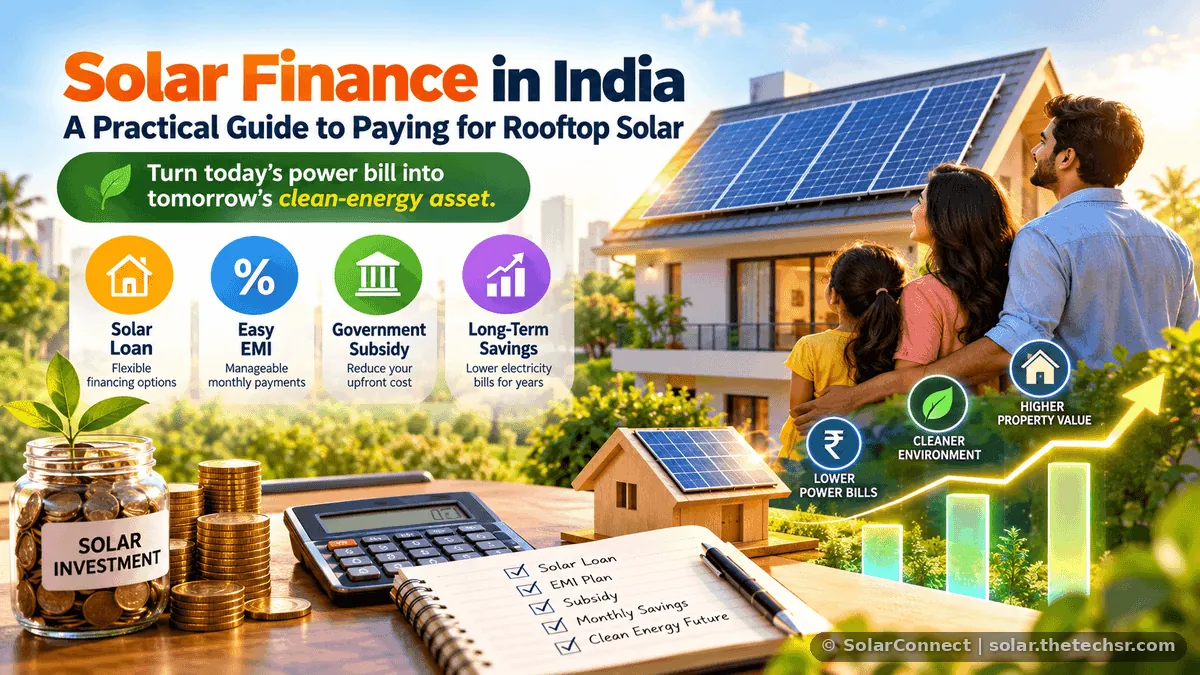
Solar Finance in India: A Practical Guide to Paying for Rooftop Solar
Thinking about solar panels for home but worried about the upfront cost? This SolarConnect guide explains solar finance, rooftop solar loans, EMI planning, subsidy impact, system cost and practical ways to evaluate a solar investment without putting unnecessary pressure on your monthly budget.
When Your Rooftop Becomes Part of Your Financial Plan
“Turn today’s power bill into tomorrow’s clean-energy asset.”
Solar is often discussed as a technology decision: choose the panels, select an inverter and install the system. But for many Indian households and businesses, the more practical question is financial: How should the solar system be paid for?
What Is Solar Finance?
Solar finance is a financing arrangement that helps a customer pay for a solar power system through structured payments rather than paying the entire project cost at once.
Depending on the lender and customer profile, financing may cover components such as solar panels, inverter, mounting structure, wiring, installation and other eligible project costs.
For homeowners, this can be particularly relevant when the upfront price of a rooftop solar system is higher than the amount they want to spend from their savings.
Why Solar EMI Is Becoming Part of the Solar Conversation
A traditional electricity bill is a recurring household or business expense. A solar system, on the other hand, is an asset that can generate electricity for many years.
Financing creates a bridge between these two ideas. Instead of treating the entire solar project as a single large payment, a customer can evaluate whether a structured monthly repayment fits the household or business cash flow.
Solar Panel Loan vs Paying the Full Amount
There is no single financing method that suits every customer. Someone with sufficient savings may prefer to purchase the system directly, while another customer may prefer to preserve cash and use a solar panel loan or other financing facility.
| Payment Approach | What the Customer Should Consider |
|---|---|
| Full Upfront Payment | No loan repayment, but a larger immediate cash outflow. |
| Solar Loan | Spreads the project cost over a defined repayment period, subject to lender approval and terms. |
| Solar EMI | Creates a predictable periodic payment, but interest and other applicable charges must be included in the calculation. |
| Business Solar Finance | Cash flow, tax treatment, project economics and repayment capacity become particularly important. |
How Subsidy Can Change the Financing Requirement
For eligible residential consumers, government financial assistance under the PM Surya Ghar framework can affect the amount that needs to be arranged by the customer.
The exact subsidy or Central Financial Assistance depends on the applicable scheme rules, system capacity, benchmark cost and other eligibility conditions. Customers should therefore verify the current official rules before calculating their final finance requirement.
The Ministry of New and Renewable Energy has published operational guidelines for residential rooftop solar and financing-related mechanisms under the PM Surya Ghar programme.
A Simple Solar Finance Calculation
Suppose a homeowner receives a quotation for a rooftop solar system. The customer should not simply divide the quotation by the number of months and call that the EMI.
A practical calculation should begin with:
- Total system and installation cost
- Eligible subsidy or financial assistance
- Customer's own contribution
- Amount financed
- Interest rate offered by the lender
- Processing or other applicable charges
- Loan tenure
- Estimated electricity savings
Use a Solar Calculator Before Choosing the Finance Amount
Before approaching a lender, customers can first estimate their solar requirement. Understanding the approximate system size, electricity consumption and project economics makes the financing discussion more meaningful.
Explore the SolarConnect Solar Calculator to begin with a solar requirement estimate.
You can also review the Solar Estimate Tool for a more structured project estimate.
Solar Panels for Home: What Should Be Included in the Budget?
A solar finance calculation should not look only at the panel price. A complete rooftop solar project can include several components and services.
- Solar PV modules
- Solar inverter
- Mounting structure
- DC and AC protection equipment
- Cables and electrical accessories
- Installation and commissioning
- Net-metering or applicable connection-related work
- Battery, where an applicable system requires storage
- Operations, maintenance and warranty considerations
For customers considering storage, SolarConnect also provides a dedicated Solar Battery information page .
Why the Inverter Matters in a Finance Decision
A rooftop solar system is not simply a collection of solar panels. The inverter is a critical part of the system because it converts the electricity generated by the PV modules into usable electrical power.
When comparing quotations, customers should therefore look at the complete system specification rather than selecting a financing option based only on the lowest monthly payment.
The SolarConnect Product section can be used to understand the wider range of solar solutions and products.
Questions to Ask Before Taking a Rooftop Solar Loan
- What is the total project cost?
- What amount will actually be financed?
- Is the interest calculated on a reducing balance or another basis?
- What is the total repayment amount?
- Are there processing or documentation charges?
- Is there any prepayment or foreclosure charge?
- What is the repayment tenure?
- What happens if subsidy processing takes longer than expected?
- What documents are required?
- What warranty and after-sales support are included in the quotation?
Solar Finance Is Really a Cash-Flow Decision
The most useful way to look at solar finance is not simply “Can I get a loan?” The better question is: “How does this solar investment fit into my monthly cash flow?”
A homeowner can compare the expected electricity savings with the proposed EMI. A business can go further and evaluate energy cost reduction, operating cash flow, project life and the financing structure.
This approach makes the solar purchase more transparent and helps prevent the customer from choosing a system or loan purely because the monthly payment appears attractive.
Explore More SolarConnect Resources
Continue your solar research through these SolarConnect resources:
Solar Calculator – Estimate your solar requirement.
Solar Estimate – Review your project estimate.
Solar QOT – Explore the quotation workflow.
Solar FAQ – Find answers to common solar questions.
SolarConnect Solar Blog – Read more solar information and updates.
Solar Services – Explore SolarConnect services.
Partner With SolarConnect – Explore partnership and dealership opportunities.
Contact SolarConnect – Connect with the SolarConnect team.
The Solar Finance Checklist
Before committing to a solar project, keep one simple checklist:
- Know your current electricity consumption.
- Estimate the appropriate solar capacity.
- Understand the complete project quotation.
- Check applicable subsidy or financial assistance.
- Compare loan amount and customer contribution.
- Calculate the actual EMI.
- Calculate total repayment, not only monthly EMI.
- Compare expected energy savings with repayment obligations.
- Verify equipment warranty and installation support.
- Read the complete financing agreement before accepting it.
Solar Should Fit Your Finance, Not Fight It
Rooftop solar can be evaluated as both an energy solution and a long-term financial decision. The right approach is to understand the system cost, available assistance, financing terms and expected savings together.
SolarConnect | Smarter Solar Decisions Start With Better Numbers.
Source: SolarConnect India – solar.thetechsr.com
Back to Solar Blog