Solar Energy Guide India 2026: Solar Panels, Rooftop Solar, Subsidy, Finance, Systems & Solar Business
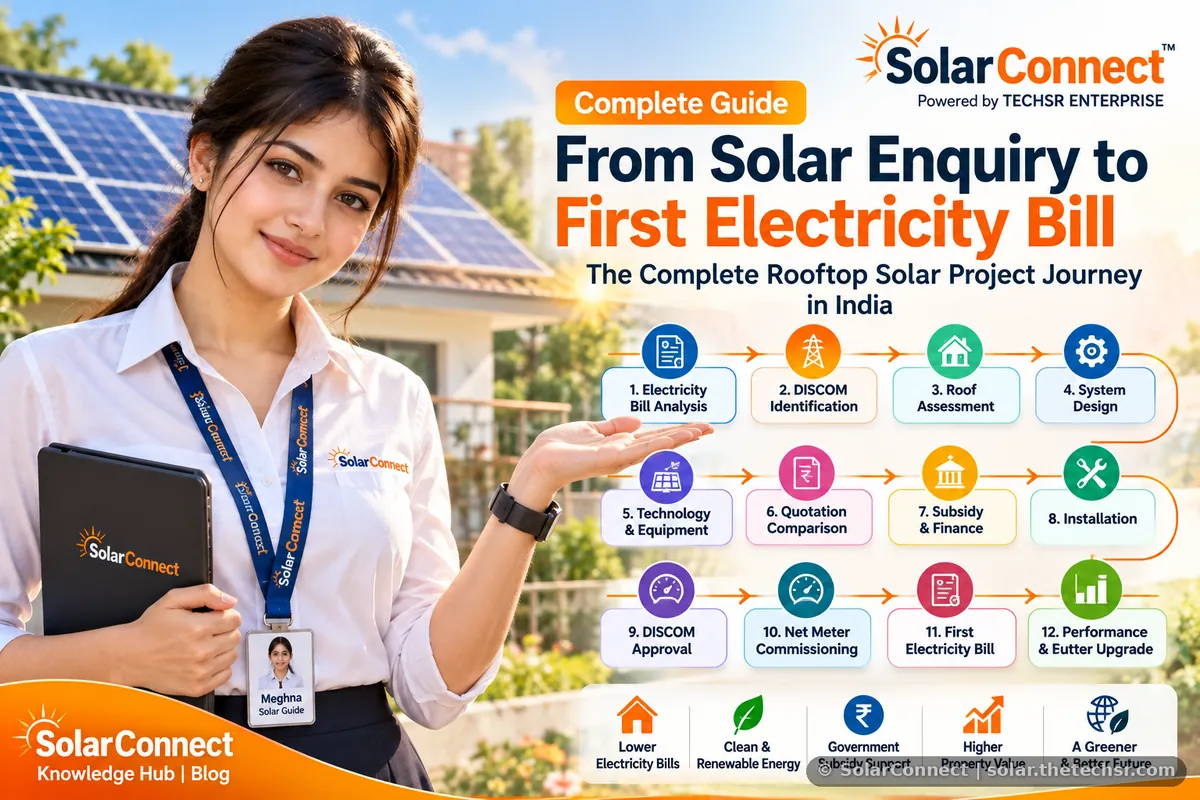
Many people understand solar panels, subsidy and electricity savings separately. The confusing part is what happens:
Solar Energy Guide India 2026: Solar Panels, Rooftop Solar, Subsidy, Finance, Systems & Solar Business
Solar energy in India is no longer limited to solar panels on a rooftop. Today, homeowners, businesses, dealers, installers and entrepreneurs need to understand the complete solar ecosystem, including solar panels, inverters, batteries, rooftop systems, government subsidy, financing, installation, maintenance, pricing and solar business opportunities.
This complete SolarConnect guide brings the major solar topics together in one place and connects them with detailed guides available across the SolarConnect Knowledge Hub.
Complete Solar Guide: Topics Covered
- Solar energy basics
- Rooftop solar for homes and businesses
- How to choose the right solar system
- On-grid, off-grid and hybrid systems
- Solar full kit and components
- Solar panel types
- Bifacial and TOPCon technology
- Solar panel pricing and market factors
- PM Surya Ghar subsidy and financing
- Solar installation and net metering
- Solar business and dealership
- B2C solar lead generation
- Solar CRM and business automation
- Solar industry and government updates
1. What Is Solar Energy?
Solar energy is electricity or usable energy generated from sunlight. In a photovoltaic solar system, solar panels convert sunlight into DC electricity, while an inverter converts that electricity into usable AC power for homes, offices and other applications.
If you are completely new to solar energy, start with our detailed educational guide:
Learn the Basics of Solar Energy with SolarConnect
Understanding the basics makes it easier to choose the correct system capacity, panel technology, inverter and installation configuration.
2. Rooftop Solar in India
Rooftop solar allows electricity consumers to generate power using the available roof area of a home, office, shop, factory or other building.
The correct system size depends on several factors, including electricity consumption, roof area, solar irradiation, shading, inverter configuration and the customer's energy requirements.
For a detailed introduction to rooftop solar, read:
Solar Energy in India: How Rooftop Solar Can Reduce Electricity Bills and Build a Sustainable Future
For a more installation-focused guide:
Rooftop Solar Installation in India: A Complete Guide
3. How to Choose the Right Solar System for Your Home
Before purchasing a solar system, homeowners should understand their monthly electricity consumption, available roof space, required capacity, inverter type, installation requirements, budget and applicable government rules.
Our dedicated guide explains the decision process:
How to Choose the Right Solar System for Your Home
4. On-Grid vs Off-Grid vs Hybrid Solar
One of the most important decisions is selecting the right system configuration.
- On-grid: Designed to operate with the electricity grid.
- Off-grid: Designed for locations where battery-backed independent operation is required.
- Hybrid: Combines solar generation with battery storage and grid interaction depending on system design.
Read the detailed comparison:
On-Grid vs Off-Grid vs Hybrid Solar System: Which One Is Right for You?
5. Understanding the Complete Solar Full Kit
A solar installation is not just solar panels. Depending on the system configuration, a complete solar kit may include panels, inverter, mounting structure, DC and AC cables, protection devices, earthing components, monitoring equipment and batteries where required.
Learn how the complete system works:
Solar Full Kit Information: On-Grid, Off-Grid and Hybrid Solar Systems Explained
6. Solar Panel Types
Solar panels are available in different technologies and configurations. Monocrystalline, polycrystalline and thin-film technologies have different characteristics, applications and space requirements.
For a complete comparison:
Solar Panel Types and Benefits: Complete Guide to Choosing the Right Solar Panel
7. Bifacial vs TOPCon Solar Panels
Modern solar markets increasingly include technologies such as bifacial and TOPCon modules. Their performance depends not only on the technology itself but also on irradiation, temperature, installation conditions, shading and system design.
Read the technology-focused guide:
How Solar Panels Perform in Sunlight: Bifacial vs TOPCon Solar Panels Explained
8. Why Solar Panel Prices Change
Solar prices can change because of module and cell costs, raw materials, manufacturing capacity, supply and demand, transportation, currency movements, regulations and procurement conditions.
For customers and solar businesses, comparing the complete system cost is more useful than looking at the panel price alone.
Read:
Why Solar Panel Prices Go Up and Down: Market Trends, Sun Performance and Buying Benefits
9. PM Surya Ghar and Rooftop Solar Subsidy
Government rooftop solar programmes can significantly affect the economics of residential solar projects. Eligibility, subsidy amounts, application procedures and other requirements can change, so customers should always verify the latest official information before applying.
SolarConnect has a detailed guide covering the subsidy and financing process:
Solar Subsidy and Loan Process in India: Complete PM Surya Ghar Application Guide
You can also read the dedicated finance guide:
Solar Finance in India: Government Subsidy, Rooftop Solar Loans and EMI Options Under PM Surya Ghar
10. Solar Finance, Loans and EMI
The initial cost of a rooftop solar installation can be a major consideration for homeowners and businesses. Depending on eligibility and lender policies, financing or EMI options may help spread the project cost over time.
For larger or commercial projects, financing structures can be different and should be evaluated based on project economics, cash flow and repayment conditions.
Explore:
Financing Options for Solar Projects in India
11. Solar Installation: What Customers Should Check
A successful solar installation requires more than purchasing equipment. Customers should review system design, roof suitability, installation quality, safety, protection devices, documentation, warranties and applicable DISCOM or net-metering requirements.
- Check monthly electricity consumption.
- Check usable roof area.
- Review the proposed system capacity.
- Understand panel and inverter specifications.
- Review installation and balance-of-system components.
- Check warranty documentation.
- Understand applicable subsidy rules.
- Confirm the required grid and net-metering process.
12. Solar Business in India
India's expanding solar ecosystem creates opportunities for dealers, distributors, installers, EPC companies, sales professionals and technology providers.
A solar business can involve equipment trading, installation, lead generation, dealership, channel partnerships, project development or customer support.
For entrepreneurs interested in solar trading:
For dealership opportunities:
13. Solar B2C Lead Generation
Lead generation is one of the most important parts of a growing solar business. Genuine B2C leads can come from search engines, social media, referrals, local communities, educational content, WhatsApp enquiries and other channels.
Start with these related guides:
How to Find High-Quality B2C Solar Leads in the Indian Market
How to Find Free B2C Solar Leads in the Indian Market: Practical Strategies That Work
Businesses looking beyond lead generation can also explore:
How to Grow a Startup Business in India with Free B2C Leads
14. Solar Sales and Customer Communication
Once a lead is generated, the next challenge is understanding the customer's electricity requirement and explaining the correct solar solution clearly.
Solar sales teams should focus on customer needs rather than simply selling a panel capacity.
Useful reading:
Free Solar Sales Conversation Client Tips: How to Talk to Customers and Close More Solar Deals
15. Solar CRM and Digital Business Management
As solar businesses grow, managing leads, customer calls, follow-ups, quotations, dealer information and sales activities manually can become difficult.
A dedicated solar CRM can help organise these processes and create a more structured sales workflow.
Explore the SolarConnect CRM guide:
SolarConnect CRM User Manual: Complete Guide to Managing Solar Leads, Calls, Follow-Ups and Sales
Businesses interested in digital operations can also read:
Streamlining Solar Business Operations: CRM, Billing, Quotation and Solar Calculator Tools
16. Solar Dealer Margins and Supply Chain
Solar dealers need to manage procurement cost, transportation, GST, inventory, credit terms, quotation pricing and supplier relationships carefully.
Read the detailed financial guide:
Protecting Dealer Margins: The Financial Mechanics Behind Profitable Solar Supply Chains
17. Solar Panel Brands and B2B Procurement
Brand selection is only one part of solar procurement. Businesses should also consider product specifications, warranty, documentation, availability, project requirements and after-sales support.
Related guide:
Partnering with Top-Tier Brands: Why Adani and Tata Solar Panels Drive B2B Trust
18. Solar Industry and Government Updates
Solar policies, manufacturing requirements, ALMM updates, rooftop solar programmes, storage projects and renewable-energy developments can influence both consumers and solar businesses.
SolarConnect publishes industry updates so readers can follow important developments in India's renewable-energy sector.
Read the latest industry overview:
India Solar Industry Update: Rooftop Growth, Manufacturing & Clean Energy Expansion
For a broader news roundup:
India Solar News: Rooftop Solar, ALMM, Manufacturing and Renewable Energy Updates
Also see:
Rooftop Solar Growth, PM Surya Ghar & New Industry Updates
19. How All These Solar Topics Connect
The solar journey is connected from beginning to end.
- Solar basics → understand how solar electricity works.
- Electricity consumption → estimate the required system capacity.
- System type → select on-grid, off-grid or hybrid.
- Solar panels → understand module technologies.
- Full kit → select inverter, structure, cables and protection equipment.
- Installation → plan the rooftop and electrical system.
- Subsidy → check applicable government rules.
- Finance → evaluate loans or EMI options where available.
- Quotation → compare the complete project cost.
- Maintenance → protect long-term system performance.
- Solar business → dealers and installers can build a customer pipeline.
- Lead generation → attract potential B2C and B2B customers.
- CRM → organise leads, calls, follow-ups and sales.
- Industry updates → keep track of changing solar policies and technology.
20. SolarConnect Knowledge Hub
The SolarConnect Knowledge Hub is designed to bring these topics together in one place. Instead of reading isolated articles, readers can move from basic solar education to system selection, installation, subsidy, finance and finally solar business topics.
Whether you are a homeowner planning rooftop solar, a business evaluating renewable energy, an installer, a dealer or a solar entrepreneur, these connected resources can help you understand the different parts of the solar ecosystem.
Frequently Asked Questions
Which solar system is suitable for a home?
The appropriate system depends on electricity usage, roof conditions, grid availability, backup requirements, budget and applicable regulations. On-grid, off-grid and hybrid systems have different use cases.
What should I check before buying solar panels?
Check module technology, specifications, warranty, installer credentials, system design, inverter compatibility, roof suitability and the complete installed project cost.
Does solar installation include only panels?
No. A complete solar installation can include panels, inverter, mounting structure, cables, protection equipment, earthing and other balance-of-system components. Battery storage is included when required by the system design.
Can solar customers use financing?
Financing and EMI options may be available depending on the project, customer eligibility and lender policies. Customers should compare the total financing cost and terms before committing.
How can a new solar business generate customers?
Businesses can use search visibility, educational content, referrals, social media, local outreach, WhatsApp enquiries and other lead-generation channels. Proper lead qualification and follow-up are equally important.
Why is a solar CRM useful?
A solar CRM can help organise customer information, leads, calls, follow-ups, quotations and sales activities, especially as the number of enquiries increases.
Conclusion
Solar energy is a complete ecosystem rather than a single product. From understanding solar panels and system types to choosing a rooftop solution, evaluating subsidy and finance, completing installation and managing a solar business, each stage is connected.
SolarConnect brings these subjects together through its Knowledge Hub so readers can move from one topic to the next without losing the bigger picture.
Start with the topic that matches your requirement, then explore the connected guides throughout the SolarConnect Knowledge Hub.
Source: SolarConnect India – solar.thetechsr.com
Back to Solar Blog