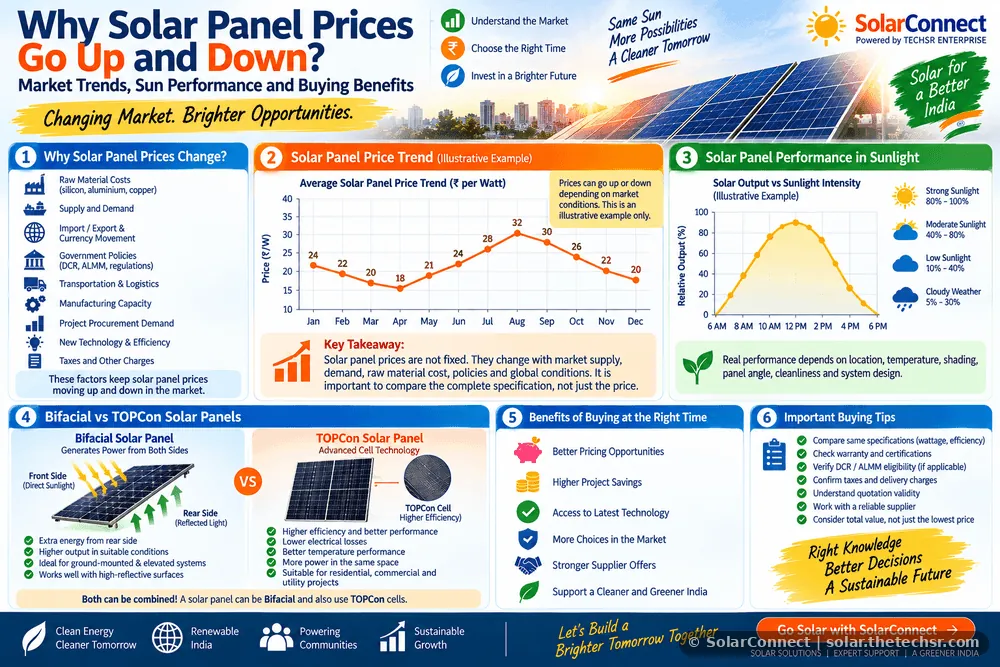
Why Solar Panel Prices Go Up and Down: Market Trends, Sun Performance and Buying Benefits
Solar panel prices are not always stable. They can move up or down because of cell and raw-material costs, supply and demand, currency movements, manufacturing capacity, regulations, transportation and procurement conditions. Learn how solar pricing changes, how sunlight affects panel performance, and how customers and solar businesses can make smarter purchasing decisions.
Why Solar Panel Prices Go Up and Down: Market Trends, Sun Performance and Buying Benefits
Solar panel prices do not remain fixed throughout the year. The price of a module can move up or down depending on market conditions, manufacturing costs, supply availability, technology, transportation, currency movements, government policies and customer demand.
For solar dealers, installers, EPC companies and customers, understanding these changes is important. A panel that has one price today may have a different quotation a few weeks or months later.
Recent reporting from India's solar market shows that module and cell pricing can be affected by domestic cell availability, DCR requirements, policy changes, input costs, currency movements and procurement demand. Market conditions can therefore differ between domestic, DCR-compliant and imported products.
Why Are Solar Panel Prices Not Stable?
Solar panel pricing is connected to the entire solar supply chain. A change in one part of the supply chain can influence the final module price.
- Solar cell prices
- Polysilicon and wafer costs
- Aluminium and copper prices
- Manufacturing capacity
- Supply and demand
- Exchange-rate movements
- Transportation and logistics costs
- Import and trade conditions
- Government policies and procurement rules
- Technology changes
- Availability of specific module models
- Large project procurement activity
Solar Cell Price and Module Price
The solar module is a finished product, but its cost is influenced by the components used to manufacture it. Solar cells are particularly important because they form the electricity-generating part of the module.
When cell prices increase, manufacturers can face higher production costs. Depending on market competition and supply conditions, some or all of that increase may eventually appear in module prices.
The opposite can also happen. If supply is abundant and manufacturers compete aggressively for orders, module prices can come under pressure even when production costs have not fallen by the same amount.
Supply and Demand Can Change the Price
Solar manufacturing capacity and project demand do not always grow at exactly the same speed.
If supply is greater than demand, manufacturers and distributors may compete more strongly for customers. This can put downward pressure on prices.
If demand suddenly increases while available supply is limited, prices can move upward.
Recent reporting has highlighted both sides of this situation. India has rapidly expanded solar manufacturing capacity, while some parts of the manufacturing sector have faced relatively low utilization. At the same time, specific domestic cell supply constraints have created pressure in other parts of the supply chain.
Government Policy Can Affect Solar Prices
Solar is a regulated and policy-sensitive industry. Procurement rules, domestic-content requirements, approved manufacturer lists and other policy changes can influence which products are available for particular projects.
For example, changes related to India's ALMM framework and DCR requirements have affected procurement decisions and the price difference between eligible domestic products and other module categories.
Therefore, a customer should not compare two solar panels only by their wattage and quoted price. The project eligibility requirements should also be checked.
Currency Movement Can Affect Solar Prices
Currency movements can influence the cost of imported solar components and equipment. A weaker domestic currency can increase the local cost of imported inputs, while changes in international commodity prices can also affect procurement costs.
Recent Indian solar-market reporting has identified higher commodity prices and rupee weakness as factors adding cost pressure across the solar value chain.
Why the Same Solar Panel Can Have Different Prices
Two quotations for apparently similar panels may not actually represent the same commercial product.
Before comparing prices, check:
- Manufacturer
- Exact model number
- Rated wattage
- Cell technology
- Module efficiency
- Warranty
- Product certification
- DCR or other applicable eligibility
- Delivery location
- Taxes
- Transportation
- Payment terms
- Availability and delivery schedule
Illustrative Solar Panel Price Movement
The following graph is an illustrative example only. It does not represent actual market prices or a specific manufacturer's price history.
| Market Period | Illustrative Price Index | Market Situation |
|---|---|---|
| Period 1 | ████████████ 60 | High supply |
| Period 2 | ██████████ 50 | Competitive pricing |
| Period 3 | ██████████████ 70 | Higher procurement demand |
| Period 4 | ████████████ 60 | Market adjustment |
| Period 5 | ████████████████ 80 | Supply pressure |
| Period 6 | █████████████ 65 | Price correction |
The purpose of this graph is to demonstrate that solar prices can move in both directions rather than following a straight line.
Solar Panel Price vs Solar Performance
A higher-priced solar panel does not automatically produce proportionally more electricity. Similarly, the cheapest panel is not automatically the most economical choice.
Solar performance depends on multiple factors:
- Solar irradiance
- Panel efficiency
- Temperature
- Shading
- Panel orientation
- Panel tilt
- Dust and soiling
- Cell technology
- Inverter performance
- System design
- Installation quality
How Solar Panels Work in the Sun
Solar cells absorb sunlight and convert it into DC electricity. When sunlight becomes stronger, the available energy for generation generally increases.
However, actual panel output is not determined by sunlight intensity alone. Temperature, shading, module characteristics, electrical configuration and other conditions also influence generation.
Illustrative Solar Performance Graph
This is a conceptual example showing the relationship between sunlight intensity and relative solar output. It is not a guaranteed performance curve for a particular module.
| Sunlight Condition | Relative Solar Output |
|---|---|
| Low sunlight | ██████ 30% |
| Moderate sunlight | ████████████ 60% |
| Strong sunlight | ████████████████ 80% |
| Very strong sunlight | ████████████████████ 100% |
In real installations, the relationship is more complex because module temperature, irradiance, inverter limits, shading and other operating conditions change throughout the day.
Does Hot Sun Always Mean More Solar Power?
Not necessarily.
Strong sunlight provides more solar energy, but photovoltaic cells also become hotter. Solar modules have a temperature coefficient that describes how their electrical performance changes as cell temperature increases.
This means a very hot day can have strong sunlight while the module experiences temperature-related output losses.
Morning, Afternoon and Evening Performance
Solar generation normally changes throughout the day.
- Morning: Solar generation starts low and increases as irradiance rises.
- Midday: Solar generation can be high when sunlight is strong, subject to temperature and system conditions.
- Afternoon: Generation can remain significant but changes with the sun's position and weather.
- Evening: Generation gradually falls as available sunlight decreases.
Why Shading Can Reduce Solar Generation
Even partial shading can affect the output of a solar array depending on the module design and electrical configuration.
Common sources of shading include trees, buildings, water tanks, parapet walls, antennas and neighboring structures.
A proper site survey should identify potential shading before the solar system is installed.
Benefits of Understanding Solar Price Movement
Understanding market movement can help both buyers and solar businesses make better purchasing decisions.
- Helps buyers compare quotations more carefully.
- Helps dealers plan inventory.
- Helps installers prepare realistic quotations.
- Helps businesses avoid unnecessary stock accumulation.
- Helps sales teams explain price changes to customers.
- Helps project developers plan procurement timing.
- Helps customers understand why quotations may have validity periods.
Why Solar Quotations Should Have a Validity Period
Because component prices and availability can change, solar suppliers often specify a quotation validity period.
A quotation may be valid for a limited number of days, after which the supplier may need to reconfirm the price and availability.
This is especially useful when the quotation depends on a specific module model, cell technology, inventory position or delivery schedule.
Do Not Buy Solar Panels Only Because the Price Is Low
Price is an important factor, but it should not be the only consideration.
A low-cost module can become expensive over the lifetime of a project if product quality, warranty support, installation quality or long-term performance is poor.
When comparing products, consider the total value of the system rather than only the purchase price.
What Should Solar Dealers Do When Prices Change?
Solar dealers and sales teams can reduce pricing confusion by maintaining regular communication with suppliers.
- Check current purchase prices before preparing important quotations.
- Confirm product availability.
- Record quotation dates.
- Clearly mention quotation validity.
- Separate product price from installation and other charges.
- Explain taxes clearly.
- Keep alternative products available where appropriate.
- Avoid promising an old price for a future order without supplier confirmation.
Solar Trading and Inventory Planning
Price fluctuations create an important challenge for solar traders.
If a trader purchases too much inventory before prices decline, the stock may become difficult to sell competitively. On the other hand, insufficient stock during a period of strong demand can result in missed orders.
A practical approach is to monitor customer demand, supplier pricing, delivery times, working capital and expected project requirements before making large purchases.
Benefits of Buying Based on Total Value
A solar panel should be evaluated using more than its purchase price.
- Power output
- Module efficiency
- Product warranty
- Performance warranty
- Temperature characteristics
- Degradation specifications
- Product availability
- Installer quality
- After-sales support
- Expected energy production
- Total installed cost
Solar Market Pricing Can Move in Both Directions
Solar prices do not always increase. They can also decline when manufacturing capacity is high, inventory needs to move, competition increases or demand becomes weaker.
Recent international market reporting has also described periods where module oversupply placed downward pressure on prices, while India's market has simultaneously experienced different pressures related to domestic cell availability, policy-driven procurement and input costs.
This is why there is no single permanent "solar panel price."
How Customers Can Compare Two Solar Quotations
Instead of asking only, "Which panel is cheaper?", compare both quotations using the same specifications.
- Same or comparable wattage
- Same or comparable technology
- Same eligibility requirements
- Comparable warranty
- Comparable inverter
- Comparable mounting structure
- Comparable installation scope
- Same tax treatment
- Same delivery conditions
Only after normalizing these factors can the price comparison become meaningful.
Conclusion
Solar panel prices are influenced by a constantly changing market. Cell prices, raw materials, supply and demand, manufacturing capacity, currency movements, government policies, logistics and procurement conditions can all affect the final quotation.
At the same time, the value of a solar panel is not determined by price alone. Actual solar performance depends on sunlight, temperature, shading, orientation, module technology, inverter performance and installation quality.
For customers, dealers and solar businesses, the best approach is to compare the complete system rather than focusing only on today's panel price.
Track the market, verify the current quotation, check the complete specifications and evaluate long-term solar performance before making a purchase decision.
In a changing solar market, informed purchasing can be more valuable than simply choosing the lowest price available on a particular day.
Source: SolarConnect India – solar.thetechsr.com
Back to Solar Blog