India's Solar Export Boom 2026
India's ALMM-driven solar manufacturing boom is now feeding export markets. Here is what that means for dealers and EPCs sourcing solar panels in 2026.
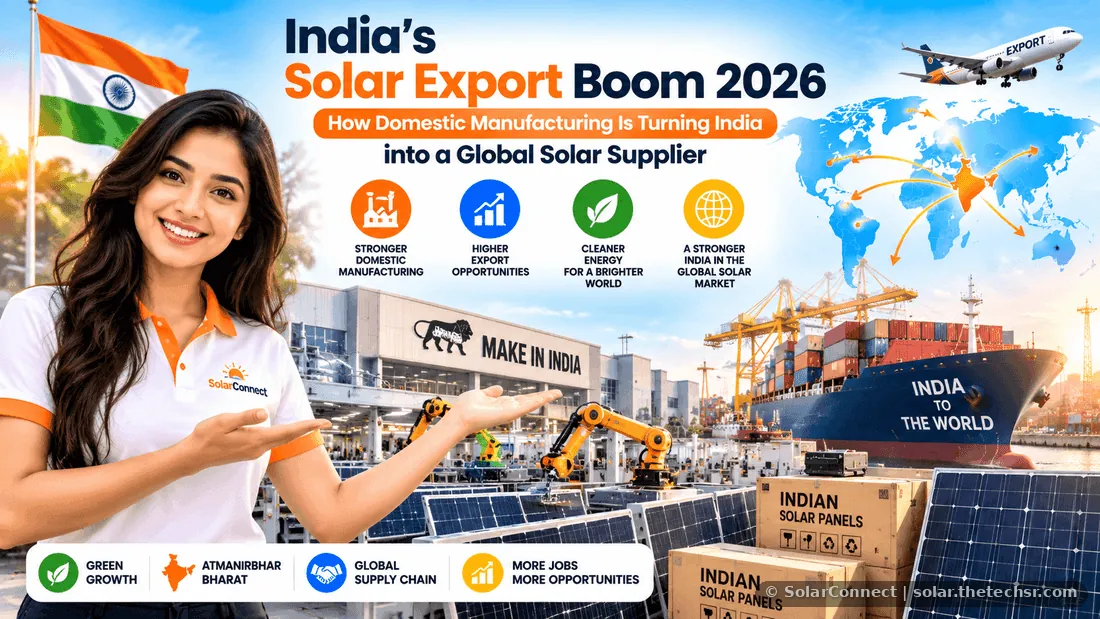
India's Solar Export Boom 2026: How Domestic Manufacturing Is Turning India into a Global Solar Supplier
India's solar industry is entering a new phase. Manufacturing capacity is expanding rapidly, domestic supply chains are becoming more important, and Indian solar manufacturers are increasingly participating in international markets. For dealers and EPC companies, this shift can change how solar panels are sourced, compared and procured.
For years, India's solar market was heavily dependent on imported equipment, particularly solar cells and modules. That picture is changing as domestic manufacturing capacity expands.
The Approved List of Models and Manufacturers (ALMM), domestic manufacturing policies and investment in new manufacturing facilities have helped create a much larger Indian solar manufacturing base. However, ALMM itself is primarily a project-eligibility framework for specified projects in India, not an export mandate.
For dealers, EPCs and solar distributors, the important question is therefore not simply whether India is manufacturing more panels. The bigger question is how this expanding manufacturing ecosystem affects availability, product selection, procurement planning, quality checks and sourcing decisions.
India's Solar Manufacturing Market in 2026
The scale of India's manufacturing expansion is significant. According to Mercom India's 1H 2026 manufacturing research, India added 50.6 GW of solar module manufacturing capacity and 9.7 GW of solar cell manufacturing capacity during the first half of 2026.
By June 2026, cumulative solar module manufacturing capacity reached approximately 261.7 GW, while solar cell manufacturing capacity reached approximately 36.6 GW.
This expansion means Indian buyers are operating in a market with a much larger domestic manufacturing base than only a few years ago.
What Is ALMM and Why Does It Matter?
The Approved List of Models and Manufacturers, or ALMM, is maintained by the Ministry of New and Renewable Energy (MNRE).
MNRE states that only models and manufacturers included in ALMM List-I for solar PV modules are eligible for use in Government Projects, Government-assisted Projects, projects under Government Schemes and Programmes, and specified Open Access and Net-Metering projects installed in India.
For dealers and EPCs working on projects where ALMM eligibility applies, checking the latest manufacturer and model listing can therefore become an important part of procurement.
MNRE regularly updates the ALMM lists, so procurement teams should verify the current list rather than relying on an old PDF, quotation or supplier statement.
Is India Really Becoming a Solar Export Hub?
India's growing manufacturing capacity is also creating greater potential for international solar supply. In 2025, domestic manufacturers exported approximately 5 GW of solar modules and about 192 MW of solar cells, according to Mercom India.
The United States accounted for the majority of India's module exports in 2025. During the first half of 2026, the U.S. remained India's largest solar export destination, accounting for approximately 92% of total exports reported by Mercom.
At the same time, export volumes can move sharply from quarter to quarter because of international trade conditions, pricing, tariffs, project schedules and supply-chain requirements. Therefore, India's export story should be viewed as a developing market trend rather than assuming that every Indian manufacturer has a stable export pipeline.
Why Is Solar Manufacturing Expanding in India?
Growing Domestic Demand
India's expanding rooftop, utility-scale, commercial and open-access solar market is creating demand for modules and cells.
Domestic Supply Chain
Manufacturing investments are increasing India's ability to produce solar modules and cells within the country.
Large Manufacturing Investments
New manufacturing facilities and capacity expansions are changing the scale of India's solar production ecosystem.
International Opportunity
Indian manufacturers are increasingly looking at international markets in addition to India's growing domestic demand.
What Does This Mean for Solar Dealers?
For a solar dealer, the expansion of domestic manufacturing can create more choices. But more choices also mean more responsibility when comparing suppliers.
A dealer should not select a module simply because it is described as "Made in India" or "ALMM approved". Product specifications, warranty, availability, commercial terms and project eligibility all need to be checked.
What Does This Mean for Solar EPC Companies?
For EPC companies, module sourcing is part of a larger project workflow. The cheapest module is not automatically the most suitable option.
An EPC should consider the complete project requirement before finalising procurement.
| Procurement Factor | Why It Matters to an EPC |
|---|---|
| Manufacturer | Helps establish product source, documentation and support expectations. |
| ALMM Status | Important where the project falls under an applicable ALMM requirement. |
| Technology | Module technology affects specifications, system design and project economics. |
| Availability | Delayed module delivery can affect project schedules and commissioning. |
| Warranty | Long-term warranty support is relevant to project risk management. |
| Pricing | Procurement price directly affects project costing and commercial planning. |
| Documentation | Correct product and project documentation can be important for compliance and handover. |
How Dealers and EPCs Should Source Indian Solar Panels in 2026
The growing number of manufacturers means that procurement teams need a structured sourcing process.
1. Start With the Project Requirement
First identify whether the project is residential, commercial, industrial, open-access, government-linked or another category. The applicable sourcing and eligibility requirements may differ.
2. Check the Latest ALMM List Where Applicable
If the project falls under an applicable ALMM requirement, verify the current MNRE list for the manufacturer and relevant model before placing the purchase order.
3. Compare Technical Specifications
Compare module technology, rated power, efficiency, dimensions, electrical characteristics and applicable certifications rather than comparing only the wattage.
4. Check Actual Availability
A quotation is useful only if the required product can actually be delivered within the project timeline. Confirm stock, production schedule, dispatch location and expected delivery.
5. Calculate Landed Cost
The purchase price is only one part of procurement cost. Transportation, insurance where applicable, handling, taxes, financing cost and project logistics should be considered before comparing suppliers.
6. Keep Documentation Organised
Maintain purchase invoices, module specifications, warranties, test certificates and other project documentation required for the particular installation.
TOPCon, Mono PERC and Other Technologies
India's manufacturing expansion is not limited to one solar technology. Mercom's 1H 2026 data showed that TOPCon represented the largest share of ALMM-listed module manufacturing capacity at the time of the report.
For buyers, however, technology selection should be connected to the project requirement rather than following a technology name simply because it is popular.
Efficiency, available roof area, temperature conditions, system design, inverter compatibility, price and warranty should all be considered together.
Will More Indian Manufacturing Automatically Make Solar Panels Cheaper?
Not necessarily.
A larger domestic manufacturing base can increase supply availability and create more supplier choices, but solar module pricing is influenced by several factors.
Raw Materials
Cell, wafer, glass, aluminium and other component costs can affect module pricing.
Technology
Different module technologies and specifications can have different production costs.
Global Markets
International prices and trade conditions can influence domestic procurement economics.
Demand & Supply
Domestic project demand, manufacturing utilisation and inventory levels can affect market prices.
Therefore, dealers should avoid promising customers that domestic manufacturing will automatically result in a fixed or continuously falling panel price.
What This Could Mean for India's Solar Business Ecosystem
A stronger manufacturing ecosystem can create opportunities beyond module manufacturing itself.
Dealers, EPCs, distributors, installers, logistics companies, electrical contractors and solar service businesses can all participate in different parts of the growing solar value chain.
For a new solar entrepreneur, understanding this complete ecosystem can be more useful than focusing only on solar panel trading.
Related SolarConnect Guides
Continue Learning About Solar
Partnering With Top-Tier Brands: Why Adani and Tata Solar Panels Drive B2B Trust Protecting Dealer Margins: The Financial Mechanics Behind Profitable Solar Supply Chains Solar Trading Business in India: A Practical Guide to Buying, Selling and Growing Your Solar Business How to Build a Profitable Solar Installation Business in India: Complete Project Workflow Solar Panel Types and Benefits: Complete Guide to Choosing the Right Solar Panel Explore More SolarConnect Solar ArticlesSolarConnect Tools for Dealers and EPCs
Planning a solar project involves more than selecting a module. System sizing, estimates and quotations also need to be organised properly.
☀️ Solar Calculator
Estimate your solar requirement based on your project needs.
Open Solar Calculator →📊 Solar Estimate
Organise a solar project estimate before moving towards quotation.
Open Solar Estimate →Frequently Asked Questions
What is ALMM in solar?
ALMM stands for Approved List of Models and Manufacturers. MNRE maintains the list of eligible solar PV models and manufacturers for projects covered by the applicable ALMM framework.
Does ALMM apply to every solar project?
No. Its applicability depends on the project category and the applicable rules. Dealers and EPCs should check the current MNRE requirements for the specific project.
Is India exporting solar panels in 2026?
Yes. Indian manufacturers exported solar modules and cells, with the U.S. remaining a major destination. Export volumes can vary significantly by period because of international market and trade conditions.
What should an EPC check before buying Indian solar panels?
An EPC should consider project eligibility, ALMM requirements where applicable, manufacturer, model, technical specifications, availability, warranty, documentation, delivery timeline and total landed cost.
Does Made in India automatically mean better solar panels?
Country of manufacture alone does not determine whether a module is suitable for a project. Buyers should evaluate technical specifications, quality documentation, warranty, supplier support, project requirements and total cost.
Can dealers benefit from India's growing solar manufacturing capacity?
A larger domestic manufacturing ecosystem can provide dealers with more potential sourcing options. The commercial benefit depends on supplier terms, demand, project requirements, inventory management and customer acquisition.
Planning Your Next Solar Project?
Whether you are a solar dealer, EPC company, installer or business owner, the sourcing decision should start with the project requirement and then move towards product, supplier, compliance and commercial comparison.
Use SolarConnect's tools and educational resources to organise your solar project more effectively.
Solar Calculator Solar Estimate Partner With SolarConnectFinal Takeaway
India's solar manufacturing ecosystem has expanded dramatically, and the country's manufacturers are increasingly participating in international markets. The combination of domestic demand, manufacturing investment and policy-driven localisation is changing the structure of India's solar supply chain.
For solar dealers and EPC companies, the opportunity is not simply to buy more Indian-made panels. The real requirement is to build a better procurement process: identify the project category, check applicable ALMM requirements, compare manufacturers and technologies, verify availability, review warranties and calculate the complete landed cost.
India's solar export story is still developing, and international demand can change quickly. For businesses operating in this market, staying updated on manufacturing capacity, ALMM lists, product technology and procurement conditions will be increasingly important.
Source: SolarConnect India – solar.thetechsr.com
Back to Solar Blog