India’s 35.95% Renewable Energy Shift in 2026-27: What Commercial & Industrial Businesses Should Prepare For
India's Renewable Consumption Obligation reaches 35.95% in FY 2026-27 and 38.81% in FY 2027-28 for applicable designated consumers. Learn how commercial and industrial businesses can plan rooftop solar, captive solar, open access, renewable energy certificates and other compliance options.
35.95% Renewable Energy Obligation in 2026-27: What Commercial & Industrial Businesses in India Need to Know
India's renewable energy compliance framework is entering an important phase. For applicable designated consumers, the Renewable Consumption Obligation (RCO) reaches 35.95% in FY 2026-27 and rises to 38.81% in FY 2027-28.
35.95% Renewable Energy Target: What Does It Actually Mean?
The Government of India's Renewable Consumption Obligation framework requires applicable designated consumers to consume a specified share of electricity from eligible non-fossil or renewable energy sources.
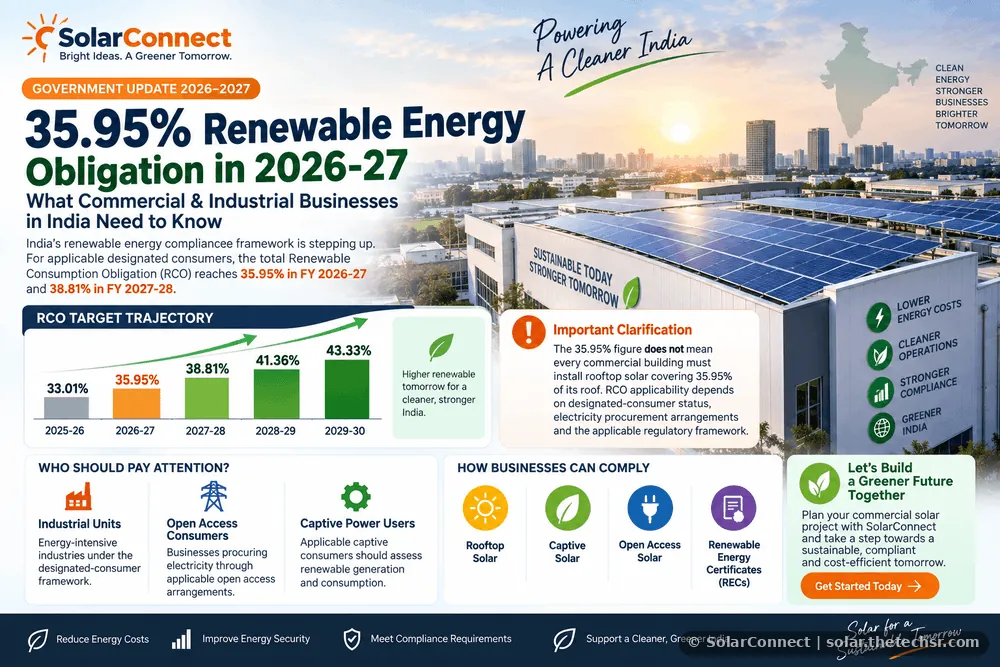
The Ministry of Power's revised Renewable Consumption Obligation framework sets a 35.95% total renewable/non-fossil energy consumption target for FY 2026-27. The target increases to 38.81% in FY 2027-28, followed by 41.36% in FY 2028-29 and 43.33% in FY 2029-30.
This is particularly relevant for businesses operating with qualifying captive power plants (CPPs), open access electricity procurement and other arrangements covered by the designated-consumer framework.
The 35.95% figure does not mean that every commercial building in India must install rooftop solar covering 35.95% of its roof. RCO applicability depends on factors such as designated-consumer status, electricity procurement arrangements and the applicable regulatory framework.
RCO Targets for 2026-27 to 2029-30
| Financial Year | Total RCO Target | Business Planning Importance |
|---|---|---|
| 2025-26 | 33.01% | Existing compliance phase |
| 2026-27 | 35.95% | Important planning year |
| 2027-28 | 38.81% | Higher renewable requirement |
| 2028-29 | 41.36% | Long-term renewable planning |
| 2029-30 | 43.33% | Higher clean-energy integration |
Who Needs to Pay Attention to the 35.95% RCO?
RCO is not a blanket requirement for every shop, office, showroom or commercial property. The framework applies to designated consumers covered under the Energy Conservation framework.
BEE's current RCO information identifies electricity distribution licensees and applicable designated consumers, including qualifying consumers using captive power plants or open access, within the compliance framework.
Industrial Units
Energy-intensive industries that fall within the designated-consumer framework should review their renewable consumption position.
Open Access Consumers
Businesses procuring electricity through applicable open access arrangements need to evaluate their RCO obligations.
Captive Power Users
Applicable captive consumers should assess renewable generation and consumption against their obligation.
Does the 35.95% Target Mean 35.95% Rooftop Solar?
No. The RCO is an electricity-consumption obligation, not a rooftop-area requirement.
Depending on the applicable rules and business structure, renewable compliance can involve renewable electricity consumption and mechanisms such as Renewable Energy Certificates (RECs) or other permitted compliance mechanisms.
This means a commercial or industrial consumer should first determine its actual obligation before deciding whether rooftop solar, captive solar, open-access renewable power, RECs or another permitted route is appropriate.
☀️ Why Commercial Solar Becomes Important
Solar can be one of the practical renewable-energy options for businesses because commercial and industrial consumers can evaluate rooftop systems, captive generation, open-access renewable procurement and other eligible arrangements according to their operational requirements.
The right solution depends on electricity consumption, sanctioned load, operating hours, available roof or land, grid connection, state regulations, financing and the applicable RCO requirements.
Distributed Renewable Energy Is Also Part of the Framework
The RCO framework also contains a distributed renewable energy component. For 2026-27, the distributed renewable energy component for the relevant trajectory is 2.70%, increasing to 3.30% in 2027-28.
BEE's RCO information specifically includes distributed renewable energy and recognizes solar installations under configurations such as net metering, gross metering, virtual net metering, group net metering and behind-the-meter arrangements, subject to the applicable rules.
Commercial Solar Options Businesses Can Evaluate
1. Rooftop Solar
Suitable for factories, warehouses, offices, hospitals, schools, commercial buildings and other properties with suitable roof space.
2. Captive Solar
Businesses with appropriate captive-generation structures can evaluate renewable generation for their electricity requirements.
3. Open Access Solar
Larger consumers can evaluate renewable electricity procurement through applicable open-access arrangements.
4. Renewable Energy Certificates
Where permitted, RECs can form part of the compliance strategy under the applicable regulatory mechanism.
Illustrative 35.95% RCO Calculation
Suppose an applicable designated consumer has annual electricity consumption of 10,000 MWh.
This is an illustrative arithmetic example only and should not be treated as a compliance determination. Actual applicability, eligible consumption, exclusions and compliance treatment must be checked against the current rules applicable to the consumer.
What Commercial Businesses Should Do Now
- Check designated-consumer status: Determine whether the business falls under the applicable BEE/Energy Conservation framework.
- Review electricity consumption: Collect electricity bills, meter data and annual consumption information.
- Identify procurement method: Check whether electricity is supplied through the distribution licensee, open access, captive generation or a combination.
- Calculate the renewable-energy requirement: Evaluate the applicable RCO percentage and eligible consumption.
- Evaluate solar generation: Assess rooftop area, system capacity, generation potential and daytime load.
- Evaluate other compliance routes: Where applicable, review renewable electricity procurement, RECs and other permitted mechanisms.
- Maintain proper records: Keep generation, consumption, procurement and compliance documentation properly organized for applicable reporting and verification requirements.
RCO and ECBC Are Not the Same Thing
Businesses should not confuse the Renewable Consumption Obligation with the Energy Conservation Building Code (ECBC). RCO concerns specified renewable or non-fossil electricity consumption for applicable obligated entities, while ECBC relates to energy-efficiency requirements for applicable buildings and building projects under the relevant rules and state adoption.
Useful SolarConnect Resources
Businesses planning commercial solar projects can also explore the following SolarConnect resources:
Frequently Asked Questions
Is 35.95% renewable energy mandatory for every commercial building in India?
No. The 35.95% RCO target applies to the applicable obligated entities/designated consumers under the relevant framework. It is not a blanket 35.95% rooftop-solar requirement for every commercial building.
What is the RCO target for FY 2027-28?
The total RCO target for the applicable designated-consumer trajectory is 38.81% for FY 2027-28.
Does RCO mean that a company must install rooftop solar?
Not necessarily. Depending on applicability and the rules, compliance can involve renewable electricity consumption and permitted mechanisms such as RECs or buyout mechanisms. Solar can be one of the options businesses evaluate.
Can solar power contribute to renewable-energy compliance?
Solar is included within the renewable-energy framework, and the distributed renewable-energy component specifically recognizes eligible solar installations under applicable configurations.
Is RCO the same as ECBC?
No. RCO and ECBC are separate regulatory frameworks with different purposes and applicability.
Plan Commercial Solar Before the Requirement Becomes a Last-Minute Exercise
The move from 33.01% in 2025-26 to 35.95% in 2026-27 and then 38.81% in 2027-28 gives applicable businesses a clear multi-year renewable-energy planning trajectory.
For commercial and industrial consumers, the practical approach is to first establish applicability, understand electricity consumption and procurement, calculate the renewable-energy requirement and then evaluate the appropriate combination of solar generation, renewable procurement, certificates and other permitted mechanisms.
Source: SolarConnect India – solar.thetechsr.com
Back to Solar Blog