Solar Plus Storage: The Hottest Trend in India’s Solar Market in 2026
Across the world, India, and especially West Bengal, the biggest conversation in solar right now is no longer just “how many panels?” It is “how do we store the power so it is useful after sunset?” Battery Energy Storage Systems (BESS) paired with solar have become the most discussed and fastest-growing topic in the solar market. This block explains the trend, why it matters for homes and businesses, and what is happening specifically in West Bengal — without duplicating existing guides on basic hybrid systems or subsidy details.
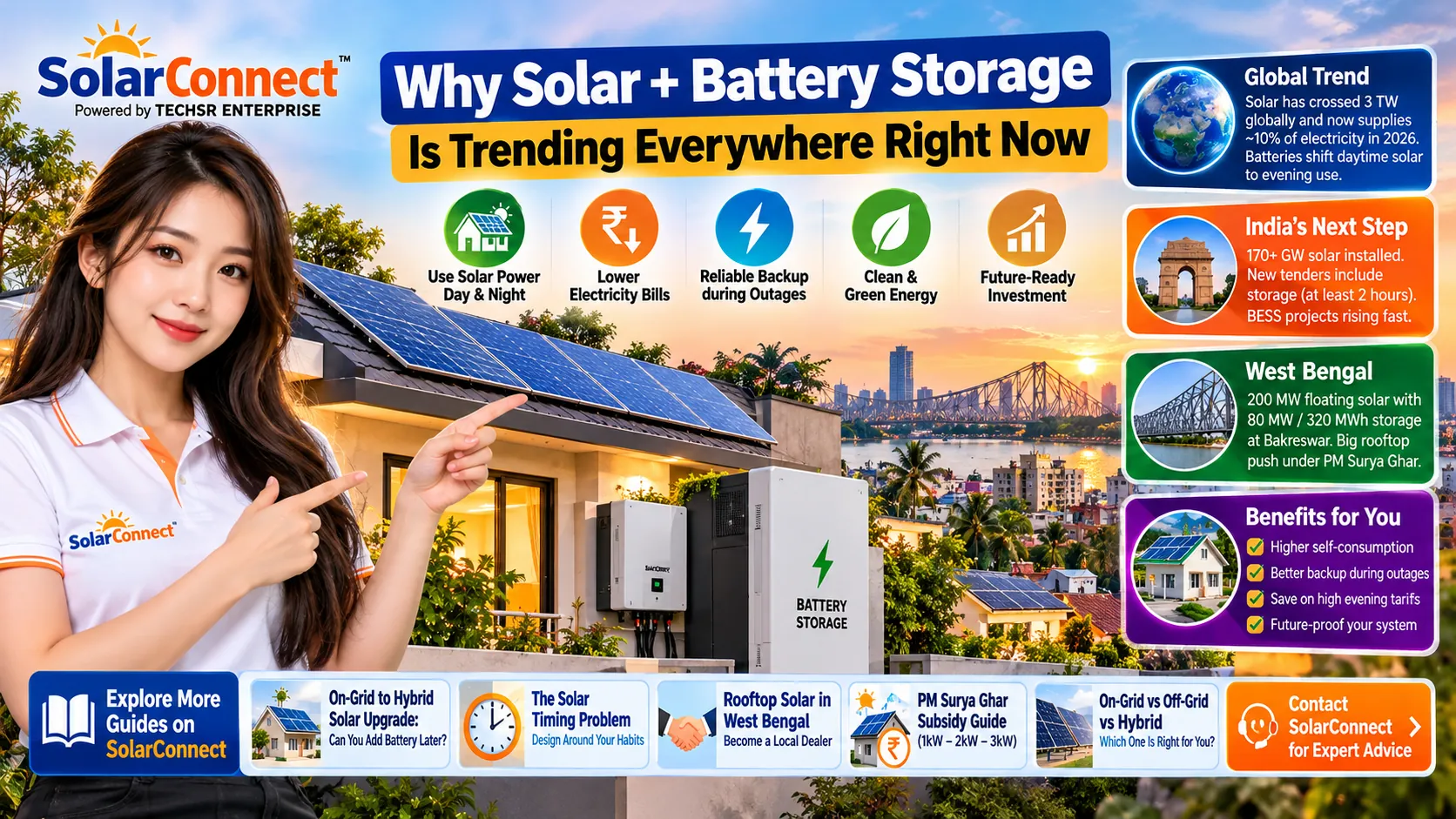
Why Solar + Battery Storage Is Trending Everywhere Right Now
Globally, solar capacity has crossed roughly 3 TW and solar already supplies about 10% of electricity in the first half of 2026. The limitation is clear: solar peaks in the middle of the day while demand often peaks in the evening. Batteries are the practical answer. Markets that added the most storage relative to new solar (Chile, Australia, parts of Europe) are already shifting a large share of daytime generation into non-sunny hours. Expect this pattern to dominate project design worldwide through the rest of the decade.
India: From Gigawatts of Solar to Intelligent Storage
India added tens of gigawatts of solar in 2026 and now has well over 170 GW of installed solar. The next bottleneck is not generation — it is absorption and evening reliability. The Central Electricity Authority has highlighted the need for large-scale storage (tens of GW / hundreds of GWh) to integrate the planned solar and wind capacity. Recent advice from planners is that future solar tenders should include at least two hours of storage (around 10% of solar capacity).
Result: solar-plus-storage auctions are clearing, standalone BESS tenders are rising sharply, and curtailment of daytime solar is becoming a visible problem in high-radiation months. Companies such as Tata Power are actively marketing integrated rooftop solar + battery packages for homes and businesses. For commercial and industrial users, storage helps manage time-of-day tariffs and reduces dependence on diesel generators.
West Bengal: Floating Solar + Storage and a Rooftop Push
West Bengal has lagged in rooftop solar compared with western and southern states, but the picture is changing. The state has approved a major 200 MW floating solar project with 80 MW / 320 MWh battery storage at the Bakreswar reservoir (around ₹2,014 crore). Other floating solar plans (including at Mukutmonipur) and smaller BESS-linked projects are also moving forward. At the same time, the government is targeting hundreds of thousands of new rooftop installations under PM Surya Ghar, with extra state support for certain categories.
For dealers and installers in Kolkata, Howrah, Hooghly, and other districts, this creates two clear opportunities: (1) residential and commercial hybrid systems that solve evening load and outage problems, and (2) participation in larger floating and storage projects as local partners.
What This Means for Homeowners and Businesses
- Higher self-consumption of solar power instead of exporting cheap daytime units and buying expensive evening power.
- Better backup during grid outages (common concern in many parts of West Bengal).
- Improved economics under evolving time-of-day or demand charges.
- Future-proofing — many existing on-grid systems can later be upgraded to hybrid.
Battery prices have fallen dramatically, but system design still matters. Capacity, chemistry (LiFePO4 is popular), depth of discharge, and whether the inverter is hybrid-ready from day one all affect cost and performance. For detailed practical guidance on upgrading an existing system or choosing hybrid from the start, see the related guides below.
Solar + storage is the clear next chapter of India’s solar story. Whether you are a homeowner looking for evening reliability, a business managing power costs, or a dealer expanding your offerings, understanding battery integration is now essential. Explore the linked guides above for system sizing, subsidies, and practical next steps, or contact SolarConnect for site-specific advice.
Source: SolarConnect India – solar.thetechsr.com
Back to Solar Blog