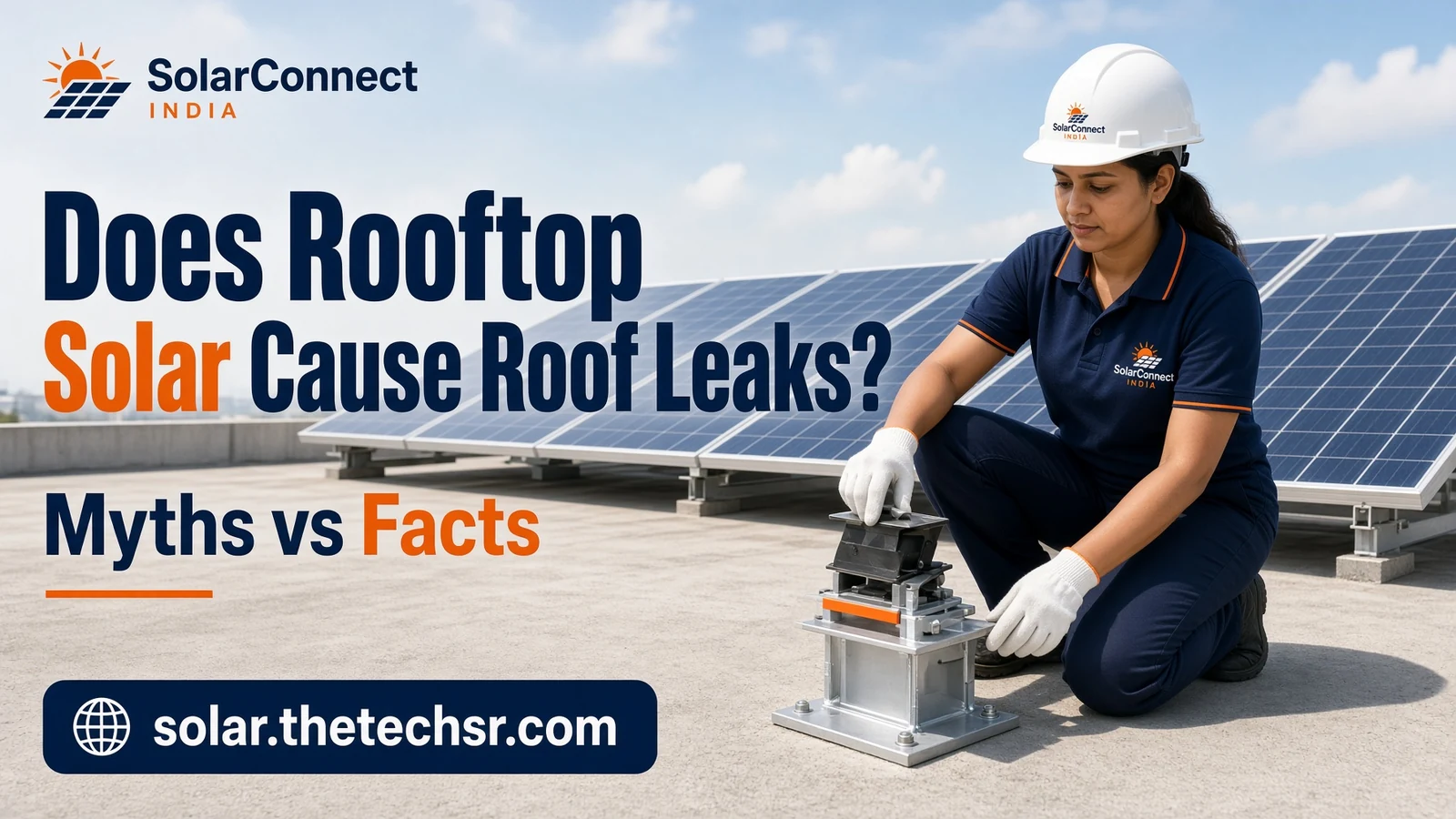
Does Rooftop Solar Cause Roof Leaks? Myths vs Facts
Will rooftop solar leak or crack your roof? 6 myths vs facts on RCC and tin-shed mounting, sealing and load checks to keep your roof safe.
Does Rooftop Solar Cause Roof Leaks? Myths vs Facts
Quick answer: No, rooftop solar does not cause leaks by itself. Leaks happen when the mounting is fixed badly: holes left unsealed, the wrong fasteners on a tin shed, drainage blocked, or old roof cracks not repaired before installation. With a proper site survey, the right mounting for your roof type (anchored or ballasted structures on RCC, sealed fixings with rubber washers on metal sheets) and good workmanship, a solar system sits safely on your roof for its full life.
"Will drilling for solar panels damage my roof?" is one of the first questions homeowners and factory owners ask. It is also one of the most common reasons people delay going solar. Below we separate the myths from the facts so you can decide with confidence. For a full list of popular misconceptions, see our Solar Myths vs Facts page.
Myth 1: Solar panels always make the roof leak
Fact: The panels themselves never touch the roof; they sit on a mounting structure. A leak can only start where that structure is fixed to the roof. If every fixing point is sealed with a suitable waterproof sealant, or a non-penetrating (ballasted) structure is used, water has no new path into the slab. In real projects, leaks are almost always traced back to poor workmanship, not to solar technology.
Myth 2: The installer has to drill big holes all over an RCC roof
Fact: On flat RCC (concrete) roofs there are several options:
- Anchored structures: the legs are fixed with anchor fasteners into the slab, and each hole is filled and sealed.
- Pedestal or block foundations: small concrete blocks are cast on the roof and the structure is bolted onto them, keeping drilling to the blocks.
- Ballasted (non-penetrating) structures: weight holds the structure in place, so the waterproofing layer is not drilled at all. A wind-load check is needed for this option.
The right choice depends on your roof condition, height and local wind conditions, which is why a site survey comes first.
Myth 3: Tin sheds and metal roofs cannot take solar without leaking
Fact: Metal sheet roofs are very common for solar on factories and warehouses. The structure is fixed to the purlins with fasteners that have EPDM rubber washers, and the fixings are sealed. Done this way, the sheet stays watertight. We explain this in detail in our guide to solar on tin shed and metal roofs.
Myth 4: Solar adds too much weight and will crack the roof
Fact: Most sound RCC roofs and properly built sheds can carry a rooftop solar system. Still, the roof's strength must be checked during the survey, especially for old buildings, cracked slabs or weak sheet roofs. If the roof needs repair, it should be fixed before installation, not after. Our checklist on 7 things to check before you install rooftop solar covers roof condition along with other key points.
Myth 5: Once solar is installed, I can never repair or waterproof my roof
Fact: Elevated structures leave space under the panels for cleaning, inspection and drainage. If major waterproofing work is needed later, the panels can be removed and refitted by a trained team. The smart move is to finish any pending waterproofing before installation so the roof is in good shape for the long run.
Myth 6: Solar is bad for the roof in every way
Fact: Panels shade the part of the roof under them, which can reduce direct sun on that area of the slab or sheet. Water still needs a clear path, so a good layout keeps drainage outlets and slopes free. Regular cleaning and inspection, explained in our solar cleaning and maintenance guide, also helps spot any loose fixing early.
How to Keep Your Roof Safe: Quick Checklist
| Check | Why it matters |
|---|---|
| Site survey of roof type and condition | Decides anchored, block or ballasted mounting |
| Repair cracks and waterproofing first | Avoids having to remove panels later |
| Seal every fixing point | Stops water entering at drilled holes |
| Rubber-washer fasteners on metal sheets | Keeps tin and metal roofs watertight |
| Keep drains and slopes clear | Prevents water pooling under the structure |
| Periodic inspection | Catches loose bolts or worn sealant early |
For Dealers: How to Answer This Customer Question
If you are a SolarConnect dealer partner, roof leakage is a question you will hear often. Explain the mounting type planned for the customer's roof, show how fixings are sealed, and recommend finishing any waterproofing before the installation date. Clear answers like these build trust and help close more leads. Under PM Surya Ghar, installations are carried out by the SolarConnect team together with the registered vendor, Pro Power Energies.
FAQ
Will solar panels damage my roof?
Not when the mounting suits your roof type and every fixing point is sealed. Damage usually comes from poor installation work, not from the panels.
Can solar be installed without drilling the roof?
Yes. On many flat RCC roofs a ballasted (non-penetrating) structure or cast concrete blocks can be used, subject to a wind-load and roof check.
Should I waterproof my roof before installing solar?
Yes, if your roof has cracks or old waterproofing. Fixing it first is easier than removing panels later.
Is solar safe on a tin shed roof?
Yes, when the structure is fixed to the purlins with sealed fasteners that use rubber washers.
Solar lagane se chhat leak hoti hai kya?
Nahi, agar mounting sahi ho aur har fixing point seal kiya gaya ho. Leak aksar kharab installation ki wajah se hota hai, solar ki wajah se nahi.
Plan a Leak-Free Solar Installation
The SolarConnect India team checks your roof type and condition first, then plans the right mounting with partner-brand panels, anywhere in India, for homes and large commercial projects.
📱 WhatsApp / Team: +91 92823 67700 | ☎️ Office: 033 3183 5203
Source: SolarConnect India – solar.thetechsr.com
Back to Solar Blog