Why Solar Energy Is Becoming Essential for Every Indian Home and Business
Solar energy is no longer just an alternative source of electricity. It is becoming an important part of India's energy future.
Rooftop solar introduces a different way of thinking about electricity: Sunlight → Solar Panels → Electricity Generation → Self-Consumption → Grid Support.
This change matters because electricity is not an occasional expense. We use it every day at home, in shops, offices, schools, factories and almost every part of modern life.
So the real question is not simply: “Should everyone install solar?”
A more useful question is: “Can solar become a practical part of my home's or business's long-term energy plan?”
India's Solar Growth: The Numbers Tell the Story
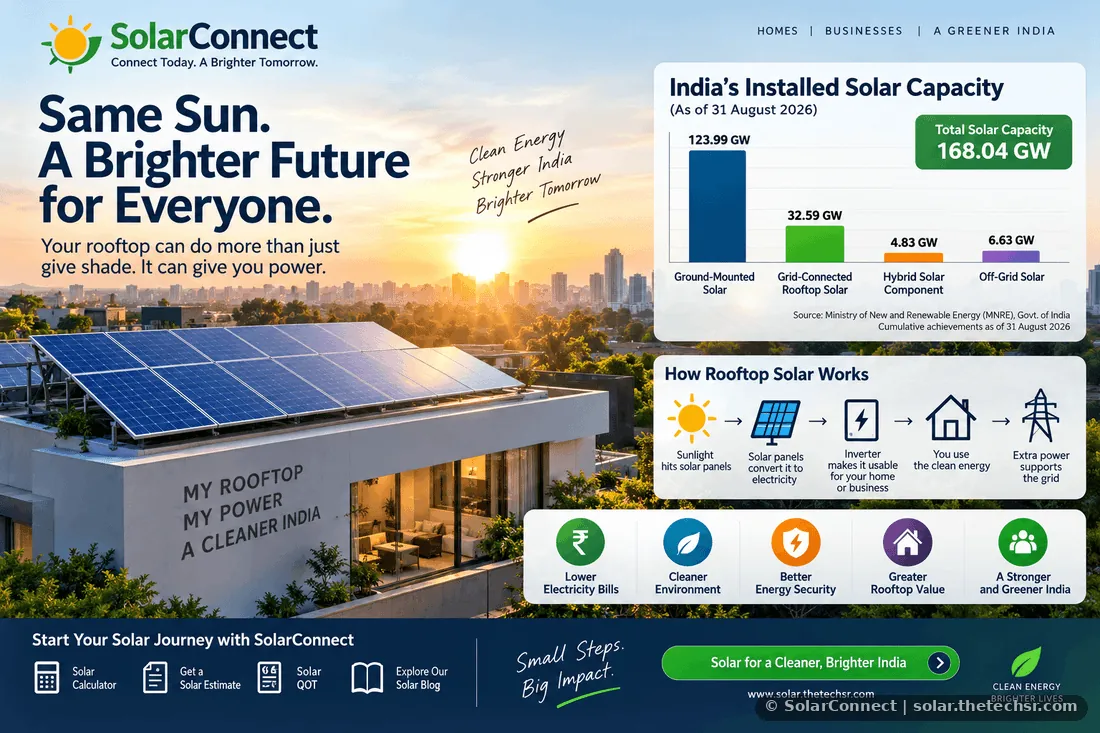
India's solar sector has grown significantly over the last decade. According to the Ministry of New and Renewable Energy (MNRE), India's cumulative installed solar power capacity reached 168.04 GW as of 31 August 2026.
The latest MNRE data includes:
- 123.99 GW of ground-mounted solar
- 32.59 GW of grid-connected rooftop solar
- 4.83 GW of hybrid projects with a solar component
- 6.63 GW of off-grid solar
These figures show that solar is no longer a small or experimental part of India's energy system. It has become a significant part of the country's renewable-energy infrastructure.
India Solar Capacity Snapshot
| Solar Segment | Installed Capacity |
|---|---|
| Total Solar Power | 168.04 GW |
| Ground-Mounted Solar | 123.99 GW |
| Grid-Connected Rooftop Solar | 32.59 GW |
| Hybrid Solar Component | 4.83 GW |
| Off-Grid Solar | 6.63 GW |
Source: Ministry of New and Renewable Energy (MNRE), Government of India. Cumulative achievements as of 31 August 2026.
Graph 1: India's Solar Capacity Is No Longer Small-Scale
The numbers provide a simple picture of how large India's solar sector has become.
| Solar Segment | Capacity |
|---|---|
| Ground-Mounted Solar | 123.99 GW |
| Grid-Connected Rooftop Solar | 32.59 GW |
| Off-Grid Solar | 6.63 GW |
| Hybrid Solar Component | 4.83 GW |
One important point stands out: rooftop solar has already reached 32.59 GW of cumulative installed capacity in India.
This makes rooftop solar an increasingly important part of distributed electricity generation.
Why Does Rooftop Solar Matter?
Large solar plants generate electricity at centralized locations. Rooftop solar works differently because the generation system can be installed close to the point where electricity is consumed.
The basic solar energy flow is:
Rooftop → Solar PV Modules → Inverter → Building Electricity System → Appliances / Equipment
A suitable home, shop, office or other building can therefore potentially use its rooftop as part of its energy-generation infrastructure.
Graph 2: Traditional Electricity vs Rooftop Solar
| Traditional Electricity Model | Rooftop Solar Model |
|---|---|
| Mostly grid electricity | Solar + grid electricity |
| Electricity is purchased | Part of electricity can be generated on-site |
| Rooftop has no electricity-generation role | Rooftop can become an energy asset |
| Focus mainly on consumption | Focus on consumption + generation |
Solar Is About Energy Planning, Not Just Electricity Bills
When people hear the word solar, one of the first questions is: “How much will my electricity bill decrease?”
That is a valid question, but it is not the complete solar calculation.
A proper rooftop solar assessment should consider several factors together:
Electricity Consumption + Rooftop Area + Solar Generation Potential + System Cost + Applicable Government Support + Electricity Tariff + Future Consumption
This is why it is better to calculate before purchasing a solar system instead of selecting a system size simply because someone recommends 1 kW, 2 kW, 3 kW or 5 kW.
Start your planning with the SolarConnect Solar Calculator.
Graph 3: How a Solar Decision Should Be Calculated
- Measure electricity consumption
- Check available rooftop area
- Check shading and roof suitability
- Estimate potential solar generation
- Calculate the complete project cost
- Check applicable government support
- Compare generation and project economics
- Select the appropriate system
This approach helps customers move from a simple product purchase to a more informed energy decision.
Why Solar Can Be Important for a Home
A modern Indian household may use electricity for lights, fans, refrigerators, televisions, water pumps, washing machines, computers, air conditioners and many other appliances.
Electricity is therefore a continuous household requirement.
Rooftop solar can allow a suitable household to generate electricity during appropriate daylight conditions.
This does not mean that every home will completely eliminate its electricity bill. Actual results depend on system size, solar generation, household consumption, electricity tariff, grid rules, rooftop conditions and other technical factors.
Before Solar
Electricity Requirement → Mainly Grid Electricity
With Rooftop Solar
Electricity Requirement → Solar Generation + Grid Electricity
Why Solar Can Be Important for Businesses
For a business, electricity can be part of recurring operating expenditure. Shops, offices, warehouses, clinics, restaurants, educational institutions, workshops and other commercial establishments may have significant electricity requirements.
For these users, solar should be evaluated through a practical business calculation:
Electricity Consumption → Solar Generation → Project Cost → Potential Savings → Payback Considerations → Long-Term Energy Planning
The correct solar system is not necessarily the biggest system. It is the system that makes technical and financial sense for the particular property and its electricity requirements.
Graph 4: Questions Every Business Should Ask Before Going Solar
| Business Question | Why It Matters |
|---|---|
| How much electricity is consumed? | Helps determine the energy requirement. |
| When is electricity consumed? | Helps understand the relevance of daytime solar generation. |
| How much rooftop space is available? | Influences the possible system size. |
| What is the electricity tariff? | Important for financial calculations. |
| What are the applicable grid rules? | Important for grid-connected solar systems. |
India's Rooftop Solar Policy Direction
Government policy is another important part of India's rooftop solar ecosystem.
The PM-Surya Ghar: Muft Bijli Yojana was launched in February 2024 with an objective of supporting rooftop solar installations for one crore households and a total financial outlay of ₹75,021 crore.
The scheme provides Central Financial Assistance for eligible residential rooftop solar installations under the applicable rules and process. 1
However, subsidy eligibility, installation requirements, vendor conditions, application procedures and other rules can change. Customers should always check the latest official government information before making a purchase.
For more basic solar questions, explore the SolarConnect Solar FAQ.
Graph 5: A Simple Solar Subsidy Decision Flow
Residential Consumer
↓
Check Current PM-Surya Ghar Eligibility
↓
Select Applicable Installation Route / Vendor
↓
Install Rooftop Solar
↓
Required DISCOM / Verification Process
↓
Applicable CFA / Subsidy Process
Government subsidy should always be checked according to the current official rules. Customers should not depend only on old advertisements, forwarded messages or outdated social-media information.
Solar Growth Is Also Creating a New Business Ecosystem
Solar is not only about consumers. The growth of rooftop solar is also creating opportunities for dealers, distributors, installers, service providers, consultants, sales professionals and technology platforms.
A modern solar ecosystem can include:
- Solar manufacturers
- Solar distributors
- Solar dealers
- Installation partners
- Electrical professionals
- Solar sales teams
- Solar financing providers
- CRM and quotation platforms
- Customer support services
SolarConnect is designed to support this wider ecosystem by bringing together solar information, tools, customer resources and business-oriented services.
Businesses interested in working with SolarConnect can explore Partner With Us.
You can also explore SolarConnect Services and Solar Products.
Why You Should Calculate Before You Buy Solar
Solar should not be purchased simply because someone says, “Install 3 kW” or “Install 5 kW.”
The correct system depends on the property and the customer's actual electricity requirements.
Before purchasing, consider:
- Monthly electricity consumption
- Annual electricity consumption
- Available rooftop area
- Roof direction and condition
- Potential shading
- Expected solar generation
- Inverter capacity
- Panel technology and specifications
- Installation and electrical requirements
- Current government rules
- Grid connection and net-metering requirements, where applicable
- Total project cost
Once these factors are understood, it becomes easier to compare different solar options and understand whether rooftop solar is suitable for your property.
Use SolarConnect Tools Before Making a Decision
SolarConnect provides dedicated tools and resources to make solar planning easier for customers, dealers and solar professionals.
Solar Calculator
Start with the SolarConnect Solar Calculator to understand basic solar requirements and calculations.
Solar Estimate
After understanding your basic requirement, explore the Solar Estimate for a more practical project view.
Solar QOT
For quotation-related workflows, explore Solar QOT.
Solar Battery
For information related to energy storage and battery-based solar solutions, visit Solar Battery.
Ask SolarConnect AI Meghna
Solar customers often have questions about solar panels, installation, electricity generation, system types, government updates and solar technology.
SolarConnect's AI assistant Meghna is designed to help users find useful solar information more easily.
Stay Updated With Solar Information
Solar technology, government policies, subsidy rules and the solar market can change over time. Staying updated is therefore an important part of making an informed solar decision.
Explore the latest articles through the SolarConnect Solar Blog.
You can also explore Solar Video Blogs for visual solar information.
The Real Reason Solar Matters
The strongest reason to consider solar is not a single number. It is the change in the way we think about electricity.
Instead of thinking:
“I need electricity, so I have to buy all of it.”
Solar allows us to consider another question:
“How much of my electricity requirement can I generate myself?”
That is a fundamentally different way of thinking about energy.
Solar in One Simple Graph
| Stage | Traditional Thinking | Solar Thinking |
|---|---|---|
| 1 | Use electricity | Measure electricity use |
| 2 | Pay electricity bill | Study generation potential |
| 3 | Ignore rooftop potential | Evaluate the rooftop |
| 4 | Depend mainly on grid electricity | Combine solar + grid |
| 5 | Focus on short-term electricity cost | Plan long-term energy use |
Final Conclusion
India's solar journey has moved far beyond a small experimental technology. According to MNRE data, India had 168.04 GW of cumulative installed solar capacity as of 31 August 2026, including 32.59 GW of grid-connected rooftop solar. 2
These numbers show the scale of India's solar transition. But for an individual family or business, the solar decision still needs to be practical and property-specific.
Not every building will need the same solar system. Not every rooftop will have the same generation potential. Not every consumer will have the same electricity consumption or financial calculation.
That is why solar planning should begin with data, calculation and proper assessment, rather than simply with a sales pitch.
How Much of Your Electricity Can Your Own Rooftop Generate?
That is the question worth asking before you choose a solar system. Once you understand your electricity consumption, rooftop potential, system requirements and project economics, you can make a more informed decision about whether rooftop solar makes sense for your home or business.
Explore Solar With SolarConnect
- SolarConnect Home
- Solar Calculator
- Solar Estimate
- Solar QOT
- Solar FAQ
- Solar Battery
- Solar Products
- SolarConnect Services
- Partner With Us
- Ask SolarConnect AI Meghna
- Solar Video Blogs
- SolarConnect Solar Blog
Sources
- Ministry of New and Renewable Energy (MNRE), Government of India, Physical Achievements.
- MNRE, Grid Connected Rooftop Solar Programme.
- Government of India, PM-Surya Ghar: Muft Bijli Yojana.
Disclaimer: Solar generation, system sizing, savings, subsidy eligibility and project economics vary according to location, electricity consumption, rooftop conditions, system design, applicable regulations and current government policies. Always verify the latest official rules and obtain an appropriate technical assessment before making a final installation decision.
Source: SolarConnect India – solar.thetechsr.com
Back to Solar Blog