Best Solar Panel Direction and Tilt in India: 6 Myths vs Facts
Which way should solar panels face in India? South vs east-west, best tilt angle, shade and flat roofs: 6 myths vs facts for homes, dealers and businesses.
Best Solar Panel Direction and Tilt in India: Myths vs Facts
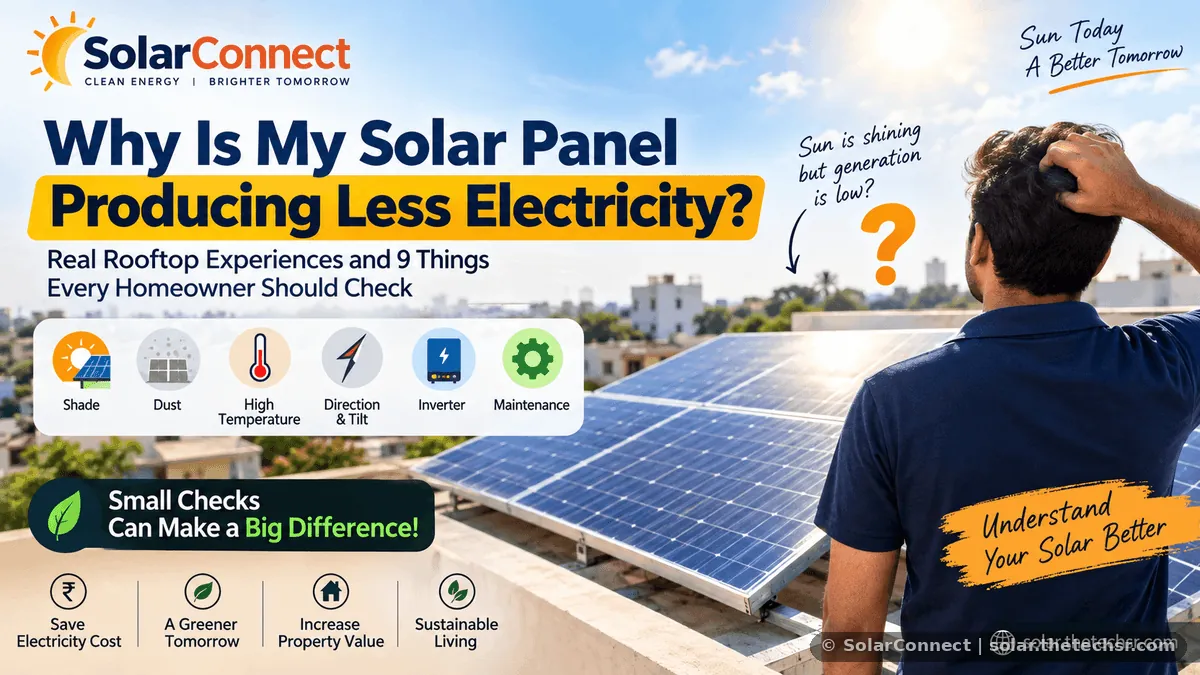
Quick answer: In India, solar panels give the most yearly energy when they face true south at a tilt close to your site's latitude. East-west layouts and small angle changes still work well; shade on the panels hurts output far more than a slightly imperfect direction.
"Which way should my solar panels face?" is one of the first questions homeowners and business owners ask, and many decisions get delayed over it. Here are the common myths about panel direction and tilt, with the facts. For more popular myths, see our Solar Myths vs Facts page.
Myth 1: Panels should face the direction where the sun rises
Fact: India is in the northern hemisphere, so through the year the sun moves across the southern part of the sky. That is why panels facing true south (not just magnetic south on a phone compass) collect the most energy over a full year.
Myth 2: If the roof does not face south, solar is not worth it
Fact: East-facing, west-facing and east-west layouts all generate useful power. They give somewhat lower yearly output than a south-facing layout, but they can match morning or evening use better and fit more panels on wide flat or metal roofs. A site survey shows what your roof can really produce.
Myth 3: One tilt angle is right for the whole country
Fact: The best fixed tilt is roughly equal to your site's latitude, so it changes from the south to the north of India: lower in Kerala and Tamil Nadu, higher in Punjab and Delhi. Most rooftop systems use one fixed tilt for the whole year; changing it by season adds work for only a small gain.
Myth 4: Panels on a flat roof can simply lie flat
Fact: Flat panels collect less energy and hold dust and water. A tilted mounting structure helps rain wash off dust and keeps the roof below easier to clean. See our solar panel cleaning and maintenance guide.
Myth 5: Direction matters more than shade
Fact: Shade from water tanks, parapets, trees or nearby buildings usually costs more energy than a small direction change, because shade on one panel can pull down a whole string. A good layout first avoids shade, then sets direction and tilt. If your plant already gives less than expected, read why is my solar panel producing less electricity?
Myth 6: More tilt always means more power
Fact: Too steep a tilt raises wind load and can cast shade on the next row of panels. The structure must be designed for your area's wind and rows must be spaced to avoid self-shading, especially in winter when the sun is lower.
Quick Direction and Tilt Checklist
| Check | Why it matters |
|---|---|
| True south, not magnetic south | Gives the most yearly output |
| Tilt close to site latitude | Good year-round generation |
| Shade study for the whole day | Shade costs more than direction |
| Row spacing | Stops panels shading each other |
| Wind-rated structure | Safety on high roofs and in storm zones |
Before you finalise any layout, also go through 7 things to check before you install rooftop solar.
For Dealers: Answer the Direction Question Early
Customers often stop at the first site visit because their roof "faces the wrong way". Explaining these facts simply, with a shade check and a realistic output estimate, helps dealers close more leads honestly. SolarConnect India supplies partner-brand solar panels and supports dealers through its pan-India EPC and distribution network. See how pan-India solar dealership with SolarConnect works.
FAQ
Which direction should solar panels face in India?
South-facing gives the highest yearly output across India because the country is in the northern hemisphere. East-west layouts also work, with somewhat lower total generation.
What is the best tilt angle for solar panels in India?
A fixed tilt close to your site's latitude gives good year-round output, which ranges from roughly 10 degrees in the far south to about 30 degrees in the north. Your installer fine-tunes it after a site survey.
Can solar panels face east or west?
Yes. East-west layouts produce more in the morning and evening and fit wide flat or metal roofs, with lower total generation than a south-facing layout.
Does shade on one panel affect the whole system?
It can. In a normal string, shade on one panel can pull down the output of the whole string, so a shade-free layout matters more than small direction changes.
Should panels lie flat on a flat roof?
No. A small tilt helps rain wash off dust and improves output, so panels on flat roofs are normally mounted on a tilted structure.
Talk to the SolarConnect India Team
The SolarConnect India team helps homes, businesses and dealers across India plan rooftop solar layouts the right way.
📱 WhatsApp / Team: +91 92823 67700 | ☎️ Office: 033 3183 5203
Source: SolarConnect India – solar.thetechsr.com
Back to Solar Blog