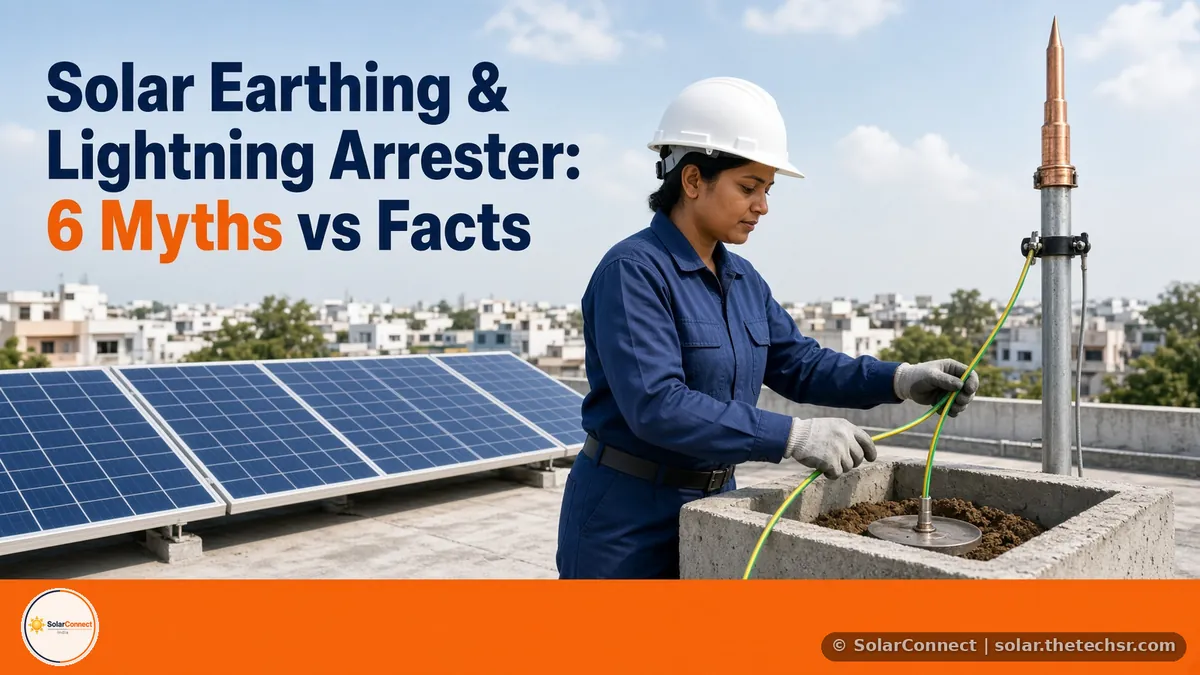
Solar Earthing and Lightning Arrester in India: 6 Myths vs Facts
Myths versus facts on solar earthing and lightning protection in India, covering IS 3043, surge devices and practical dealer checks.
Solar Earthing and Lightning Arrester in India: 6 Myths vs Facts
Quick answer: Proper earthing and surge protection are essential safety requirements for solar PV systems, guided by Indian standards such as IS 3043. They limit touch voltages, clear faults and divert lightning-induced surges. A correctly designed system uses multiple earth electrodes, equipotential bonding and coordinated SPDs on both DC and AC sides.
Solar rooftop and ground-mount systems face unique earthing challenges because they combine outdoor DC arrays, metal frames, long cable runs and sensitive inverters. In India, IS 3043 governs earthing practice while lightning protection follows IS/IEC 62305 principles and SPD requirements draw from IEC 61643 series standards. Understanding common misconceptions helps dealers specify and supply systems that remain safe and reliable over decades. For more common misconceptions, see our Solar Myths vs Facts page.
Myth 1: One earth pit is enough for the whole solar plant
Fact: Best practice and many project specifications call for separate or functionally distinct earth electrodes for the PV array/module frames, the inverter/AC equipment and the lightning protection system. These are interconnected at a main equipotential bar so that fault currents and surge currents have low-impedance paths without transferring dangerous potentials between circuits. A single shared pit often raises overall resistance and can allow surge energy to enter the inverter.
Myth 2: Lightning arresters or SPDs are unnecessary except in a few high-risk states
Fact: Many parts of India experience significant lightning activity during the monsoon. Even without a direct strike, induced surges travel along DC and AC cables. Coordinated Type 1 and Type 2 SPDs on the DC side (per IEC 61643-31 guidance) and AC side protect inverters and modules. Risk assessment under IEC 62305 principles determines whether an external lightning protection system is also required; SPDs remain useful in either case. Surge damage is a frequent cause of inverter faults, as covered in solar inverter in India: 6 myths vs facts.
Myth 3: Earth resistance of 10–15 ohms is acceptable if the connection looks solid
Fact: IS 3043 does not prescribe one universal resistance value; safety depends on touch voltage, step voltage and fault-loop impedance. In common Indian solar practice the target is kept at or below 5 ohms, with lower values preferred for sensitive electronics and commercial systems. High resistance delays fault clearance, raises touch voltages and reduces the effectiveness of SPDs that rely on a low-impedance earth path.
Myth 4: Only the AC side needs earthing because DC voltages are relatively low
Fact: Module frames and mounting structures must be bonded and connected to the protective earth conductor to prevent hazardous touch voltages if insulation fails. Long outdoor DC cable runs also pick up induced surges, so DC-rated SPDs are required at array junctions and inverter inputs. Transformerless inverters in particular demand careful equipotential bonding and correct PE connections as specified by the manufacturer.
Myth 5: Chemical earthing is always superior and mandatory for solar
Fact: IS 3043 permits plate, pipe or rod electrodes sized according to soil resistivity and fault current. Chemical backfill or enhancement compounds improve conductivity mainly in high-resistivity or dry soils; they are not universally required. Material selection (copper-bonded, GI or pure copper) depends on soil corrosivity, expected life and local practice. Proper installation depth, spacing and testing matter more than the marketing label of the electrode.
Myth 6: Once the system is commissioned, earthing needs no further attention
Fact: Soil moisture changes, connections corrode and clamps loosen over time, raising resistance. Periodic re-testing with the fall-of-potential method, visual inspection of bonds and tightening of terminations are recommended. Many inverter manufacturers also expect documented earth-resistance values to remain within warranty limits throughout the system life. Good records also help with claims, see our solar panel warranty guide.
Quick Earthing and Surge Protection Checklist
| Check | Why it matters |
|---|---|
| Measure soil resistivity and design electrodes accordingly | Ensures the calculated resistance meets the project target under local conditions |
| Bond every module frame and metal structure to the PE network | Prevents touch voltages and provides a path for induced currents |
| Install coordinated DC and AC SPDs of the correct type and rating | Diverts surge energy before it reaches the inverter or modules |
| Achieve and document earth resistance at or below the design target | Confirms fault-clearance capability and SPD effectiveness |
| Re-test earthing and inspect bonds periodically | Catches corrosion or loosening before safety or performance is compromised |
For Dealers: Earthing Protects Your Reputation
Dealers who supply systems with correctly designed earthing and surge protection reduce the frequency of inverter failures, nuisance trips and module damage reported by customers. Fewer service calls protect the dealer’s reputation and free technical teams for new business rather than repeated site visits. Clear documentation of earth resistance, bonding and SPD installation also supports warranty claims with manufacturers and gives customers confidence that the installation follows recognised Indian and international practice. Consistent attention to these details therefore strengthens long-term customer relationships. SolarConnect India supplies partner-brand solar panels and supports dealers through its pan-India EPC and distribution network.
FAQ
Does IS 3043 specify a fixed maximum earth resistance for solar systems?
No single universal value is mandated. Designers target a resistance that keeps touch and step voltages safe and allows protective devices to operate; common practice keeps the value at or below 5 ohms, with lower figures preferred for commercial or sensitive installations.
Are separate earth pits required for the lightning arrester?
Practice varies, but many designs use a dedicated electrode for the lightning protection system that is bonded to the main equipotential network through an appropriate connection. This limits the transfer of high surge currents into the power-system earth.
Must every solar installation have an external lightning rod?
Not automatically. IEC 62305 principles call for a risk assessment that considers location, structure height and occupancy. SPDs on DC and AC circuits are still recommended to handle induced surges even when a full external system is not fitted.
Can GI electrodes be used instead of copper for solar earthing?
Yes, when selected and installed according to soil conditions and IS 3043 guidance. Copper or copper-bonded electrodes generally offer better corrosion resistance in aggressive soils, but properly specified GI systems remain acceptable in many locations.
How often should earth resistance be re-measured?
At commissioning and then periodically, typically at least once a year or after major storms or soil disturbance. Continuous monitoring is not required, but documented re-tests confirm that the system continues to meet its design intent.
Talk to the SolarConnect India Team
The SolarConnect India team helps dealers and businesses across India with partner-brand solar panels and system planning support.
📱 WhatsApp / Team: +91 92823 67700 | ☎️ Office: 033 3183 5203
Source: SolarConnect India – solar.thetechsr.com
Back to Solar Blog