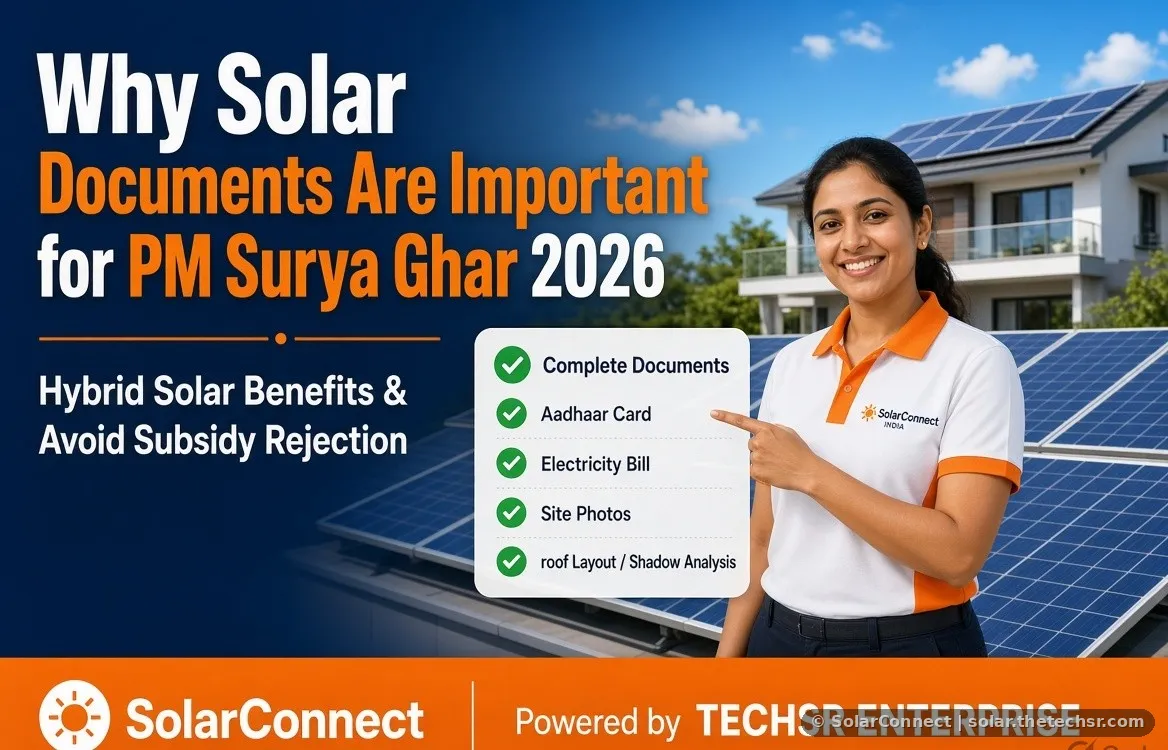
Why Solar Documents Are Important for PM Surya Ghar Subsidy 2026 + Hybrid Solar Benefits
Why are solar documents so important for PM Surya Ghar subsidy? Learn the common reasons applications get rejected and why many homes are now choosing hybrid solar in 2026 for backup during power cuts.
Why Solar Documents Are Important for PM Surya Ghar Subsidy & Why Hybrid Solar Matters in 2026
Many homeowners start the PM Surya Ghar: Muft Bijli Yojana process but face delays because of incomplete or mismatched documents. Proper paperwork is not just a formality — it is the key to getting your subsidy approved smoothly and avoiding rejection.
In this guide, we explain why solar documents are important, what happens when documents are incomplete, and why choosing a hybrid solar system is becoming important for many Indian homes in 2026.
Why Solar Documents Are Critical for PM Surya Ghar
The PM Surya Ghar portal and your local DISCOM verify every document carefully. Even a small mismatch can stop your application.
- Name matching is mandatory — The name on your Aadhaar, electricity bill, and bank account must match exactly. Even “S. Kumar” vs “Sunil Kumar” causes rejection.
- Subsidy is credited through DBT — Without a correct Aadhaar-linked bank account, the subsidy cannot be transferred.
- Electricity bill proves eligibility — It shows your consumer number, DISCOM, residential category, and sanctioned load.
- Property proof confirms rooftop rights — Required to ensure you can install solar on the roof.
- Site survey photos help accurate design — Poor site data leads to wrong system size and lower generation.
For the complete list of documents, see our detailed guide: Solar Documents Checklist 2026: Aadhaar, Electricity Bill, PAN & Site Survey.
What Happens If Documents Are Incomplete?
- Application gets rejected or put on hold
- DISCOM approval takes longer
- Subsidy credit is delayed (sometimes by months)
- You may need to re-apply and upload documents again
Preparing documents correctly from the start saves time and money. You can also read our Solar Subsidy 2026 State-Wise Guide and the official process on our PM Surya Ghar page.
Why Hybrid Solar Is Important in 2026
Most homes in India still choose on-grid solar for lower cost and net metering benefits. However, hybrid solar is becoming more relevant because of frequent power cuts and the need for backup.
- Backup during power cuts — On-grid systems shut down when the grid fails. Hybrid systems with battery continue to supply power.
- Better use of solar energy — Store excess daytime solar power and use it at night or during outages.
- Future-ready system — You can start with hybrid-ready equipment and add battery later if needed.
- Higher self-consumption — Useful in areas where net metering credits are low or power cuts are common.
Not every home needs a battery. For most homes with stable electricity, on-grid is still the best choice. Read our detailed comparison:
- Should You Add a Battery to Rooftop Solar in 2026?
- On-Grid vs Off-Grid vs Hybrid Solar System
- On-Grid to Hybrid Solar Upgrade: Can You Add Battery Later?
How to Choose the Right System for Your Home
- Stable electricity + goal is bill savings → On-grid system is usually best.
- Frequent power cuts or need backup → Hybrid solar makes more sense.
- Want flexibility → Choose a hybrid inverter now and add battery later.
Before deciding, check your electricity bill and roof conditions. Use our free Solar Calculator and read the Solar Decision Guide India 2026.
Final Takeaway
Correct documents are essential for a smooth PM Surya Ghar subsidy process. At the same time, understanding whether you need on-grid or hybrid solar helps you choose a system that actually matches your needs.
Prepare your documents using our Documents Checklist, compare quotations carefully with the 12-Point Quotation Checklist, and decide on hybrid only if backup is important for you.
Need help? Ask Meghna AI or contact SolarConnect for site survey and document support.
SolarConnect | Powered by TECHSR ENTERPRISE
Source: SolarConnect India – solar.thetechsr.com
Back to Solar Blog