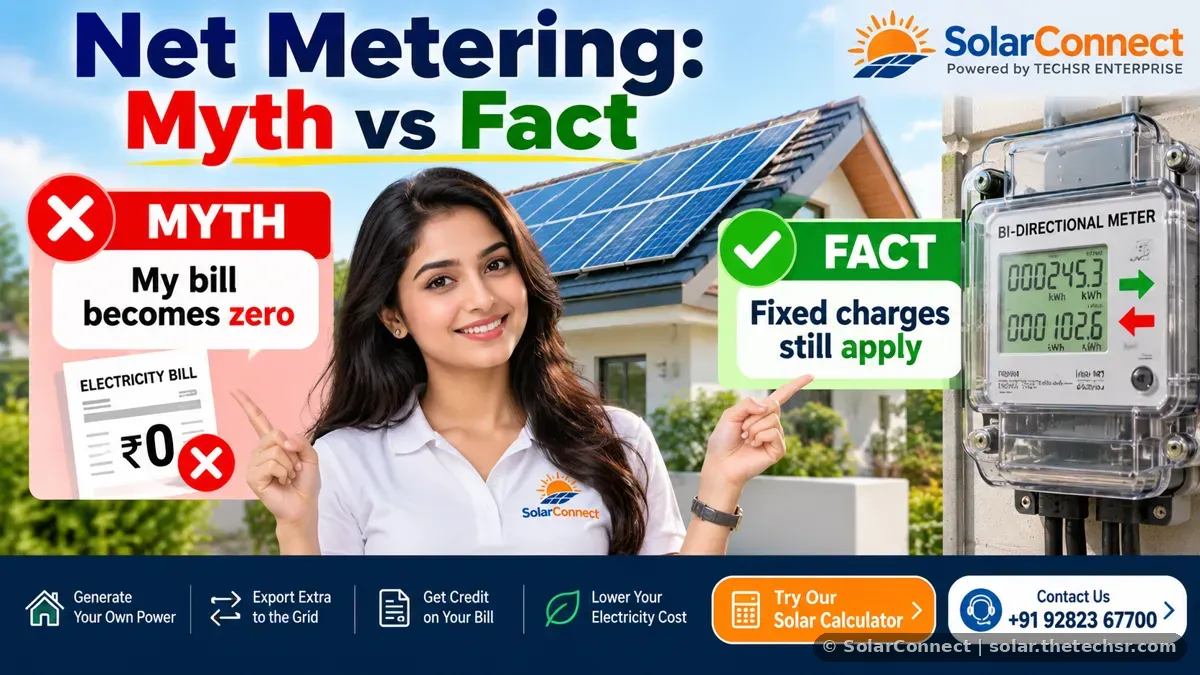
Net Metering Solar in India 2026: 8 Myths vs Facts
Will net metering make your bill zero or pay you for every unit? We bust 8 common rooftop solar net metering myths for Indian homes and businesses.
Net metering is the part of rooftop solar that most people hear about and few fully understand. Neighbours say "your bill will become zero", vendors say "the DISCOM will pay you", and some families delay solar because they think the paperwork is impossible. This guide from the SolarConnect team separates the common myths from the facts, so homes, housing societies and businesses across India can plan with clear expectations.
Rules differ by state electricity regulator and by DISCOM, so always confirm the latest regulation for your area. Where we mention subsidy, we use the official figures published on pmsuryaghar.gov.in.
What Is Net Metering, in Simple Words?
With an on-grid rooftop solar system, your panels feed power to your home first. When the panels produce more than you are using, the extra units flow to the grid. A bi-directional (net) meter records both directions: units you import from the grid and units you export to it. Your bill is then calculated on the difference, according to your DISCOM's rules. For the full process, read our complete net metering guide.
Net Metering vs Net Billing: What Is the Difference?
"Net metering vs net billing" is one of the most searched solar questions in India. Under net metering, exported units are offset unit-for-unit against imported units. Under net billing, exported units are valued at a set rate and imported units are charged at your tariff, so the two are settled in rupees rather than units. Under gross metering, all solar generation is fed to the grid and paid at a set rate. Under the Electricity (Rights of Consumers) Rules as amended in 2021, net metering is generally allowed up to 500 kW or the sanctioned load, whichever is lower, and larger systems use net billing or gross metering. Your state commission sets the detailed settlement rules, so confirm the method that applies to your connection before finalising the design.
Myth 1: "With Net Metering, My Electricity Bill Becomes Zero"
Fact: Solar can reduce the energy portion of your bill sharply, but a bill rarely becomes exactly zero. Most DISCOMs still apply fixed or demand charges, meter rent and applicable duties every month, whether or not you import units. Night-time use, cloudy weeks and a growing load also add imported units. Plan for a much lower bill, not a zero bill.
Myth 2: "The DISCOM Will Pay Me Cash for Every Extra Unit"
Fact: Under net metering, exported units are usually adjusted against the units you import, and any surplus is carried forward or settled according to the state regulation. How surplus is treated at the end of a settlement period, and at what rate, depends on your state. Rooftop solar is designed to cut your own bill, not to run as an income scheme, so size the system to your consumption rather than to "sell" power.
Myth 3: "Bigger Is Always Better, So I Should Install the Maximum"
Fact: Oversizing beyond your real consumption rarely gives proportional benefit, because surplus treatment is limited by regulation, and DISCOMs commonly cap system size relative to your sanctioned load. The right approach is to match capacity to your monthly units and daytime habits. Our article on designing solar around your electricity habits explains why timing matters as much as size. You can also get a quick estimate from the SolarConnect solar calculator.
Myth 4: "Net Metering Means My Solar Works During Power Cuts"
Fact: A standard on-grid, net-metered system shuts down automatically when the grid fails. This safety feature protects line workers repairing the grid. If you need backup during outages, you need a hybrid system with a battery. Read On-Grid to Hybrid Solar Upgrade: Can You Add Battery Later? before you decide.
Myth 5: "Getting a Net Meter Is Too Complicated for an Ordinary Family"
Fact: For residential consumers, the application goes through the national portal at pmsuryaghar.gov.in, which links to your DISCOM. The usual steps are registration, feasibility approval, installation by a registered vendor, net meter installation and inspection, and then commissioning. Keeping your documents ready makes it smoother; see our solar documents checklist. A good installer team guides you through each step, but you should never share your OTP or login with anyone.
Myth 6: "Net Metering and Subsidy Are the Same Thing"
Fact: They are separate. Net metering is how your DISCOM accounts for exported and imported units. The subsidy is central financial assistance for eligible residential rooftop systems under PM Surya Ghar: Muft Bijli Yojana. As published on pmsuryaghar.gov.in, it is ₹30,000 per kW for up to 2 kW, ₹18,000 for the additional capacity up to 3 kW, with a maximum of ₹78,000 for systems above 3 kW. Housing societies and RWAs have their own provision. Details are in our PM Surya Ghar subsidy guide.
Myth 7: "Net Metering Is Only for Homes, Not Businesses"
Fact: Commercial and industrial consumers can also use net metering or similar schemes such as net billing or gross metering, depending on their state, category and system size. Large commercial rooftops are not covered by the residential PM Surya Ghar subsidy, but businesses that use most of their power during the day often benefit strongly from direct self-consumption. See Commercial Rooftop Solar in India 2026: 8 Myths vs Facts.
Myth 8: "Once the Net Meter Is Installed, I Don't Need to Check Anything"
Fact: Check your bill every month. Confirm that both import and export readings appear, that carried-forward units are shown, and that your solar generation looks normal for the season. If output drops, dust, shade or an inverter fault may be the cause. Our guide on why solar panels produce less electricity lists what to check.
Quick Myth vs Fact Summary
- Zero bill: Myth. Fixed charges and night use usually remain.
- Cash for every unit: Myth. Surplus treatment depends on state rules.
- Maximum size is best: Myth. Size to your consumption and sanctioned load.
- Works in power cuts: Myth for on-grid. You need a hybrid with battery.
- Too complicated: Myth. The process runs through the official portal and your DISCOM.
- Same as subsidy: Myth. They are two separate things.
- Homes only: Myth. Businesses can use state net metering or net billing schemes.
- No checking needed: Myth. Review your bill every month.
Frequently Asked Questions
Does net metering make my electricity bill zero?
Usually not. Solar can reduce the energy charges a lot, but fixed charges, meter rent, applicable duties and night-time imported units normally remain on the bill.
Will an on-grid net-metered solar system work during a power cut?
No. A standard on-grid system shuts off automatically when the grid fails, for the safety of line workers. For backup during outages, you need a hybrid system with a battery.
Is net metering the same as the PM Surya Ghar subsidy?
No. Net metering is the DISCOM's billing method for imported and exported units. The PM Surya Ghar subsidy is central financial assistance for eligible residential rooftop systems, up to ₹78,000 as per pmsuryaghar.gov.in.
What is the difference between net metering and net billing?
Net metering offsets exported units against imported units one-for-one. Net billing values exported and imported units separately in rupees at their applicable rates. Your state regulation decides which applies.
Can businesses and factories get net metering in India?
Many can, depending on the state regulation, consumer category and system size. Some states use net billing or gross metering instead, so check your DISCOM's current rules.
Plan Your Net-Metered Rooftop Solar with SolarConnect
Want to know the right system size for your bill? Try the SolarConnect solar calculator, then talk to our team for a site survey and guidance on net metering and subsidy. Call or WhatsApp our team at +91 92823 67700 or call 033 3183 5203, or reach us through our contact page.
Source: SolarConnect India – solar.thetechsr.com
Back to Solar Blog